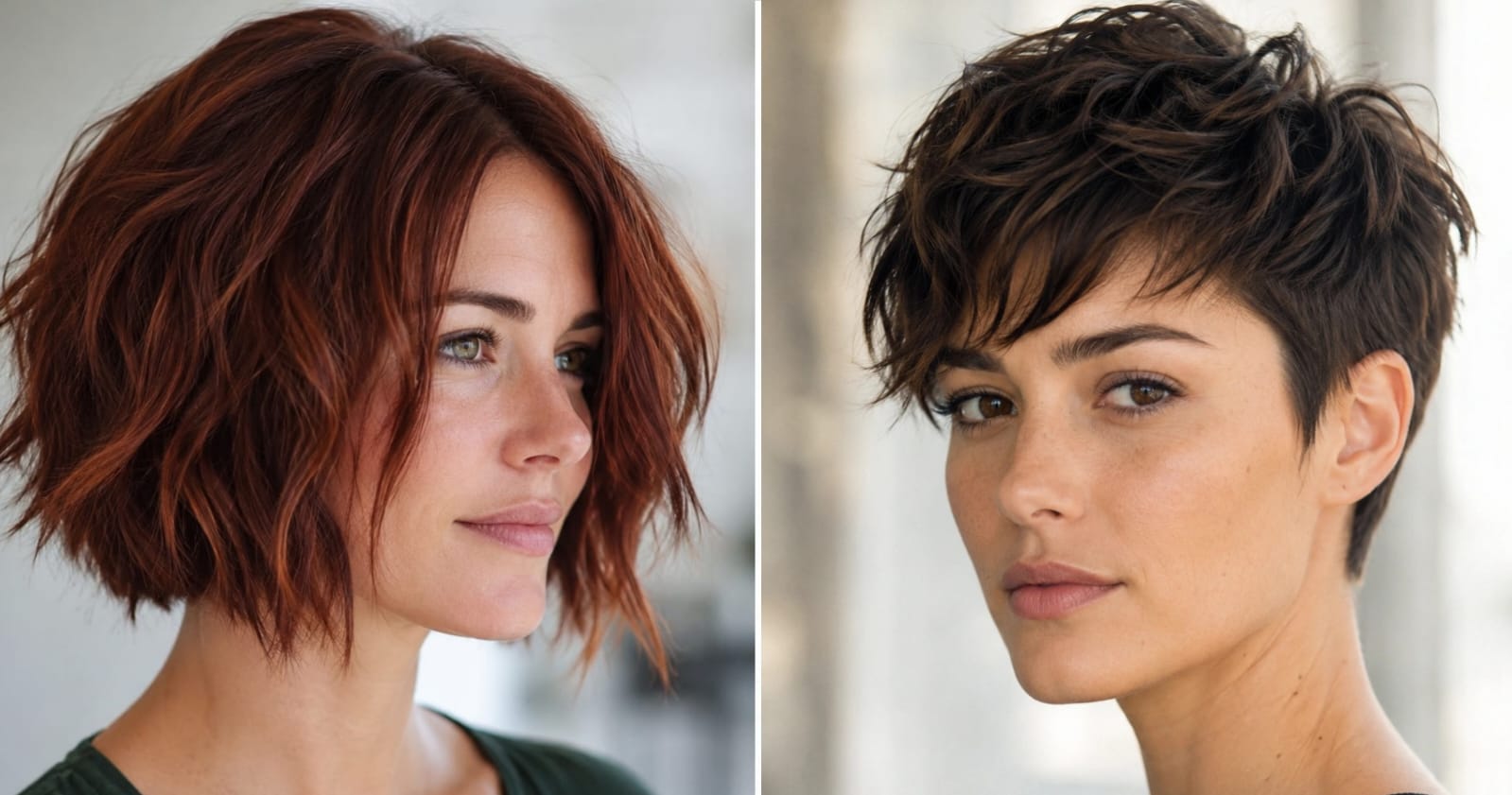
Hair density is the factor most layered haircut guides completely ignore — and it’s the reason a cut that looks incredible on one person falls completely flat on another. The number of individual strands packed onto your scalp determines how layers behave after you leave the salon. Too many layers on dense hair creates an uncontrollable triangle shape. Too few layers on fine, low-density hair and the cut goes limp within 24 hours.
Short layered cuts are having a real moment in 2026, but the styles you see on Pinterest were shot on specific hair types. This article maps 16 short layered haircuts to the density they actually work for — high, medium, or low — so the cut you choose is built to hold its shape on your hair, not someone else’s.
If you’re unsure of your density, the quick test is simple: part your hair and look at your scalp. If you can see a lot of scalp easily, you have low density. If your scalp is barely visible through thick coverage, you have high density. Medium sits in between. Use that as your guide through the list below.
Quick Takeaways
- Best for low-density hair: #1, #4, #7, #10, #13
- Best for medium-density hair: #2, #5, #8, #11, #14
- Best for high-density hair: #3, #6, #9, #12, #15, #16
- Works across all densities with the right layer placement: #2, #8
1. Blunt-Tip Pixie with Minimal Crown Layers — Low Density

Low-density hair needs weight to look full, and most pixie cuts rob it of that immediately by stacking layers at the crown. This version keeps the top section blunt-cut and heavy, with layers restricted to the perimeter around the ears and nape. The result is a cut where the weight sits exactly where it needs to: on top, creating the illusion of thickness.
The key mechanic here is that blunt ends reflect more light than tapered ones, making each strand appear wider and more substantial. If you have fine hair alongside low density, this structure is especially important — you need every optical trick working in your favor. Ask your stylist for “point-cut ends only at the perimeter, blunt on top.”
2. Textured Crop with Disconnected Layers — Medium Density

Disconnected layers are placed deliberately away from each other rather than blended seamlessly, which creates visible contrast between sections. On medium-density hair, this contrast reads as intentional movement rather than the chaotic volume that high density would produce with the same technique.
The crop length keeps the weight concentrated at the top while the disconnection adds texture without removing bulk you can’t afford to lose. This is one of the more versatile cuts on this list because medium density sits in a range where small adjustments in layer depth can tip the result toward a fuller or sleeker finish. Start with shallower disconnection and go deeper at your next appointment if you want more texture. Pair it with short hair hairstyles ideas to see how different styling approaches change the whole look.
3. Razor-Cut Shag — High Density

High-density hair fights back against volume-adding techniques because it already has more volume than most cuts can manage. The razor-cut shag is one of the few short layered styles specifically designed to remove bulk rather than add it. The razor creates frayed, airy ends that dissipate weight throughout the cut rather than concentrating it.
Heavy density without enough layering creates a rounded, mushroom-shaped silhouette as the hair grows. The shag’s curtain fringe and deep interior layers counteract this by carving channels through the bulk, allowing the hair to fall in separated sections instead of one solid mass. This is why short shag haircuts trend so reliably — they solve a real structural problem for thick-haired people.
4. Wispy Pixie Bob — Low Density

The pixie bob (or “pixob”) hits the sweet spot for low-density hair: long enough to carry some weight, short enough that the strands don’t collapse under their own length. The wispy version specifically means the ends are point-cut to create separation rather than a blunt, heavy line — which sounds counterintuitive for fine hair, but the purpose here is to create definition between strands, not remove weight.
Without visible separation, low-density hair in a pixie bob looks like one flat piece. The wispiness gives the eye something to follow. Keep the interior solid and save the lightening for the outermost layer only. Products with a light wax or clay base work better than volumizing spray here because they define without expanding.
5. Layered French Bob — Medium Density

The French bob at chin length is a forgiving structure for medium density because the weight line sits at a point where the hair naturally has enough body to hold a slight bend without extra product. Layers inside a French bob are typically cut at 45-degree angles from the interior, which removes some bulk while preserving the exterior silhouette.
Medium-density hair benefits from this because the layers do actual structural work — reducing the interior weight that would otherwise push the exterior outward. Without interior layers, medium-density hair in a blunt bob develops a slight triangular flare at the ends as it grows. The layered version stays rounder and more controlled between appointments. Short French bobs break down this style further with variations on fringe and length.
6. Stacked Bob with Heavy Interior Layering — High Density

Stacking — where the back is cut shorter underneath and graduates longer toward the top — is a technique that uses the hair’s own density against the bulk problem. On high-density hair, the weight of the upper layers sits on top of the stacked under-layers, compressing the silhouette instead of letting it expand outward.
The heavy interior layering component means the inside of the bob is aggressively thinned through the mid-section, which prevents the classic “puffing out” that dense hair does in a standard bob. Without this internal work, a stacked bob on high-density hair stays sleek for about two weeks before the volume starts to push outward as it grows. Plan for interior-layer touch-ups every six to eight weeks to maintain the shape.
7. Textured Micro Bob — Low Density

A micro bob — sitting between the chin and jaw — is short enough that low-density hair doesn’t have enough length to go flat, which is the main advantage of this cut for that density type. The texture here means the ends are cut with a point-cut or sliced technique to create micro-separation between strands.
On low-density hair, this separation makes individual strands visible as distinct units rather than a thin, see-through sheet. The shorter length also means less surface area for light to pass through, which reduces the transparent look that low-density hair often has at the ends of longer styles. Styling with a round brush while blow-drying adds the only volume enhancement you need — no thickening products required.
8. Curtain Bang Lob with Internal Layers — Medium Density

The lob (long bob, sitting at collarbone length) is usually too long to appear on a “short” list, but when it’s cut with significant internal layers, it behaves more like a short cut — the weight is distributed and the ends stay light. Curtain bangs add a layered element at the front that medium-density hair can support without them flopping or going flat.
What makes this work for medium density specifically: the internal layers remove just enough mid-section bulk that the ends don’t go stringy, but the density is sufficient to keep the curtain bangs full and separated rather than wispy. Fine, low-density hair struggles with curtain bangs because they separate too much. High density keeps them too bunched together. Medium density is the range where they fall naturally into the parted shape.
9. Wolf Cut — High Density

The wolf cut’s defining characteristic is the contrast between a very short, layered crown and longer, heavier ends — and this contrast only reads properly when there’s enough density to give each zone visual weight. On high-density hair, the crown layers create genuine separation and movement rather than just looking messy, while the longer back retains enough substance to avoid looking stringy.
Dense hair also holds the wolf cut’s shape through humidity and activity far better than fine or low-density hair, which tends to collapse the crown layers by midday. This is why the wolf cut hairstyles trend took off largely on thick-haired people — the cut was designed to work with that density, not despite it.
10. Face-Framing Pixie with Solid Top — Low Density

Face-framing layers in a pixie are cut from the temple forward, angled to fall toward the cheekbones. For low-density hair, keeping these layers to the front perimeter only — while leaving the top completely solid — concentrates the visual interest at the face without thinning the crown where you can least afford to lose weight.
The solid top is critical. Many stylists over-layer the crown of a pixie to add “lift,” but on low-density hair this creates transparency at the top of the head that no amount of volumizing product can disguise. The face-framing pieces do all the work of making the cut look textured and intentional, while the solid crown holds its ground.
11. Bixie Cut with Point-Cut Layers — Medium Density

The bixie (between a bob and a pixie) sits at a length where medium-density hair has just enough weight to hold its shape without layering help, but benefits significantly from layers to prevent a blocky, one-piece appearance. Point-cut layers — where the scissors cut into the ends at a vertical angle rather than straight across — add texture without dramatically reducing bulk.
Medium density at bixie length is at risk of looking too uniform, like a helmet, if it’s cut blunt throughout. The point-cutting breaks that up by creating micro-variation in end length, which catches light differently and gives the cut visible dimension. See the bixie cuts for a broader look at how this hybrid length performs across different styling approaches.
12. Choppy Bob — High Density

Choppy ends — created by cutting into the ends of the hair at varied angles — are one of the most effective ways to handle high-density hair at bob length. The choppiness creates deliberate irregularity in the weight line, which interrupts the tendency of dense hair to form a solid, rounded mass at the ends.
Without this interruption, high-density hair in a standard blunt bob develops a dome shape as it grows. The choppy ends break the perimeter into sections that read as individual — reducing the overall visual weight of the cut without removing actual density from the interior. Choppy bob haircuts go into more detail on how chop placement changes the final silhouette.
13. Graduated Pixie — Low Density

Graduation in a pixie means the back is cut so the hair gradually gets longer from the nape upward toward the crown. For low-density hair, this graduation concentrates weight at the top of the back of the head — exactly where fine hair needs visual bulk most.
This is a more structured approach than a standard pixie and it shows in how much longer the cut holds its shape between appointments. Standard pixies on low-density hair tend to look overgrown quickly because there’s no structural architecture supporting the shape. The graduation acts as a scaffold, keeping the back compact and defined as it grows rather than spreading outward.
14. Inverted Bob with Soft Layers — Medium Density

The inverted bob — shorter in the back, longer toward the face — creates a natural direction of movement that suits medium density well. Soft layers (rather than choppy or razor-cut) maintain enough weight to support this movement without removing the density needed to keep the back stacked.
Medium-density hair in an inverted bob without any layering can look stiff, particularly at the longer front sections where the extra length adds weight. Soft layers through the mid-section release this stiffness while preserving the angular silhouette that makes the inverted bob distinctive. Check inverted bob hairstyles for variations in angle and length.
15. Undercut Pixie — High Density

An undercut removes hair entirely from the nape and lower sides — rather than layering it — which is the most direct solution to high-density bulk at the base of a pixie. This isn’t a layering technique so much as a weight-reduction technique, but it enables the layers above it to behave correctly.
With the undercut in place, the remaining hair on top has room to fall naturally rather than being pushed outward by volume below. High-density hair without an undercut in a pixie often sits wide at the sides and base, creating a triangular shape that no amount of styling can correct. The undercut resets the foundation and lets the layering do its intended work.
16. Textured Crop with Heavy Nape Tapering — High Density

Nape tapering on high-density hair means the hair at the back of the neck is reduced significantly in bulk, which prevents the growth pattern at the nape from pushing the entire back section outward. On dense hair, this area grows in multiple directions simultaneously, and without tapering, the back of a crop quickly loses its structure.
Heavy tapering combined with texture throughout the top of the crop gives high-density hair a cut that behaves for six to eight weeks instead of two to three. The texture prevents flatness at the crown while the tapered nape controls the silhouette at the base — both problems that untextured, untapered crops on thick hair develop fast.
Short Hair with Layers by Hair Density: Quick Reference
Low Density Cuts: Blunt-Tip Pixie, Textured Micro Bob, Graduated Pixie Why: Preserve weight at the crown and create the illusion of fullness — blunt ends reflect more light, making each strand appear wider.
Medium Density Cuts: Layered French Bob, Bixie Cut, Curtain Bang Lob Why: Balance texture and volume without removing too much bulk — interior layers do structural work while the exterior silhouette stays controlled.
High Density Cuts: Wolf Cut, Razor-Cut Shag, Undercut Pixie Why: Remove excess bulk and improve shape control — razor ends and deep layers carve channels through the mass so hair falls in separated sections.
FAQ
How do I actually measure my hair density at home, without guessing? Take a one-inch section of hair from the top of your head and hold it up. If the section is thinner than a standard pencil, you have low density. If it matches the pencil roughly, you have medium density. Thicker than a pencil means high density. This is more accurate than the scalp-visibility test alone because density and porosity can combine to obscure scalp visibility even on relatively fine hair.
Can a layered short haircut change how fast my hair grows out unattractively? Yes — the layer structure determines how gracefully a cut grows out. Blunt cuts grow out with a clear, defined “overgrown” look. Textured and layered cuts are more forgiving because the irregularity in the ends means there’s no single moment where the cut suddenly looks wrong. For low-density hair especially, choosing a point-cut or textured finish over blunt gives you an extra two to four weeks before the shape reads as grown-out.
Why do some short layered cuts look full immediately after the salon but flat by week two? This is a product and porosity issue more than a cut issue. High-porosity hair absorbs moisture quickly, which causes it to swell and look full right after a wash or styling session in the controlled salon environment. At home, humidity and natural oils change how the hair sits. The solution isn’t more product — it’s adjusting the layer depth so the cut holds its shape dry and unstyled. Ask your stylist to check how the cut looks on day-two unwashed hair before you finalize the length.
Final Thoughts
Short layered cuts don’t fail because of the cut itself — they fail because density wasn’t factored into the decision. A razor-cut shag that transforms thick hair creates a different result on low-density hair: it removes weight the strand count can’t replace. Once you know your density and match it to a cut built for that structure, the difference in how long the style holds and how little effort it takes to maintain is immediate.
Browse short haircuts for women for more length and texture variations, or if layers on a bob are what you’re after, layered bob haircuts covers the overlap between these two styles in detail.

