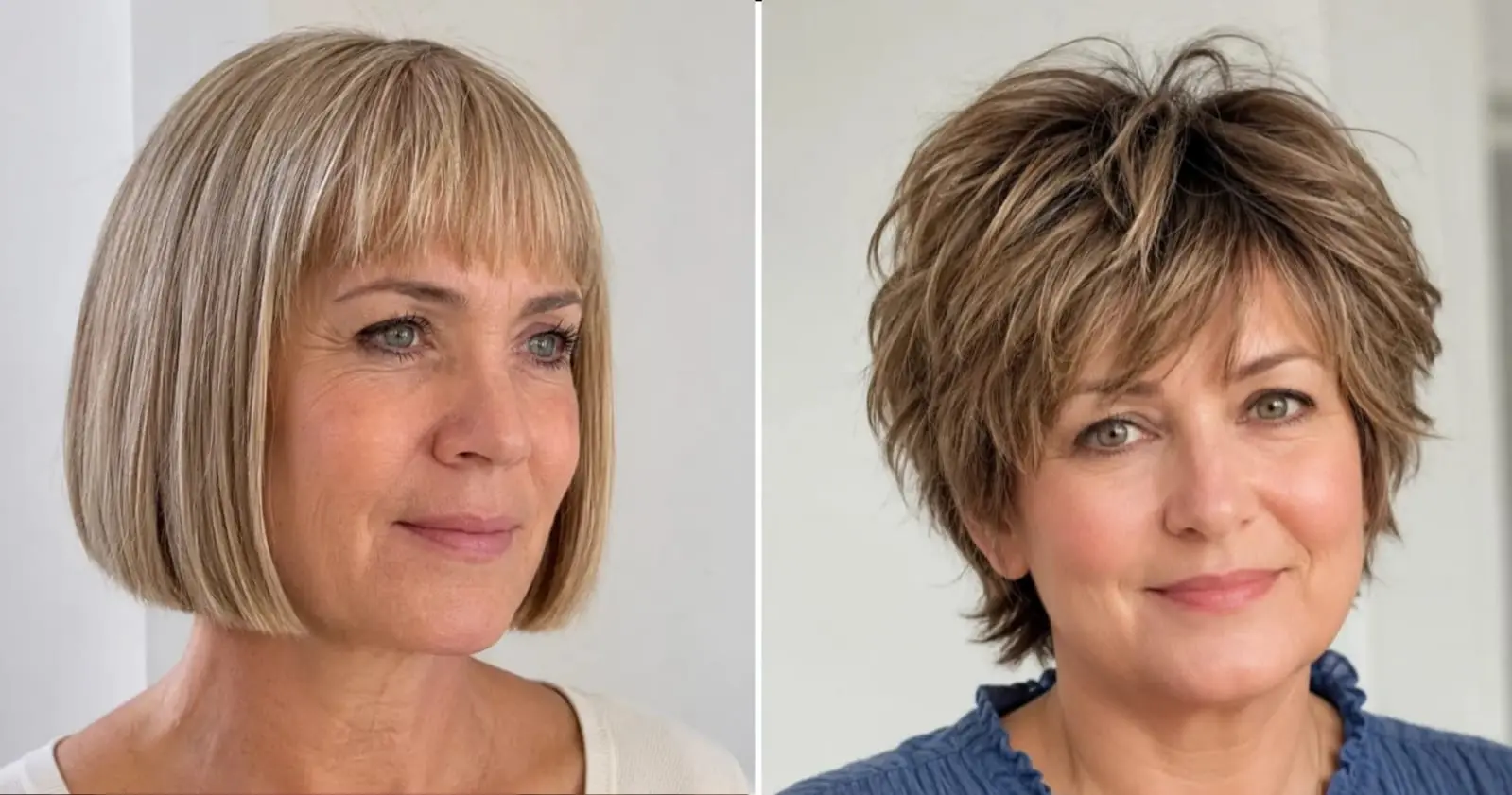
Short haircuts for older women aren’t just a haircut — they’re a decision that touches your mornings, your confidence, and how your face reads to the world. And yet most guides just hand you a photo gallery and wish you luck. That’s backwards. The right short cut for you depends on four things working together: your face shape, your hair’s actual texture, how much time you’re honestly willing to spend on it, and how your hair has changed with age. Get those four right, and any of the cuts below will look intentional, not just “short.”
This guide walks through all four, then gives you real cuts, real styling terms, and honest answers — including what to avoi
Table of Contents
How to Choose the Right Short Haircut for Older Women
By Face Shape
Your face shape decides where a cut should add width and where it should take it away.
- Oval faces are the easiest to cut for — almost every style here works, from a pixie cut to a blunt bob.
- Round faces need height at the crown and length that breaks at or below the jaw, so the eye travels down instead of across. Side-swept bangs paired with an A-line or angled cut do this well — see our full round face haircut guide.
- Square faces soften with texture and movement near the jaw — a shag or feathered layers break up strong angles instead of echoing them.
- Heart faces carry a pixie beautifully because the shorter length balances a narrower chin.
- Long faces benefit from width at the sides — think a fuller bob or shag rather than anything sleek and vertical.
For a deeper breakdown of how face shape (not just “type”) actually interacts with your features, our guide to choosing a new hairstyle walks through the logic stylists use.
By Hair Type and Density
This is where most short-haircut advice falls apart — a cut that’s stunning on thick hair can go flat and shapeless on fine hair within a day.
- Fine or thinning hair needs a cut with a defined shape, not just “add layers.” Too many layers on fine hair actually removes the weight that creates the illusion of fullness. A blunt line at the perimeter, like in a classic bob for fine hair, gives hair something to hang onto. Our volumizing cuts for thin hair guide covers this in more depth.
- Thick or coarse hair can handle — and usually needs — more layering to avoid looking like a helmet. This is where a shag or textured crop earns its keep.
- Wavy or curly hair should be cut dry or with the curl pattern in mind; a layered shape lets natural texture do the styling work for you.
- Straight hair shows every line of a cut clearly, so precision matters more than volume of layers.
By Lifestyle and Styling Time
Be honest with yourself here, because this is the single biggest reason women end up disliking a cut they loved in the photo.
- 5 minutes or less: a blunt bob or soft pixie that air-dries into shape.
- 10–15 minutes: a layered bob or textured crop that needs a quick blow-dry with a round brush.
- 20+ minutes, and you enjoy it: a shag or feathered pixie with more movement to style.
By Age Range Nuance
Hair genuinely changes texture between your 60s and your 70s and beyond — it’s not just about “older” as one category. In your 60s, hair often just starts thinning at the crown. By your 70s, the hair shaft itself can become finer and drier, which is why very short, closely shaped cuts (rather than long layers that rely on density) tend to look more polished. If this stage applies to you, our haircuts for women over 70 guide goes deeper on this specific window.
Quick Comparison Table
Here’s a quick side-by-side look at the most popular short haircuts for older women, so you can compare maintenance and face-shape fit at a glance.
| Haircut | Best For Face Shape | Best For Hair Type | Maintenance | Trim Frequency |
|---|---|---|---|---|
| Pixie Cut | Oval, Heart | Fine, Thin | Low | Every 4–5 weeks |
| Classic Bob | Round, Square | Fine, Medium | Low–Medium | Every 5–6 weeks |
| Layered Bob | Almost all shapes | Fine, Thin, Wavy | Medium | Every 6 weeks |
| Short Shag | Square, Long | Wavy, Curly, Thick | Medium | Every 6–8 weeks |
| Textured Crop | Oval, Round | Thick, Coarse | Low | Every 4–6 weeks |
| French Bob | Oval, Heart | Straight, Fine | Medium–High | Every 4–5 weeks |
| Silver/Gray Pixie | Oval, Round | Fine, Thinning | Low | Every 4–5 weeks |
20 Best Short Haircuts for Older Women
1. Classic Layered Pixie

Shorter at the sides, longer through the crown — the layering adds volume exactly where fine hair falls flattest first. Best for oval and heart face shapes, since it opens up the face without adding bulk anywhere it isn’t needed.
Styling-wise, this is one of the fastest cuts to manage: a rough towel-dry and a swipe of light mousse through the roots is often enough, since the layers are designed to fall into place on their own. More options in our pixie cut hairstyles guide.
2. Soft French Pixie

Longer, side-swept bangs replace a hard fringe, which softens the whole shape and keeps it from looking severe. It’s a good bridge cut if you’re not ready for a very short crop but still want the low-maintenance benefit of going short.
Because the front is left longer, this pixie also grows out more gracefully than a blunt-fringed version — you can go slightly longer between trims without the shape looking off. It’s especially flattering on oval and heart-shaped faces.
3. Textured Crop with Undercut Nape

Keeps visual weight up top and away from a thinning nape — a detail most guides skip, but it’s often the exact spot where age-related thinning shows first. The undercut is barely visible day to day, since the longer top hair falls over it naturally.
This cut is genuinely low-effort: textured, piece-y styling means imperfection actually works in its favor, so a bad hair day is nearly impossible. It suits thicker or coarser hair especially well, since there’s enough density up top to create texture.
4. Long Pixie with Side-Swept Bangs

More length on top than a classic pixie, with a tapered back that keeps the silhouette neat. The longer bangs act as a “security blanket” for anyone easing into short hair for the first time, since there’s still enough length to tuck behind an ear or sweep to the side.
It also styles well with minimal heat — a bit of texturizing spray scrunched in while damp lets natural movement do most of the work. This makes it a solid pick if you want short hair without a big daily styling commitment.
5. Chin-Length Classic Bob

The blunt perimeter line creates the appearance of density that layering alone can’t — this is the cut to ask for if you want hair to look thicker without extensions or fibers. It works particularly well on round and square face shapes, where the length hits right at the jaw.
Maintenance is straightforward: it holds its shape well between trims and mostly needs just a round brush and a few minutes of blow-drying to look polished. Full range of variations in best short bob haircuts.
6. Stacked A-Line Bob

Shorter in back, gradually longer toward the front. The stacking builds volume specifically at the crown and nape, the two areas that thin first with age, so this cut does double duty as both a style and a subtle fix for thinning.
It’s also one of the more forgiving bobs to grow out, since the graduated shape blends naturally rather than developing an awkward straight-across line. Best suited to fine or medium-density hair.
7. French Bob

A shorter, blunter bob usually paired with a fringe — it reads modern but needs more frequent trims to keep its crisp shape intact. This one works best on oval and heart faces, where the shorter length and fringe combination doesn’t compete with strong jaw or cheekbone lines.
Because precision is the whole point of this cut, it shows growth faster than a looser bob — plan on a trim every 4–5 weeks rather than stretching it out. Styling notes in our French bob guide.
8. Layered Bob (Lob-Adjacent)

For hair with some length flexibility, internal layering adds movement without sacrificing the length that helps fine hair look fuller. It’s a middle-ground option for anyone not ready to go as short as a classic bob or pixie.
The layers also make it more versatile day to day — it can be worn sleek and smooth or slightly tousled without looking like two different haircuts. More in 10 layered bob haircuts.
9. Graduated Bob with Bangs

Razor-cut layers at varying lengths add volume while keeping the cut easy to style — ask your stylist specifically for graduated layers if your hair has always felt flat at the crown. The bangs add a softer, more youthful frame around the face.
Because the layering is built in rather than added through styling, this cut holds volume even on second- or third-day hair, which makes it a practical option for anyone who doesn’t wash daily.
10. Asymmetrical Bob

One side longer than the other. The uneven line creates a subtle slimming effect and works especially well if you want something less predictable than a classic bob, without going as short as a pixie.
It also gives you styling flexibility — tucking the shorter side behind an ear instantly changes the look for a night out, without any extra cutting or color needed.
11. Short Shag with Curtain Fringe

Built entirely around movement — layers throughout, soft fringe blending into the sides. One of the best options if your hair has natural wave, since the cut works with texture instead of against it, letting waves do most of the styling.
It’s more forgiving between trims than most short cuts, since the shaggy, undone silhouette absorbs growth well rather than looking overgrown. Browse more in short shag haircuts.
12. Modern Spiky Pixie-Shag Hybrid

More edge and personality than a standard pixie — it photographs younger largely because of how the texture catches light, not because of length. This is a strong pick if you want a cut that reads as a deliberate style choice rather than just “practical.”
It does need a small amount of daily product — usually a texturizing paste worked through with fingers — to keep the piece-y definition from falling flat. Full guide: spiky haircuts for older women.
13. Feathered Crop

Razor-cut, feathered ends add natural-looking movement and are especially forgiving on wavy hair — no blow-dry required if your texture already has some bend to it. It suits oval and round faces particularly well.
Because the ends are feathered rather than blunt, this cut also disguises regrowth and split ends longer than a precision cut would, meaning slightly more flexibility between salon visits.
14. Wolf-Inspired Cropped Cut

A shorter take on the wolf cut trend — choppy layers and a shaggy silhouette that reads modern rather than “safe,” good for anyone wanting a trend-forward option without going full shag length.
The choppiness also means small styling inconsistencies don’t show, so it’s a genuinely low-stress cut to maintain between appointments — a quick scrunch of texture cream is usually all it needs.
15. Silver Graduated Bob

Gray and white hair resists holding curl and can look coarser than it feels, so a graduated (stacked) shape gives it a defined outline instead of ballooning outward. This structure is what keeps gray hair looking sleek rather than frizzy or shapeless.
It’s also a smart choice if you’re mid-transition to gray, since the graduated layers help blend the demarcation line between colored and natural hair more subtly than a one-length cut would.
16. Wash-and-Wear Silver Pixie

If you’re transitioning away from color entirely, this is often the lowest-effort route — short enough that regrowth lines barely show, and the silver tone does the “styling” once it catches light.
Beyond convenience, this cut also tends to photograph exceptionally well, since the shorter length and natural shine of silver hair pair well together without needing a lot of product or heat styling.
17. Salt-and-Pepper Textured Crop

Leans into natural dimension instead of fighting it — the mix of light and dark strands adds built-in depth that a single-process color can’t replicate. It works best when the cut has enough texture to let both tones show through.
This is also one of the lowest-maintenance color-and-cut combinations on this list, since there’s no root touch-up schedule to manage — the natural graying process is the whole point.
18. Curly Cropped Pixie

Short length keeps curls from getting weighed down and dragging at the face, which is what usually makes curly hair look “tired” rather than defined at longer lengths. Cutting curly hair short actually increases bounce and definition rather than reducing it.
It should be cut dry or with curl pattern in mind — a stylist cutting curly hair the same way as straight hair is one of the most common reasons curly pixies don’t turn out as expected.
19. Blunt Micro Bob

An ultra-short, sharply blunt bob — high-impact and low-maintenance, but works best on hair with enough natural density to hold the shape without added texture. It’s a bold option for anyone ready for a real change.
Because the cut is so precise, it’s less forgiving of growth than a layered style — expect to book trims closer to every 4 weeks to keep the sharp line intact.
20. Tapered Pixie with Choppy Layers

Clipper detailing at the nape keeps the shape crisp between trims, while choppy layers on top keep it from ever looking stiff or dated. It’s a strong option for anyone who wants a pixie with a bit more texture than the classic version.
The tapered nape also means this cut grows out unusually well — the choppy top disguises new growth long before the shape actually needs a trim, stretching the time between salon visits.
FAQ
What’s the best low-maintenance short haircut for older women?
A classic or graduated bob with minimal layering is usually the lowest effort — it air-dries into shape and only needs trimming every 5–6 weeks.
Are short haircuts for older women hard to maintain?
Not at all — most short haircuts for older women are actually lower maintenance than long hair, since there’s less length to manage daily. The trade-off is more frequent trims (every 4–6 weeks) to keep the shape sharp.
How short is too short after 60?
There’s no universal limit — it comes down to face shape and hair density. Very short crops work best on oval or round faces with enough natural texture to add shape; if your hair is very fine and flat, an ultra-short cut can look sparse without added texture or color contrast.
Does short hair make you look older or younger?
A well-cut short style, matched to your face shape and hair density, more often reads as younger and more polished — length alone doesn’t create a youthful look, but a cut that’s actually shaped to your features does.
How often should older women get haircuts?
Every 4–6 weeks for most short cuts, depending on the style — pixies and crops on the shorter end, bobs and shags on the longer end.
What’s the best short haircut for thinning hair?
A blunt bob with a defined perimeter or a layered pixie with volume retained at the crown — both create the appearance of density rather than relying on hair that isn’t there.
Can I still color my hair short and go gray at the same time?
Yes — many women use a short cut specifically to manage the grow-out period, since regrowth lines are far less visible in short hair than in long hair.
Conclusion
Choosing from the best short haircuts for older women isn’t about picking whatever looks best in a photo — it’s about matching a cut to your face shape, your hair’s actual density and texture, and how much time you honestly want to spend each morning. Once those three line up, almost any of the 20 cuts above can look sharp, intentional, and genuinely youthful.
Whether you go for a low-maintenance bob, a textured pixie, or a shag that works with your natural wave, the goal is the same: a cut that makes your mornings easier, not harder. Bring this guide — or a couple of specific reference photos and the salon terms we covered — to your next appointment, and you’ll walk out with a haircut that holds its shape for weeks, not just for the first blow-dry.

