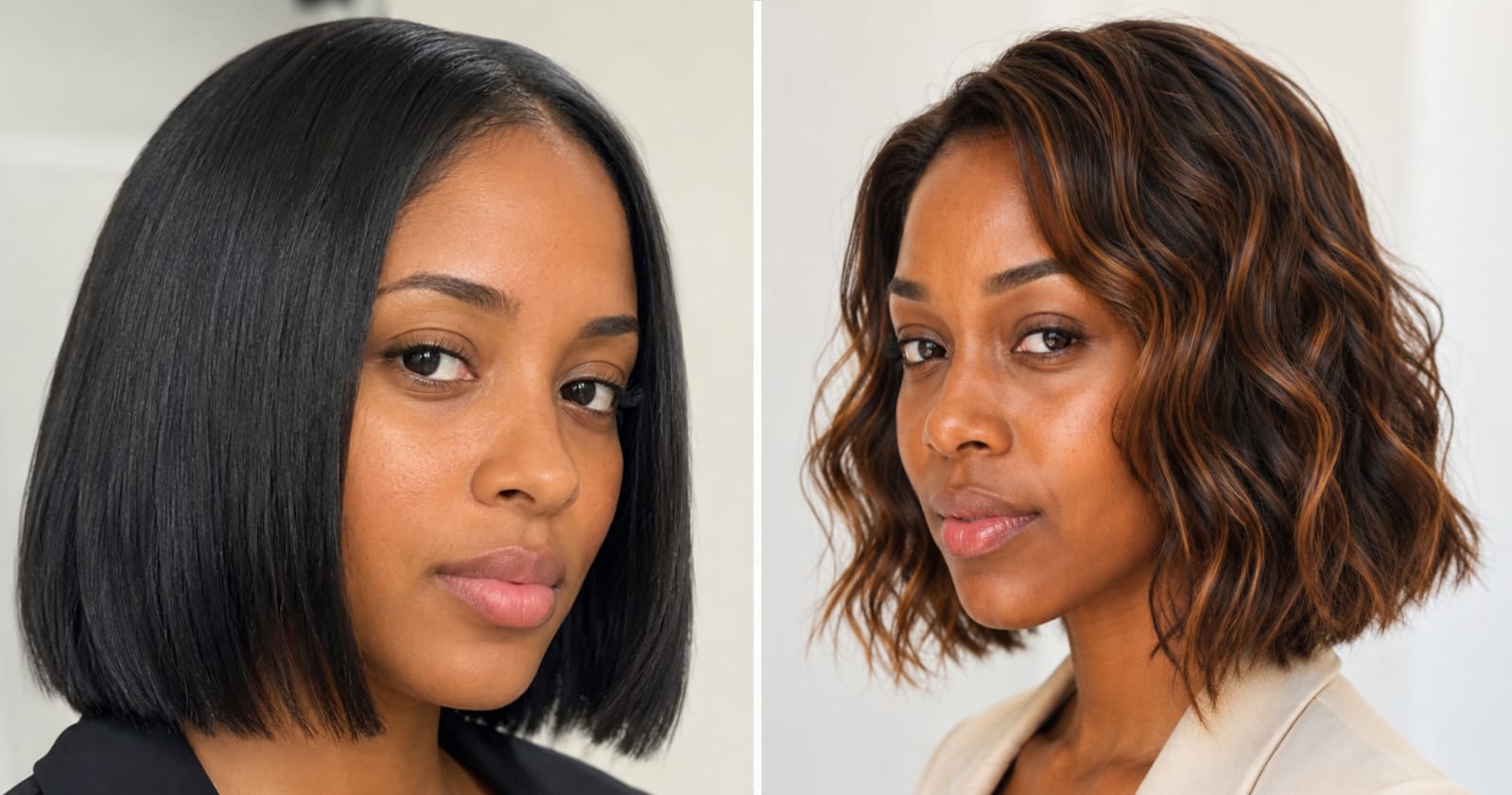
Bob haircuts look simple on a mood board. In reality, the way a bob actually behaves on your hair depends almost entirely on your hair’s texture, density, and whether you’re working with natural coils, relaxed strands, or heat-trained hair. The same blunt chin-length cut that looks sleek on fine straight hair can appear significantly shorter or fuller on a type 4 coil pattern — not because the cut is wrong, but because shrinkage, volume, and curl formation all reshape the final silhouette.
That’s the part most bob roundups skip. They show you the finished look without explaining which texture it was cut on, or why a specific technique — like razor-finishing the ends vs. blunt-cutting them, or cutting dry vs. wet — changes everything about how the bob lays on natural or relaxed Black hair. This article is built differently. Every bob below is matched to a hair behavior, so you’re not just choosing a style that looks good in a photo — you’re choosing one that will actually behave the way you expect it to.
Whether you have high-density natural coils, fine relaxed hair, heat-trained strands, or anything in between, at least a handful of these 18 bob hairstyles for Black women will make practical sense for your hair’s specific starting point.
Quick Takeaways
- Best for natural 4A–4C coils: Tapered bob, loc bob, wash-and-wear rounded bob (#1, #4, #7)
- Best for relaxed or silk-pressed hair: Blunt bob, sleek asymmetrical bob, swooped side-part bob (#2, #9, #14)
- Best for fine or low-density hair: Stacked bob, angled bob, bob with loose waves (#5, #11, #16)
- Best for protective-style crossover: Bob braids, faux lob with extensions, bob with cornrow base (#6, #10, #18)
18 Bob Hairstyles for Black Women
1. The Wash-and-Wear Rounded Bob for Type 4 Coils

If you have type 4 hair and want a bob that doesn’t require heat to look intentional, the rounded bob is one of the most practical cuts available. The key is that it’s cut specifically to account for shrinkage: your stylist cuts the hair significantly longer than the target length so that when coils spring up, the final result lands at the chin or jaw — not at the ear unexpectedly.
This shape works because the rounded perimeter mimics the natural dome shape that tight coils form on their own. Rather than fighting your hair’s natural silhouette, the cut reinforces it. You can wear it fully shrunk for a compact, defined look, or stretch it slightly with a diffuser for more length. Either way, the shape holds. For similar short natural styles, explore short natural hairstyles for black women that pair well with this cut.
2. The Blunt Silk-Press Bob

The blunt bob is a classic, but its full impact shows up most clearly on silk-pressed natural hair or relaxed strands, where the ends can sit perfectly even and catch the light as a clean horizontal line. On naturally straight or pressed hair, blunt ends create visual weight at the perimeter, which makes fine or medium-density hair look substantially thicker than it actually is.
This isn’t a low-maintenance option if you’re starting with natural hair — the silk press step is real upkeep. But for Black women who already silk-press regularly, adding a blunt bob shape to that routine gives the style a more finished, high-impact result than leaving the ends uncut or tapered. It’s also one of the styles that photographs particularly well because the line is so defined.
3. The Tapered Bob With a Defined Nape

A tapered bob — longer in the front, closely cut or faded at the nape — is particularly well-suited to natural hair with coil patterns that shrink significantly. Because the nape is cut short and the fade blends into the rest of the style, there’s no awkward length mismatch when your hair shrinks unevenly (which is common, since the nape often has a tighter curl pattern than the crown).
The shape is also practical for hairlines that need maintenance. A clean nape taper makes the entire bob look more precise, even if the rest of the hair is worn in its natural state. It’s worth asking your stylist to use clippers rather than shears at the nape for the cleanest blend, especially if your nape hair is finer or has a different texture than the rest of your hair. This style complements many short hairstyles for black women if you’re ready to go even shorter on your next visit.
4. The Loc Bob

Locs behave very differently from loose natural hair: they’re denser, heavier, and don’t have the same spring-back that coils do. A bob cut into locs uses that weight intentionally. When locs are trimmed to jaw or chin length, they swing and move with a fluidity that longer, heavier locs can’t achieve, and the ends — especially mature, rounded loc ends — create a naturally polished finish without any product.
The practical consideration here is that loc bobs are genuinely permanent — you’re cutting mature locs, not just trimming. For that reason, most loc wearers who go bob-length start from a place of intentional commitment rather than experimentation. If you’re on the fence, a headband or temporary pin-up to simulate the length is a useful test before you cut.
5. The Stacked Bob for Fine Natural or Relaxed Hair

Fine Black hair — whether natural, relaxed, or transitioning — can lose volume at the ends, especially if the hair has any damage or has been chemically processed. The stacked bob addresses this structurally: the hair is layered internally at the back so it builds up and outward rather than hanging flat. The stacking happens beneath the surface, which means the exterior still looks smooth and intentional.
For fine relaxed hair specifically, a stacked bob with a slight beveled shape at the back creates the appearance of significantly more volume than a blunt cut would on the same hair. It also tends to hold its shape longer between washes because the internal layers support the outer section of hair. Ask for the stack to start at the occipital bone (the bump at the back of your skull) for the most flattering lift. Check out bob haircuts for fine hair for more options suited to finer textures.
6. Bob Braids

Bob braids are a protective style framed in a bob silhouette — typically using braiding hair or extensions to create individual braids that hang at chin or jaw length. Because the length is built into the extension hair rather than your own strands, shrinkage is a non-issue, and the final shape stays consistent for weeks.
What makes this a genuinely practical option is the install-and-leave factor: once done, they require minimal daily effort beyond moisturizing your scalp. The bob shape also means less bulk and weight than longer braided styles, which some people find more comfortable for daily wear. Knotless box braids and goddess braids both work well at bob length, and you can vary the part pattern to change the silhouette.
7. The Defined Curly Bob for 3B–3C Hair

Looser curl patterns in the 3B–3C range have enough definition to form a bob shape without the same extreme shrinkage that tighter coils experience, but they still need to be cut dry — or at least cut with shrinkage factored in — to get accurate length. Wet cutting on curly hair often results in a cut that’s shorter than expected once the curls spring back.
The curly bob works especially well at collarbone length for these curl types: long enough that gravity helps elongate the curls slightly, but short enough that the ends don’t get weighed down and lose definition. A curl-specific stylist will often cut this style section by section while the hair is in its natural, dry curl state so each section lands at the right length relative to its own shrinkage pattern.
8. The Sleek Asymmetrical Bob

An asymmetrical bob — longer on one side than the other — reads as more modern and editorial than a traditional even bob. On relaxed or pressed hair, the angle of the cut creates a strong geometric line that draws the eye across the face and works particularly well on oval, heart, and square face shapes.
The reason this style is especially effective on sleek textures is that the asymmetry only reads clearly when the hair is lying flat. On high-shrinkage natural hair, the length difference can be obscured by the curl pattern unless it’s quite dramatic. For relaxed hair, even a subtle 1–2 inch length difference front-to-back creates a noticeably elevated silhouette. Pair it with a deep side part for maximum effect.
9. The Swooped Side-Part Silk Press Bob

The swooped side-part bob takes the sleekness of a silk press and shapes it with a deep part and a forward sweep on one side. The longer front section grazes the cheekbone or chin and creates an asymmetrical framing effect that softens stronger facial features. On full-density natural hair that’s been pressed, the weight of the strands helps maintain the swoop without excessive product.
It’s one of the most face-flattering variations of the bob available, because the swept section functions like a soft curtain across one side of the face. For round face shapes in particular, the diagonal line created by the sweep adds angles that a centered, even-length bob wouldn’t provide.
10. The Faux Lob With Extensions

A faux lob (long bob, typically at collarbone length) using clip-ins or a sew-in is a way to access bob-length styling without committing to a cut. For natural hair that’s still growing in, or for someone who wants a longer bob shape but doesn’t have the length yet, extensions allow you to try the silhouette fully before making it permanent.
The practical advantage is versatility: you can swap the extensions out, wear your natural hair loose on off days, and adjust the length if the first install isn’t quite right. A sew-in with leave-out is the most seamless option for blending with natural or relaxed hair, especially when your natural leave-out is silk-pressed to match the extension texture.
11. The Angled Bob for Added Volume

The angled bob is longer in the front and shorter in the back — the inverse of the stacked bob. For low-density or fine hair, the angle creates an illusion of movement and weight without the hair actually being thick. Because the front sections are longer, the eye reads the overall style as fuller than a shorter even cut would appear.
On relaxed or heat-trained hair, the angled bob is one of the easiest styles to maintain at home between salon visits: the front length is forgiving if it grows out slightly, and the back is short enough that major upkeep isn’t required for weeks. It also layers well with bangs — a side-swept or curtain bang at the front blends naturally into the longer front sections.
12. The Blowout Bob

A blowout bob relies on heat-stretched natural hair — not pressed flat, but stretched and shaped using a blow dryer and a round brush — to create a full, rounded silhouette with visible body. The result is somewhere between the volume of a wash-and-go and the sleekness of a silk press, and it’s particularly practical for high-density type 3 or 4 hair that becomes difficult to manage at longer lengths.
Because the hair is stretched rather than pressed, the bob retains more texture and movement than a fully silk-pressed style. It’s also gentler on the hair long-term since the heat used is significantly lower than flat iron temperatures. The blowout bob is a strong choice for anyone who wants a low-shrinkage look without committing to full heat styling every time.
13. The Choppy Bob With Texture

A choppy bob uses intentionally uneven, jagged ends — cut with a razor or point-cutting technique — to add texture and movement that a blunt cut doesn’t provide. On relaxed or fine natural hair, those textured ends prevent the bob from looking flat or too polished, and the slight irregularity at the ends means minor growth doesn’t immediately make the cut look unkempt.
This approach is also popular with transitioning hair, where the ends may have some texture variation due to the contrast between new growth and previously relaxed strands. The choppy cut works with that variation rather than against it, making different textures on the same head of hair look like part of the style rather than a flaw. For more in this direction, see choppy bob haircuts 2026.
14. The Bob With Face-Framing Pieces

Face-framing pieces — shorter, often slightly curved sections at the front of a bob that fall forward around the cheeks — are a finishing detail that changes how any bob interacts with your face shape. They’re different from bangs because they’re integrated into the main length of the bob, just slightly shorter and shaped to curve inward toward the face.
On natural or relaxed Black hair, face-framing pieces work best when they’re cut in context: your stylist shapes them based on how your hair actually falls (or shrinks back) at your particular curl pattern, rather than cutting them to match a flat-lay image. The result should be pieces that stay in front and don’t spring backward or outward — something that requires knowing your hair’s specific behavior.
15. The Short Textured Bob at Jaw Length

At jaw length, a bob sits in the space between obviously short and obviously medium, which makes it one of the most versatile options for Black women who want clear styling flexibility. At this length on natural hair, you can wear it fully coiled, stretched, or in a twist-out without any single version looking unintentional.
On relaxed hair, jaw length is practical because it’s short enough to avoid heavy maintenance but long enough to style in multiple directions — tucked behind the ear, swept to one side, curled under, or flipped out. The jaw-length bob is also a useful transitional cut for women growing out a shorter style, since it gives the hair a defined shape while it continues to gain length.
16. The Bob With Loose Waves

Loose waves on a bob — created with a large-barrel iron or flexi rods — add a softness that straight or fully coiled bobs don’t have. On fine or low-density hair, the waves increase the perceived volume of the style significantly, because the bends in the hair create more surface area and lift at the roots.
On natural hair, this look is often achieved with flexi rods or perm rods on freshly moisturized, stretched hair, which produces a looser wave pattern than the natural coil. It’s a gentler heat-free option compared to using a curling iron, and the waves tend to hold their shape for several days. This is also a style that can be refreshed with a little water and leave-in conditioner rather than re-styled from scratch.
17. The Bob With Side-Swept Bangs

Side-swept bangs on a bob change the entire geometry of the face frame. Rather than the bang sitting across the forehead, the side-swept version angles across one eye and blends into the longer front section of the bob, creating a continuous line from forehead to jaw on one side.
For Black women with relaxed or silk-pressed hair, the side-swept bang works because the hair is lying flat enough to follow that diagonal line cleanly. On natural hair, getting a bang to stay swept requires either some hold product or a brief moment with a blow dryer at the bang section. The style is especially effective for softening a prominent forehead or adding dimension to a round face, without requiring a dramatic overall style change.
18. The Bob With a Cornrow Base

A bob worn over a cornrow base — whether that’s a full sew-in, a partial install, or a wig laid over braided-down hair — gives the finished silhouette complete control over shape. Because the bob is sitting on a flat, braided foundation rather than on loose hair, the style doesn’t shift, expand, or change with humidity, and the part sits exactly where it’s meant to.
This is a particularly useful approach for protective styling: the natural hair is tucked and cornrowed flat, reducing daily manipulation, while the bob unit provides styling flexibility without heat or tension on your own strands. It’s also one of the most time-efficient options over a multi-week period — once installed, the daily routine is minimal. For more protective styling inspiration, see vacation hairstyles for black women that translate the same low-maintenance logic to travel.
Frequently Asked Questions
How do you know if a bob will actually hit at the right length on natural hair?
The most reliable method is a dry length test before you commit to a cut. Stretch a single coil or section of hair downward (without heat) to approximately where you want the bob to land when stretched, then release it and see where it shrinks back to. That shrunk position is your cut length if you want the bob to sit there when worn natural. Ask your stylist to factor in at least 30–50% additional length depending on your specific shrinkage rate — type 4C hair can shrink up to 75% of its stretched length, which means a 6-inch bob in its natural state may need to be cut at 8–10 inches when stretched.
Does it matter if a bob is cut on wet or dry natural hair?
Yes — significantly. Wet cutting is standard for straight or relaxed hair because the hair’s length is consistent when wet. On natural hair, wet cutting can produce unpredictable results because each curl section shrinks by a different amount as it dries, and the final lengths won’t be even in the same way. Many curl specialists cut natural bobs dry (or on stretched-but-not-pressed hair) so they’re seeing and shaping the actual finished length the hair will sit at. If a stylist always cuts natural hair wet without discussing shrinkage, that’s worth raising before the cut begins.
Can you wear a bob on natural hair without heat every day?
Yes, and the key is choosing the right length and curl type for your specific pattern. At chin length or longer, most type 3 and type 4 coil patterns have enough length to form a defined, shapeable bob without heat. Shorter bobs on very tight coils may feel more like a full TWA (teeny weeny afro) when worn fully shrunk — which can still look intentional, but is a different shape than a traditional bob. Moisture, a leave-in conditioner, and a diffuser (rather than heat straightening) are usually enough to define the bob shape on wash days. Refresh days in between can use water and a light curl cream on any sections that need reshaping.
Final Thoughts
The bob is genuinely one of the most adaptable haircuts available — but only when it’s chosen and cut with your specific hair behavior in mind. Shrinkage, density, curl pattern, and whether you’re working with natural, relaxed, or extension-based hair all shape how any of these 18 styles will actually look on you. The cuts that deliver on their visual promise are the ones that account for how your hair moves, not just how they look in a styled photo.
If you’re exploring bob options for the first time or coming from a longer length, shoulder length bob hairstyles and layered bob haircuts are useful next reads that cover adjacent length ranges with the same level of specificity.

