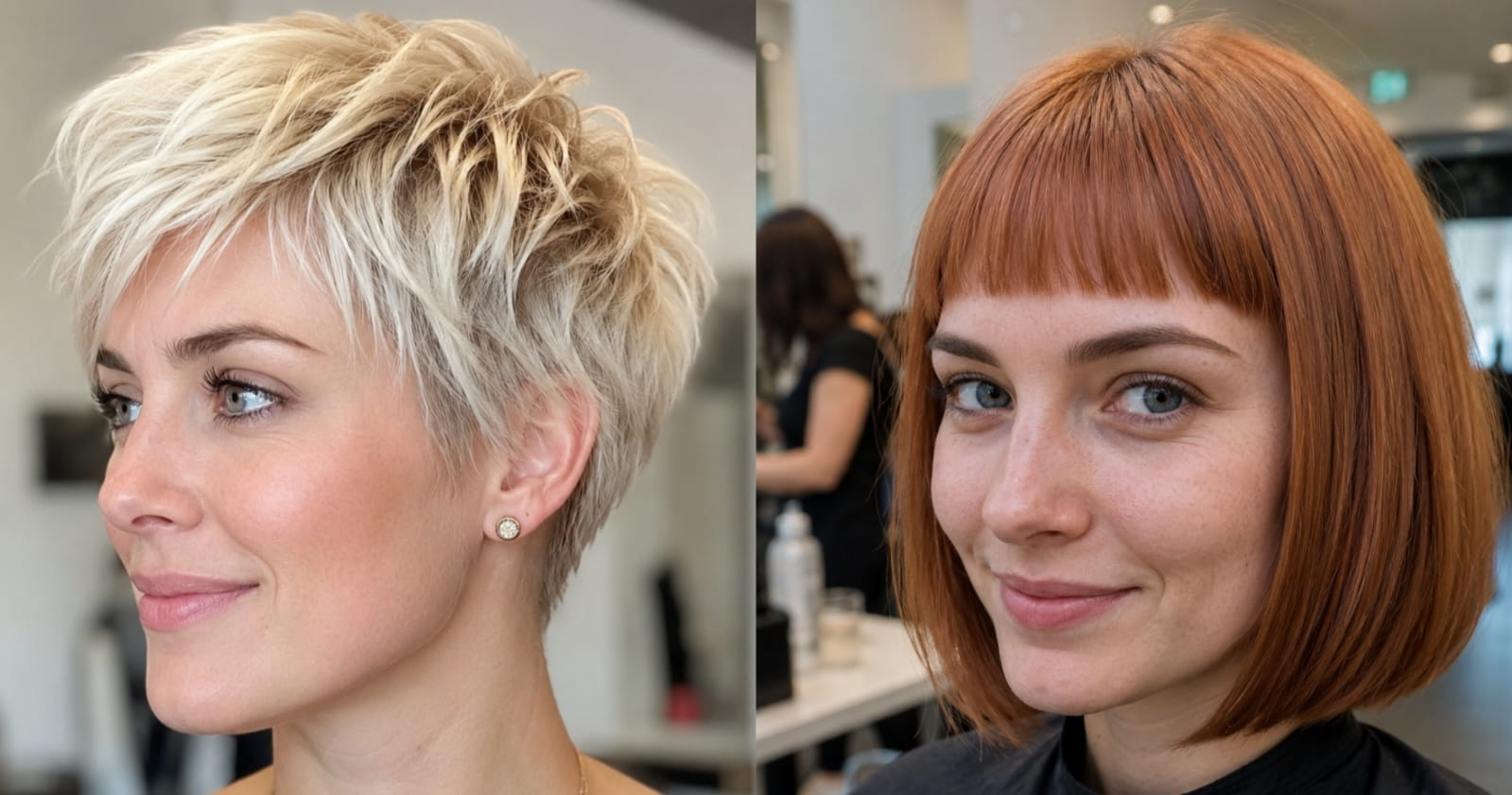
Fine hair has a cut problem — not a product problem. Most people with flat, limp strands have spent years cycling through volumizing mousses, root-lifting sprays, and dry shampoos, only to watch their hair deflate by midday anyway. The actual issue is almost always the shape sitting on their head.
The cut is doing the heavy lifting long before any product touches your hair. It determines whether your ends look full or see-through, whether your roots have lift or fall flat within an hour, whether your ponytail looks deliberate or defeated. If you’ve ever wondered why the same blowout looks incredible on your friend with similar hair — it’s the cut. If you’re specifically looking at shorter lengths, bob haircuts for fine hair are worth a separate deep-dive too. But whether you want a crop, a lob, long layers, or something in between, these 17 haircuts are the ones that genuinely make fine hair look fuller — no optical illusions required.
1. The Textured Pixie Cut

My friend Danielle chopped her fine hair into a pixie two years ago and hasn’t looked back. The textured pixie works because it removes all that dead weight dragging fine strands down.
Ask your stylist for point-cut ends and disconnected layers on top. That choppy finish creates the illusion of thickness even when individual strands are thin as thread.
- Best for face shapes: Oval, heart, square
- Hair texture: Pin-straight to slightly wavy fine hair
- Maintenance level: Medium
- Trim frequency: Every 4–6 weeks to keep shape
- Styling difficulty: Easy
- Common mistake: Going too uniform and smooth — ask for texture, not a sleek finish
- Pros: Maximum volume, minimal product needed, always looks intentional
- Cons: Frequent trims required, not for anyone wanting length
2. The Bob with Invisible Layers

This is the one I personally wear right now. A chin-to-jaw length bob with interior layers that you can’t even see from the outside but feel completely different when you style it.
My stylist explained it to me like this: visible layers on fine hair can make it look thinner because you’re seeing gaps. Interior layers add movement without exposing sparse ends.
- Best for face shapes: Round, oval, heart
- Hair texture: All fine textures
- Maintenance level: Low to Medium
- Trim frequency: Every 6–8 weeks
- Styling difficulty: Easy
- Common mistake: Asking for too many layers — less is more with fine hair bobs
- Pros: Flattering on almost everyone, versatile styling options
- Cons: Can look boxy if not layered correctly
3. The French Bob (Blunt Cut at Cheekbone Level)

Think Parisian effortless. The French bob sits right at or just below the cheekbone, and the bluntness of the cut is the whole point.
Blunt cuts on fine hair are a stylist’s secret weapon. The straight-across edge makes hair look denser because all the ends line up together instead of tapering into nothing.
- Best for face shapes: Oval, oblong, heart
- Hair texture: Straight fine hair especially
- Maintenance level: Low
- Trim frequency: Every 5–7 weeks to maintain that clean line
- Styling difficulty: Easy
- Common mistake: Adding too much graduation — keep it blunt
- Pros: Incredibly chic, naturally creates fullness at the ends
- Cons: Requires regular trims to stay sharp
4. The Shag with Curtain Bangs

The shag is everywhere right now, and fine-haired women are the ones benefiting most. All those layers? They’re actually adding visual density.
I tried this last spring and was shocked at how much body I had at my roots after styling. The curtain bangs framing the face also draw attention to your features rather than the thinness of your strands.
According to Byrdie’s hair experts, layered shag cuts create movement and texture that make fine hair appear significantly fuller when styled with a round brush or diffuser.
- Best for face shapes: Oval, square, heart
- Hair texture: Fine and slightly wavy
- Maintenance level: Medium
- Trim frequency: Every 6–8 weeks
- Styling difficulty: Medium (needs a round brush blowout or diffuser)
- Common mistake: Skipping the styling step — shags on fine hair need a little effort
- Pros: Trendy, lots of volume potential, face-framing
- Cons: Can look flat if air-dried without product
5. The Lob (Long Bob) at Collarbone Length

The lob is probably the most-requested cut among fine-haired women at salons right now, and for good reason. It hits at that perfect point where hair doesn’t drag itself down with its own weight.
Anything past collarbone length on fine hair tends to look stringy. The lob is the sweet spot — you still feel like you have “long” hair, but there’s actual body to it.
- Best for face shapes: All face shapes
- Hair texture: Any fine texture
- Maintenance level: Low
- Trim frequency: Every 8–10 weeks
- Styling difficulty: Easy
- Common mistake: Growing it past the collarbone and wondering why it looks flat
- Pros: Extremely versatile, universally flattering
- Cons: The “in-between” growth stage can be tricky
6. The Layered Pixie Bob (Pixob)

Somewhere between a pixie and a bob lives this underrated cut. It’s longer at the front, shorter at the nape, with lots of internal texture.
My cousin has incredibly fine Asian hair and this is the only cut that makes people question if she’s wearing a wig (in the best way). The contrast between lengths creates automatic volume.
- Best for face shapes: Oval, heart, square
- Hair texture: Straight fine hair
- Maintenance level: Medium
- Trim frequency: Every 5–6 weeks
- Styling difficulty: Easy to Medium
- Common mistake: Asking for too much length at the front — keep it balanced
- Pros: Edgy, lots of movement, very on-trend
- Cons: Grows out unevenly if not trimmed regularly
7. The Feathered Layers Cut

This one takes me straight back to the ’70s — but it’s back and it works beautifully for fine hair. Feathered layers are soft, face-framing, and they add a gorgeous airy texture.
The key difference between feathered layers and regular layers is the technique. A razor or point-cut is used to soften each layer so they literally “feather” outward. It’s almost like giving fine hair its own built-in volume.
- Best for face shapes: Oval, round, heart
- Hair texture: Fine straight or wavy
- Maintenance level: Medium
- Trim frequency: Every 7–8 weeks
- Styling difficulty: Medium
- Common mistake: Over-styling with heavy serums — kills the feathered effect
- Pros: Romantic, retro-cool, loads of movement
- Cons: Needs light-hold products only
8. The Blunt Micro Fringe + Bob Combo

Bold? Yes. Worth it for fine hair? Absolutely.
The micro fringe — that short, straight-across bang sitting high on the forehead — immediately draws the eye upward and away from sparse ends. Paired with a bob, it’s one of the most visually impactful cuts for fine-haired women.
- Best for face shapes: Oval, heart
- Hair texture: Straight fine hair
- Maintenance level: High
- Trim frequency: Every 3–4 weeks for the fringe
- Styling difficulty: Medium
- Common mistake: Cutting the fringe yourself — please see your stylist
- Pros: Striking, editorial look, very full-looking
- Cons: High upkeep, not for everyone’s lifestyle
9. The Graduated Bob (Stack Bob)

The graduated or “stacked” bob is shorter at the nape with longer pieces at the front. That stacking at the back builds volume right where fine hair tends to go the flattest.
I’ve recommended this to at least four friends with fine hair and every single one texted me after their appointment saying the same thing: “Why didn’t I do this sooner?”
Research from hair professionals featured on Allure confirms that stacked bobs are among the most effective cuts for adding volume to fine, limp hair at the crown and nape area.
- Best for face shapes: Round, square, heart
- Hair texture: All fine textures, especially straight
- Maintenance level: Medium
- Trim frequency: Every 5–7 weeks
- Styling difficulty: Easy
- Common mistake: Asking for stacking too low — it should start higher up the nape
- Pros: Incredible back volume, grows out beautifully
- Cons: Back requires expert cutting — choose your stylist carefully
10. The Wispy Bang Trim

Sometimes the cut isn’t a whole new style — it’s just adding the right bang.
Wispy bangs are cut longer and slightly ragged at the tips, which means they don’t compete with fine hair. They soften the forehead and add a whole new dimension to a basic haircut without making the overall look feel heavy.
- Best for face shapes: Round, square, oblong
- Hair texture: All fine textures
- Maintenance level: Low to Medium
- Trim frequency: Every 4–6 weeks
- Styling difficulty: Easy
- Common mistake: Cutting them too blunt or too short
- Pros: Instantly refreshes a look, very flattering
- Cons: Grow out quickly
11. The Collarbone Lob with Face-Framing Highlights

Okay, this is technically a cut plus color — but the two work together so well for fine hair that I had to include it.
The face-framing pieces (sometimes called “money pieces”) are lightened slightly to create the illusion of dimension. More dimension = the appearance of more hair. It’s visual trickery and it genuinely works.
- Best for face shapes: All
- Hair texture: Any fine texture
- Maintenance level: Medium (color upkeep)
- Trim frequency: Every 8 weeks
- Styling difficulty: Easy
- Common mistake: Going too chunky with the highlights — subtle is more convincing
- Pros: Adds the look of volume and depth simultaneously
- Cons: Color maintenance adds time and cost
12. The Butterfly Cut

This newer trend is basically a shag’s cooler younger sister. The butterfly cut has heavy layers concentrated around the crown and upper half of the head, creating a “butterfly wing” effect when viewed from the back.
For fine hair, this is brilliant — you’re adding the most volume exactly where fine hair needs it most (the top and crown area).
- Best for face shapes: Oval, heart, square
- Hair texture: Fine wavy or straight
- Maintenance level: Medium
- Trim frequency: Every 6–8 weeks
- Styling difficulty: Medium
- Common mistake: Letting it air dry flat — use a diffuser or round brush
- Pros: Very trendy, dramatic crown volume
- Cons: Needs styling to look its best
13. The U-Cut with Layers

A U-cut follows the natural curve at the back of the head, creating a rounded hemline that’s longer in the center and shorter at the sides. Add layers throughout and fine hair suddenly has bounce and movement it’s never had before.
This works especially well for women who want to keep some length but still need body. The U-shape removes bulk at the sides (where fine hair tends to fall flat) while keeping that length.
According to Healthline’s beauty section, the right layering technique is one of the most impactful ways to add movement and fullness to naturally thin hair.
- Best for face shapes: Oval, oblong, heart
- Hair texture: Fine and slightly wavy
- Maintenance level: Low
- Trim frequency: Every 8–10 weeks
- Styling difficulty: Easy
- Common mistake: Requesting too sharp a U — keep it subtle
- Pros: Keeps length while adding movement
- Cons: May need professional blow-drying to see full effect
14. The Textured Crop

The textured crop is short — think ear-level — but deliberately messy and piece-y. No sleek finish here.
Stylists use a razor or texturizing shears to break up the ends, and that scattered finish makes fine hair look like it has much more substance. It’s the cut I almost got before going with the bob, and I still think about it.
- Best for face shapes: Oval, heart, square
- Hair texture: Straight fine hair
- Maintenance level: Medium
- Trim frequency: Every 4–6 weeks
- Styling difficulty: Easy
- Common mistake: Over-smoothing with flat iron — keep it textured
- Pros: Low styling time, great for active lifestyles
- Cons: Regular trims are non-negotiable
15. The Long Layers Cut (Mid-Back Length)

Yes, fine hair can be long — it just needs to be cut correctly.
Long layers done right mean the heaviness is removed from underneath while the top has movement and flow. The mistake most people make is adding too many layers, which creates stringy, see-through ends. Done conservatively, long layers can give fine hair a gorgeous, full appearance.
- Best for face shapes: Oval, oblong
- Hair texture: Fine with some natural wave
- Maintenance level: Medium
- Trim frequency: Every 10–12 weeks
- Styling difficulty: Medium (needs a round brush or hot tool)
- Common mistake: Too many layers thinning out already-sparse ends
- Pros: Still feels “long,” adds movement
- Cons: Heavy products will make it look flat fast
16. The Asymmetrical Bob

One side slightly longer than the other. It sounds like a minor detail but visually, the asymmetry creates incredible movement and interest on fine hair.
The longer side swoops forward and draws the eye — it’s almost like an optical illusion that makes the hair look denser than it is. My stylist Sarah calls it “the cheat code for fine hair.”
- Best for face shapes: Oval, square, heart
- Hair texture: All fine textures
- Maintenance level: Medium
- Trim frequency: Every 6 weeks to maintain asymmetry
- Styling difficulty: Medium
- Common mistake: Making the difference between sides too dramatic — keep it subtle
- Pros: Edgy, modern, very slimming on the face
- Cons: Grows out unevenly and needs upkeep
17. The Voluminous Blowout Bob

This is the cut that’s literally designed around the blowout. A slightly longer-at-the-ends, beveled-under bob that curls naturally inward when blow-dried.
When you run a round brush under the ends with heat, the entire thing flips under and boom — suddenly your bob looks twice as thick. Products like the Revlon One-Step Volumizer or Dyson Airwrap do wonders with this cut at home.
- Best for face shapes: All face shapes
- Hair texture: All fine textures
- Maintenance level: Medium (requires blowout for best results)
- Trim frequency: Every 6–8 weeks
- Styling difficulty: Medium
- Common mistake: Air drying this cut — it needs heat styling to work
- Pros: Maximum volume potential, very polished
- Cons: Not wash-and-go friendly
Products That Actually Help Fine Hair
The cut does the heavy lifting, but the right products make a real difference too. I personally use Living Proof Full Shampoo and it genuinely doesn’t weigh my hair down. For volume, Bumble and Bumble Thickening Spray is my go-to before blow-drying. And Oribe Dry Texturizing Spray is life-changing for hold without heaviness.
Avoid anything labeled “moisturizing” or “hydrating” for fine hair — those are code words for “will flatten your hair immediately.”
FAQ
Q: Can fine hair ever look thick without heat styling? Yes — but the cut has to do the work. A blunt bob or stacked bob can look full even air-dried. Add a sea salt spray like Not Your Mother’s Curl Talk for texture without heat.
Q: How often should fine hair really be trimmed? More often than you think. Fine hair benefits from trims every 5–8 weeks because split ends on thin strands are immediately visible and make hair look even more sparse.
Q: Is coloring bad for fine hair? Done carefully, no. Highlights can actually make fine hair look fuller by adding dimension. The issue is over-processing — bleach damage makes fine hair break and look thinner. Stick with a reputable colorist and do regular bond treatments like Olaplex No. 3.
Q: Should I avoid layers if I have fine hair? Not at all — but the type of layering matters enormously. Interior layers and subtle face-framing layers are your best friends. Razor-sharp, heavy layers that go too thin at the ends will make fine hair look worse.
The Real Talk Conclusion
Fine hair isn’t a problem to solve — it’s a texture to work with. I wasted years fighting mine before I realized that the right cut made more difference than every product in my cabinet combined.
If you’re walking into a salon soon, bring reference photos, tell your stylist your specific concerns (flatness, no volume at roots, thin ends), and ask specifically about cuts designed for fine hair. A great stylist will know exactly what to do.
You don’t need more hair. You just need a cut that makes the most of what you have.

