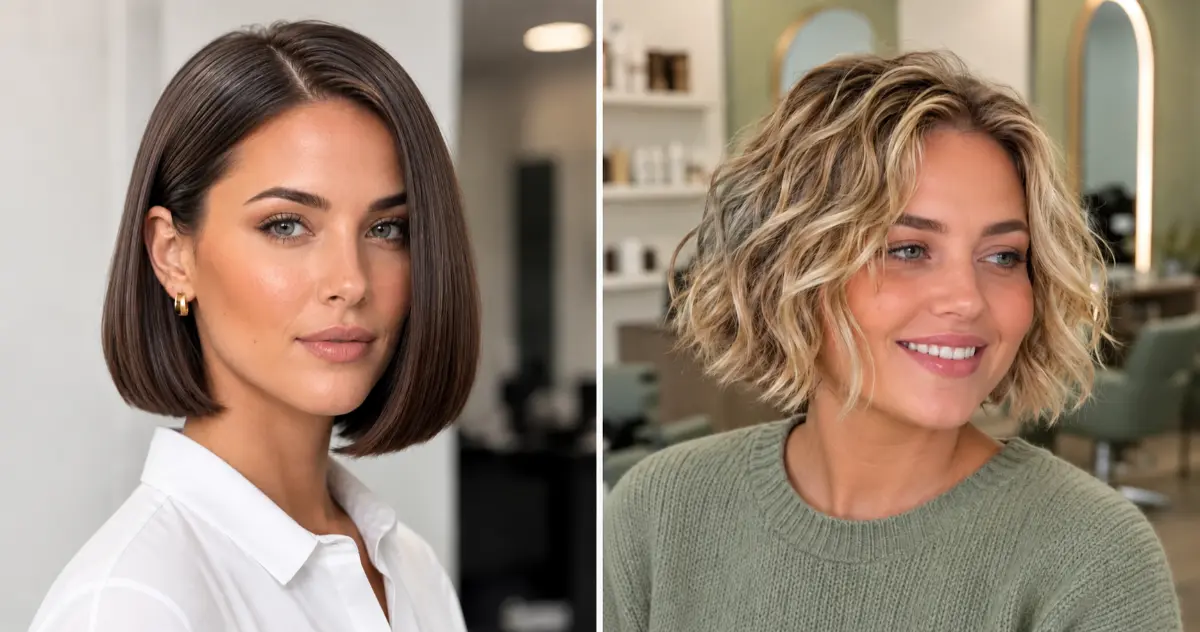
A short French bob is a jawline-grazing bob with a blunt or softly textured perimeter and an undone Parisian finish. It flatters most face shapes, suits straight, wavy, and curly hair when cut with the right technique, and usually needs a trim every 5 to 8 weeks to keep its shape.
| Question | Short answer |
|---|---|
| How short is a short French bob? | Between the earlobe and the jawline, sometimes just above the chin |
| What makes it “French”? | A blunt or lightly textured perimeter, minimal layers, and an effortless undone finish |
| Who does it suit? | Most face shapes. Round and square faces do best with softened edges or curtain bangs |
| Which hair types work? | Straight, wavy, curly, and coily hair all work with the right cutting technique |
| How much daily styling? | About 5 to 10 minutes, and several versions air-dry beautifully |
| How often are trims needed? | Every 5 to 8 weeks, depending on the version |
| What does it cost at a US salon? | Roughly $50 to $85 for a cut, based on Booksy salon listing averages |
Table of Contents
Why the Short French Bobs Keeps Winning
Few haircuts photograph as differently from one face to the next as the short French bob. A half inch of length or a slightly softer fringe can shift the whole look from severe to soft, which is why this cut has so many versions worth studying before sitting down in the salon chair.
The numbers back the obsession. In Pinterest’s 2026 Beauty Trend Report, which compares global searches from July 2025 with July 2026, “French bob with wispy bangs” grew 394% and “textured French bob” grew 338%. The cut keeps evolving: flipped ends are back too, with “flipped bob hairstyles” searches up 299%.
This guide goes beyond a gallery. It covers 15 versions of the short French bob, which face shapes each one flatters, exactly what to ask a stylist for, what it costs at a US salon, how to style it step by step, and how to grow it out without an awkward phase. Every idea includes a plain-English note on who it suits and a ready-to-use salon request.
What Is a Short French Bob?
A short French bob sits shorter and blunter than a standard bob, usually landing between the earlobe and the jawline. The perimeter stays fairly clean, layers stay minimal, and the finish looks a little undone rather than salon-perfect. A fringe is common but not required: curtain bangs, blunt bangs, baby bangs, or no bangs at all can each sit on the same base cut.
It is easy to mix up with its cousins, so here is how they differ.
| Cut | Typical length | Finish | Overall feel |
|---|---|---|---|
| Short French bob | Earlobe to jawline | Blunt or lightly textured, undone | Chic and Parisian |
| Italian bob | Chin to neck, fuller | Soft layers, more volume | Glamorous and polished |
| Classic blunt bob | Chin to collarbone | Sleek, precise, often longer | Sharp and modern |
| Curtain bob | Any bob length | Curtain bangs as the star | Easygoing and current |
Readers torn between the two European classics can compare them in detail in the guide to Italian bob haircuts.
15 Short French Bob Ideas for 2026
The 15 ideas below cover every major version, from the blunt classic to curly, shaggy, and grown-out takes. Each one lists who it suits and a ready-to-use salon request.
1. The Classic Blunt French Bob

Sharp, clean ends sitting right at the jawline. No layers, no overthinking. This is the starter French bob, and it is perfect for anyone nervous about going short for the first time. Straight hair absolutely loves this cut because the one-length perimeter makes ends look thick and deliberate.
Blow dry it smooth with a round brush and finish with a flat iron just on the ends to keep that sharp edge. It takes about ten minutes once the routine is learned.
Best for: straight hair, oval and heart faces, first-time short cuts.
Ask for: a one-length jawline bob with a clean blunt perimeter and no layers.
Upkeep: shape trim every 5 to 6 weeks to keep the edge crisp. For more one-length inspiration, see the blunt bob haircuts guide.
2. The Textured Messy French Bob

Choppy ends, slightly undone, the kind of cut that looks like effort without trying. This one is a dream for wavy or thick hair because texture does the styling work. Sea salt spray, air dry, done.
The trick is point cutting: the stylist angles scissors into the ends instead of cutting straight across, which creates soft, jagged texture. At home, flipping hair upside down while damp and scrunching keeps the piece-y finish alive.
Best for: wavy and thick hair, anyone who wants wash-and-go texture.
Ask for: a jaw-length bob with point-cut ends and light internal texture.
Upkeep: shape trim every 8 to 10 weeks; texture hides regrowth well. Similar energy lives in the choppy bob haircuts roundup.
3. French Bob With Curtain Bangs

Not ready for a full fringe? Curtain bangs are the move. They part in the middle, frame the face softly, and blend right into the bob length. They flatter oval and heart-shaped faces especially well, and soften strong jawlines too.
Ask for bangs that start near the crown, stay shorter in the center, and taper toward the cheekbones. A round brush pulls each side slightly away from the face while blow drying, which builds that natural sweep. For 22 versions of this exact combination, see the full guide to French bob with curtain bangs.
Best for: oval, heart, and square faces, first-time fringe wearers.
Ask for: a jaw-length bob with center-parted curtain bangs that melt into the sides.
Upkeep: bang trim every 4 to 6 weeks. Readers with rounder faces can also browse the best bangs for a round face guide.
4. The Wavy French Bob

Waves and a French bob were made for each other. The trick is asking the stylist to keep the front pieces slightly longer so the waves have room to bounce without shrinking too short once dry.
Curl cream on damp hair, a gentle scrunch, and a diffuser on low heat build the shape. Hands stay out of wet hair until it is fully dry, because touching breaks up the wave and invites frizz.
Best for: 2A to 3A waves, square and oval faces.
Ask for: a jaw-length bob with soft layers and slightly longer front pieces.
Upkeep: shape trim every 8 to 10 weeks.
5. The Micro French Bob

Cropped above the chin, sitting close to the ear. This one takes nerve, but when it lands right it is one of the most striking cuts anyone can wear. It suits strong jawlines and confident minimalists.
This is not a cut for just any stylist. Slight graduation in the back keeps the nape clean, and a small round brush keeps everything tight during styling. At this length even a little mess reads completely deliberate.
Best for: defined jawlines, petite features, bold personal style.
Ask for: an earlobe-length bob with slight graduation at the nape.
Upkeep: shape trim every 4 to 5 weeks; short lengths lose shape fastest.
6. Asymmetrical French Bob

One side longer, one side shorter. It sounds strange written down but looks editorial and intentional in real life. A great pick when a regular bob feels too safe.
About an inch to two inches of difference between the sides is enough to notice without needing an explanation. The longer side sweeps toward the collarbone while the shorter side sits at the jaw. Blow drying it smooth lets the shape do the talking.
Best for: oval and heart faces, anyone who wants an edge.
Ask for: a French bob with one side 1 to 2 inches longer than the other. Upkeep: shape trim every 5 to 6 weeks so the angle stays clean. Bolder angles live in the asymmetrical bob haircuts guide.
7. French Bob With Blunt Bangs

A full straight-across fringe with a short bob underneath. Very Amelie, very timeless. The bangs need a trim every few weeks to stay sharp, but the overall look never really dates.
Ask for bangs cut just above or right at the eyebrow with a slight curve following the brow arch. Blow drying them downward with a flat brush keeps them sitting flat, and a tiny bit of pomade on the ends stops them flipping up through the day.
Best for: oval and long faces, thick straight hair.
Ask for: a jaw-length bob with a full brow-skimming fringe.
Upkeep: bang trim every 3 to 4 weeks.
8. The Shaggy French Bob

Heavy layers, choppy ends, face-framing pieces, full seventies energy. Thick hair that needs movement absolutely thrives with this cut, and it grows out beautifully, which matters more than people think when picking a short style.
Razor-cut or point-cut ends with face-framing layers starting around the cheekbone build the shape. Rough drying with fingers first creates volume, then a diffuser or a small curling wand on random sections finishes the undone shape.
Best for: thick or wavy hair, square faces, low-effort routines.
Ask for: a short bob with razored ends and face-framing shag layers.
Upkeep: shape trim every 8 weeks. More texture-forward takes are in the short shag haircuts guide, and mature readers can see the shaggy bobs for fine hair over 50 version.
9. Sleek and Polished French Bob

Smooth, blow-dried, tucked behind one ear. This is the version for days when polish matters: work, events, or anytime effort feels worth it. A round brush and smoothing serum get it there.
Heat protectant goes on damp hair first, then each section is blow dried downward and slightly under for that inward curl at the ends. A flat iron handles anything that needs extra smoothing, and a light-hold spray locks it in.
Best for: straight to slightly wavy hair, professional settings.
Ask for: a jaw-length bob with a smooth blowout finish and minimal texture.
Upkeep: shape trim every 6 weeks; sleek cuts show regrowth sooner. For event-ready volume, the shoulder-length blowout technique adapts well to this length.
10. French Bob With Face-Framing Layers

Just a few shorter pieces around the face to soften the whole look. When the blunt bob feels too harsh on a more angular face, this version bridges the gap without going full shag.
The key phrase is disconnected face-framing layers: shorter pieces only at the front, everything else stays one length. Wrapping those front pieces around a small wand, curling away from the face, builds a soft frame that feels natural rather than stiff.
Best for: square and oblong faces, anyone softening a blunt cut.
Ask for: a one-length bob with disconnected face-framing layers at the front.
Upkeep: shape trim every 7 to 9 weeks. Layered lovers can explore the 10 layered bob haircuts guide.
11. The Curly French Bob

Curly hair can absolutely wear this cut, but the stylist matters more here than anywhere else on this list. Curly hair should be cut dry, because the curl pattern changes everything once it dries and wet cuts on curls are almost always a gamble.
Curl cream and gel go on soaking wet hair in sections before diffusing. The hover method works best: hold the diffuser about an inch away instead of pressing it directly into the hair, on low heat, with no touching until fully dry.
Best for: 3A to 4A curls, anyone embracing natural texture.
Ask for: a dry-cut French bob shaped to the curl pattern, with bangs left longer to allow for shrinkage.
Upkeep: trims on a curl specialist’s schedule. More curl-specific shapes are in the hairstyles for short curly hair guides.
12. French Bob With a Middle Part

No bangs, clean center part, hair falling naturally on both sides. Honestly the easiest and most low-maintenance version on this whole list. Wash-and-go people, this is the cut.
While hair is damp, the end of a comb draws a clean part straight from forehead to crown. Air dry or blow dry from there and the two sections frame the face without extra work. One pass with a flat iron adds polish when needed.
Best for: symmetrical features, busy routines, fine hair that needs simplicity.
Ask for: a jaw-length bob with a clean center part and no fringe.
Upkeep: shape trim every 8 to 10 weeks. Fans of easy routines will also like the low maintenance haircuts for fine hair guide.
13. Highlighted French Bob

Same cut, totally different energy. A money piece in the front or some balayage through the ends changes everything. Balayage works especially well on short hair because it grows out without a harsh line, so there is no awkward regrowth stage to manage.
A money piece means two bright sections framing the face at the hairline. Toning shampoo once a week keeps highlights from going brassy between salon visits, and color-protecting shampoo stretches the color weeks longer since short ends fade faster.
Best for: anyone wanting dimension without a new cut.
Ask for: a French bob with a face-framing money piece or painted balayage.
Upkeep: gloss or toner every 8 to 10 weeks.
14. The Dark and Dramatic French Bob

Rich brunette or jet black, blunt ends, zero highlights needed. This version photographs beautifully and has an effortless timeless quality. Think quiet confidence.
Keeping the color one solid deep tone creates its own natural dimension in different lighting. Gloss treatments every couple of months at the salon keep it looking saturated rather than dull, and a monthly clarifying wash removes the buildup that dark hair shows faster than lighter shades.
Best for: anyone who loves high-contrast, low-fuss color.
Ask for: a blunt French bob in one deep, solid tone with a gloss.
Upkeep: shape trim every 6 to 8 weeks, gloss every 8 weeks.
15. The Grown-Out French Bob

This one gets skipped over constantly and it should not. That in-between stage where the bob grazes the shoulders can be genuinely one of the prettiest lengths when styled right. There is no need to rush to the salon the second it starts growing.
Wrapping random sections around a one-inch curling wand in alternating directions, then breaking the curls up with fingers, turns growing-out awkwardness into an effortless lob. Keeping a few face-framing pieces slightly shorter preserves the original French bob shape as everything grows in.
Best for: anyone growing out a bob without the awkward phase.
Ask for: shaping trims only, keeping the ends healthy while length gathers.
Upkeep: dust the ends every 10 to 12 weeks. The destination look is covered in the trendy lob haircuts guide.
Best Short French Bob by Face Shape
Length and fringe placement change how a short French bob frames each face shape. Bringing reference photos of people who share the same face shape helps the stylist see what the cut will really do.
| Face shape | What tends to work | Ideas to try |
|---|---|---|
| Round | A bob that ends at or just below the jaw to add length, with curtain bangs sweeping past the cheekbones | #3 Curtain Bangs, #10 Face-Framing Layers |
| Oval | Almost any version works, so hair type and taste can lead | #1 Classic Blunt, #12 Middle Part, #9 Sleek |
| Square | Softened edges, texture, and wispy bangs to ease sharp corners at the jaw | #2 Textured Messy, #8 Shaggy, #10 Face-Framing Layers |
| Heart | Chin-grazing length with curtain bangs to add width near the jaw | #3 Curtain Bangs, #1 Classic Blunt |
| Oblong | Side volume and bangs to build width and balance a longer face | #7 Blunt Bangs, #10 Face-Framing Layers, #2 Textured Messy |
| Diamond | Soft pieces around the cheekbones, avoiding hard blunt lines | #3 Curtain Bangs, #8 Shaggy |
Readers with a rounder face can dig deeper with the guides to the best bangs for a round face, side swept bangs for round faces, and short haircuts for women with a round face. The best short bob haircuts roundup covers the wider bob family.
How to Ask a Stylist for a Short French Bob
The smartest consultation combines a photo, a few precise words, and an honest description of daily habits. Reference photos help most when they show someone with a similar face shape and hair texture, since that reveals what a cut can realistically do. About three images, including one of a look that is not wanted, tells the stylist as much as the favorites do.
A Copy-Ready Salon Request
Ask for: a short French bob sitting between the earlobe and the jawline, with a clean but lightly point-cut perimeter, minimal layers, and an undone finish. Bangs: curtain bangs parted in the middle and blended into the sides (or no bangs for the middle-part version). Hair air-dried most days.
Small swaps customize it. Curly hair adds “cut dry, and leave everything longer to allow for shrinkage.” Fine hair adds “very few layers and a blunt perimeter for density.” Thick hair adds “internal texture to remove bulk without changing the outline.”
Stylist Vocabulary That Prevents Mix-Ups
| Term | What it means in plain English |
|---|---|
| Point cutting | Snipping into the ends so they look feathered instead of ruler-straight |
| Internal texture | Hidden shorter pieces that remove bulk without changing the outline |
| Weight line | The heavy, solid edge at the bottom of a bob |
| Dry cut | Cutting hair when it is dry, so the stylist sees how it really falls |
| Graduation | A shape that stacks slightly shorter at the back toward the nape |
Red Flags in a Consultation
A stylist who skips the cowlick check, cuts curly bangs wet without explaining shrinkage, or suggests a very short fringe on a first visit without discussing grow-out may not be the right match. Stylists with short-cut experience, a portfolio on similar textures, and a habit of asking about routine tend to deliver the best results.
How Much a Short French Bob Costs (and How Often to Trim)
A women’s cut with wash and blowout typically runs $45 to $90 at a US salon, and a short French bob fits neatly inside that range. These figures come from Booksy’s US salon listing averages, which reflect real salon pricing rather than guesses. Actual prices shift with city, stylist experience, and whether color is included.
| Service | Average price | Typical time |
|---|---|---|
| Trim only (dry, no wash) | $25 to $50 | 20 to 40 minutes |
| Women’s haircut with wash and blowout | $45 to $90 | 45 to 75 minutes |
| Bang trim only | $10 to $25 | 10 to 20 minutes |
Booksy’s stylists suggest a shape trim every 6 to 8 weeks for a bob, and bangs need attention every 3 to 6 weeks depending on the fringe type. A shape trim every 6 to 8 weeks adds up to about 7 to 9 visits a year. At $50 to $85 per visit, that is roughly $350 to $765 a year before tips. Many salons offer a free or low-cost bang trim between full appointments, so it is worth asking at the first visit.
How to Style a Short French Bob Step by Step
The charm of this cut is soft, slightly imperfect hair rather than a stiff finish. Here is the routine most stylists recommend, with a quick version, a polished version, and an air-dry version.
The 5-Minute Routine
- Start with damp hair and work a pea-size amount of lightweight cream or mousse through the lengths.
- Rough dry with fingers, lifting at the roots for a little volume.
- If there are bangs, blow dry them first with a small round brush, pulling each side away from the face.
- Scrunch in a light texturizing or sea salt spray for the undone finish.
- Tuck one side behind the ear for instant Parisian polish.
The 10-Minute Polished Version
- Apply heat protectant to damp hair.
- Blow dry in sections with a round brush, pulling each section downward and slightly under.
- Pass a flat iron through the mid-lengths and ends only, since heat at the roots can puff the shape.
- Finish with a drop of shine serum on the ends and a light-hold spray.
The Air-Dry Version for Waves and Curls
- Apply curl cream or sea salt spray to damp hair.
- Scrunch the lengths and part bangs gently with the fingers.
- Leave the hair alone until it dries. A diffuser speeds things along for curls.
Day Two and Day Three Refresh
Bangs sit on the forehead and pick up oil first, so they usually need help before the rest of the hair does. A light dusting of dry shampoo at the roots of the bangs the night before keeps them fresh by morning. A quick rinse and blow dry of only the bangs resets them in about two minutes, and a bit of texture spray revives the bob.
Growing Out a Short French Bob
A bob that sits at the jawline needs roughly 6 to 8 months to reach the collarbone at an average growth rate of about half an inch per month. The trickiest window is usually month four or five, when the back starts flipping out and the front feels neither short nor long.
What helps through the awkward stage: shaping trims only, so length is never lost at each visit; waves or a deep side part to disguise uneven stages; a mini claw clip or silk headband for the front pieces. Idea #15 above covers the grown-out styling in detail, and the trendy lob haircuts guide shows where the grow-out lands.
Common Mistakes With a Short French Bob (and How to Fix Them)
| Mistake | Why it hurts | Easy fix |
|---|---|---|
| Cutting bangs too short on the first visit | Bangs look shorter once dry and grow-out is awkward | Start longer, shorten at the next visit |
| Too many layers | Layers can wipe out the clean French perimeter | Keep layers subtle and blended, or skip them |
| Wet-cutting curly bangs | Shrinkage pulls them far shorter than planned | Ask for a dry cut by a curl-experienced stylist |
| Skipping trims | The bob loses its shape and starts flipping out | A shape trim every 5 to 8 weeks |
| Heavy products on fine hair | The cut goes flat and loses its airy finish | Pea-size amounts of lightweight formulas only |
| Choosing a photo with the wrong texture | The result cannot match a different hair type | Pick photos of people with a similar texture and face shape |
| Over-styling the undone finish | Too much heat kills the effortless look | Air dry when possible, heat only for polish |
Short French Bob FAQs
What is a short French bob?
A short French bob is a jawline-grazing bob with a blunt or lightly textured perimeter and an undone Parisian finish. It usually sits between the earlobe and the jawline and can be worn with curtain bangs, blunt bangs, or no bangs at all.
What is the difference between a French bob and a regular bob?
A French bob is shorter, usually earlobe to jawline, with minimal layers and an effortless finish. A regular bob can be any length and is often sleeker or more graduated. The French version almost always carries that undone Parisian attitude.
Does a short French bob suit round faces?
Yes, with the right tweaks. A length that ends at or just below the jaw adds length instead of width, and curtain bangs sweeping past the cheekbones create soft diagonal lines. Very short blunt versions with a full fringe can emphasize roundness, so softer edges work better.
Is a short French bob good for thin or fine hair?
Often, yes. A blunt perimeter builds density at the ends, which makes fine hair look fuller. The cut works best with very few layers. Readers exploring this angle should see the bob hairstyles for fine hair guide.
Can curly hair wear a short French bob?
Absolutely. The key is a dry cut by a stylist experienced with curls, with everything left longer than expected to allow for shrinkage. The result is a soft, rounded shape with beautiful natural movement.
How often should a short French bob be trimmed?
Every 5 to 8 weeks for most versions. Micro and blunt versions need the shorter end of that range, while textured and shaggy versions can stretch to 8 to 10 weeks. Bangs need their own trim every 3 to 6 weeks.
How much does a short French bob cost?
At a US salon, a women’s cut with wash and blowout averages $45 to $90 on Booksy listings. A year of shape trims every 6 to 8 weeks comes to roughly $350 to $765 before tips, depending on location and stylist.
How long does it take to grow out a short French bob?
About 6 to 8 months to reach collarbone length at average growth rates. Shaping-only trims, waves, and accessories like mini claw clips make the in-between stage much easier.
Can you put a short French bob in a ponytail?
A full ponytail is rarely possible at jaw length. Half-up styles, small claw clips, and tucked front pieces work well, and the grown-out version past the chin gives the most flexibility.
Is the short French bob still in style in 2026?
Yes. Pinterest’s 2026 Beauty Trend Report shows searches for “French bob with wispy bangs” up 394% and “textured French bob” up 338% between July 2025 and July 2026. Stylists continue to call it one of the most requested short cuts of the year.
Final Thoughts
The best short French bob is the one that fits the hair a woman actually has, not just the photo she saved. Length, fringe choice, and texture matter more than the name of the style, and a stylist who listens to daily habits will get the details right. Whether the final pick is a blunt classic, a wavy wash-and-go version, or a shaggy textured take, the Parisian shape keeps it chic, flattering, and easy to grow out.
A saved photo, a few of the salon requests above, and a clear idea of upkeep are all that is needed for a confident consultation. Readers who want to keep exploring can browse the best short bob haircuts roundup, the inverted bob hairstyles guide for angled shapes, or the haircuts for women over 70 guide for gentle, age-flattering takes on the bob.

