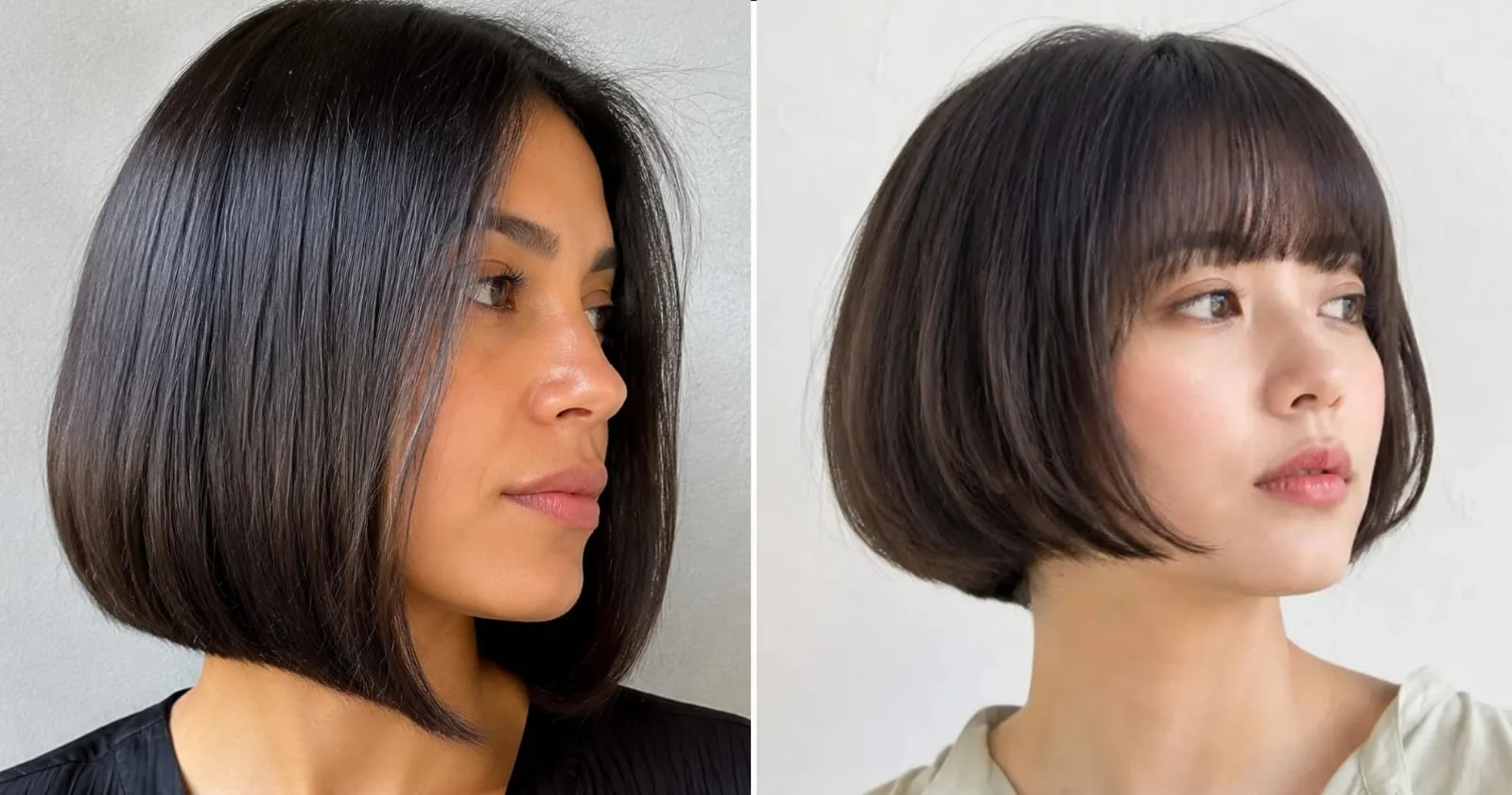
A blunt cut removes every wispy, uneven end and replaces it with one clean line — and that single decision changes how hair behaves more than almost any other cut you can ask for. It’s why the blunt bob keeps resurfacing as a go-to style year after year: it’s not really about length or color, it’s about geometry. Cut correctly, that hard perimeter line packs the ends together so hair reads as denser, glossier, and more deliberate, even on strands that are naturally thin or a little unruly.
But “blunt bob” isn’t one haircut. It’s a family of shapes, and the version that flatters your best friend might do nothing for you. Density, natural texture, how your hair grows at the nape, and even how patient you are with a flat iron all decide which blunt cut earns its keep and which one just looks stiff by day two.
A true one-length blunt bob is cut with the shears held straight across… Neither is “better” — they’re suited to different hair types and different tolerance for maintenance, and we’ll flag which is which as we go, the same way we do in our bob haircuts for fine hair guide.
Quick Takeaways
| If you want… | Consider… |
|---|---|
| Maximum fullness for fine hair | Classic Chin-Length Blunt Bob |
| A face-framing softer front | Blunt Bob with Full Fringe |
| More versatility as it grows | Collarbone-Length Blunt Bob |
| A relaxed, undone finish | Modern French Bob |
| A striking, graphic edge | Asymmetrical Blunt Lob |
| Zero daily styling effort | Curly or Wavy Blunt Bob |
1. Classic Chin-Length Blunt Bob

This is the version most people picture: hair cut to one exact length at the jawline, with no layering to soften the edge. That single, uninterrupted line is why fine and medium-density hair often looks noticeably fuller the moment the cut is finished.
Instead of thinning the ends the way layers do, this cut concentrates weight right at the perimeter, so hair falls as one solid mass rather than separating into thin pieces. It suits oval and heart-shaped faces especially well, since the line lands right where the face narrows.
The trade-off is precision. Because there’s nowhere for an uneven strand to hide, any flaw in the cutting line shows up fast, so this is worth booking with someone who cuts blunt lines regularly rather than a generalist.
2. Collarbone-Length Blunt Bob

Push the same blunt line down to the collarbone and the whole personality of the cut shifts. It’s long enough to tuck behind an ear or half-pin back, but still short enough to keep the density payoff that makes a true blunt cut worth getting — and it sits close enough to a shoulder-length bob that either length works well if you’re torn between the two.
The extra length gives the ends slightly more weight, so the line looks less severe and a little more lived-in than a chin bob. This makes it one of the most forgiving lengths for people who aren’t sure how sharp they want their bob to feel.
It also air-dries reasonably well day to day, though a trim every eight to ten weeks keeps the edge from softening into a shapeless line.
3. Blunt Bob with Full Fringe

Pair a blunt perimeter with a straight-across fringe and you get a cut that reads as far more graphic than either element alone. Round or elongated faces tend to benefit most, since a heavy fringe visually shortens the face while the blunt ends add width at the jaw.
Here’s what most people don’t realize going in: two blunt lines on one head means two different growth clocks. The fringe needs trimming every three to four weeks even while the rest of the cut can comfortably wait two months.
If you’re not someone who wants to think about your hair that often, this isn’t the low-effort haircut it looks like in photos — it’s one of the higher-maintenance options here.
4. Asymmetrical Blunt Lob

Keep one side longer than the other and the blunt line becomes a diagonal instead of a straight shelf. Square and angular face shapes soften nicely under this shape, since the asymmetry breaks up strong jaw corners in a way a symmetrical bob simply can’t — and if you like the idea of length variation, it’s worth browsing trendy lob haircuts more broadly before deciding how dramatic you want the angle.
A deliberate, defined part is what separates this cut from looking accidental versus intentional. Without one, the asymmetry tends to read as uneven rather than styled, especially on straighter textures.
Compared to a straight-across bob, it actually grows out more forgivingly — the longer side buys extra weeks before the shorter side starts looking noticeably short.
5. Modern French Bob

Where earlier French bobs leaned heavy and tightly cut, the 2026 version is softer — chin to cheekbone length, with the blunt line allowed to relax rather than sitting razor-sharp. It suits straight to slightly wavy textures best, and if the relaxed vibe appeals to you, it’s really its own sub-style within the broader world of short French bobs.
This softness has to be cut in deliberately; it isn’t achieved by simply skipping trims on a classic blunt bob. A stylist typically point-cuts subtly along the perimeter to remove some of the harshness without losing the overall blunt silhouette.
Because it’s meant to look a little grown-in, there’s far more room between salon visits before it looks like it needs attention — a genuine advantage for anyone who doesn’t want to track a strict trim schedule.
6. Blunt Bob with a Money Piece

This isn’t a different shape so much as a different finish — take any blunt bob length and add a lightened face-framing section near the part. Fine hair benefits most, since the color contrast tricks the eye into seeing more movement than a single-tone blunt cut usually offers, and if you’re weighing color options for it, browsing a few hair color ideas first can help you pick a shade that grows out gracefully alongside the cut.
Thicker hair can wear this combination too, though it tends to read less dramatic since there’s already natural shadow and depth built into the hair underneath.
Realistically, this pairing means running two maintenance schedules at once — a haircut trim on one clock and a color touch-up on another — so it’s worth budgeting for both before committing.
7. Mushroom Blunt Bob

A rounded, slightly curved perimeter instead of a flat line, cut with heavier interior weight left at the crown. Thicker, coarser hair suits this especially well, since the extra density up top balances out the fuller, rounder silhouette at the ends.
Face shape matters less here than hair texture does. This cut really lives or dies on how much natural body the hair has to fill out that rounded shape — fine hair can end up looking flat rather than voluminous.
Styling stays fairly simple day to day, usually just a round-brush blow-dry, though the shape softens faster than a straight blunt line, so trims tend to land closer to every six weeks.
8. Super-Short Ear-Length Blunt Bob

This is the boldest length here, sitting just below or at the ear, and it demands the most confidence to wear well. Fine, straight hair actually does beautifully at this length, since short hair is one of the only reliable ways to create real thickness illusion without extensions.
Oval and heart faces wear this most comfortably. Very round faces may want to test the look with a stylist first, since shorter length draws the eye straight to the cheeks rather than elongating the face.
Daily styling stays minimal, but because every bit of growth is visible at this length, expect to be back in the chair every four to six weeks.
9. Long One-Length Blunt Cut

Not every blunt cut is short — take the same one-length philosophy and apply it at waist length for a dramatically different result. Thick, straight hair holds this shape best, since the sheer weight naturally pulls the ends into a clean line with minimal effort.
This is arguably the lowest-maintenance haircut on the list in terms of trim frequency. A blunt line at this length grows out gracefully for months without looking ragged, unlike shorter blunt bobs.
The trade-off is styling time, not upkeep — a full blowout on hair this long simply takes longer than any bob length, even though the cut itself asks less of you between appointments.
10. Curly Blunt Bob

Cutting curls blunt, dry, and in their natural pattern is a completely different technique from cutting straight hair blunt, and it deserves its own category because of it. Medium to low-density curl patterns respond best to a zero-layer approach here.
Very high-density or tightly coiled curl types may need a stylist to add subtle internal shaping so the ends don’t stack into a heavy, triangular silhouette at the base.
What makes this cut genuinely worth seeking out: it needs almost no daily heat styling, since the whole point is working with the curl’s own shape instead of fighting it.
11. Wavy Textured Blunt Bob

For naturally wavy hair, a fully blunt line can sometimes look stiff against the movement of the wave — so this version keeps the blunt perimeter but lets the natural wave pattern do most of the styling work. It suits nearly every face shape.
A lot of people ask for extra layers here assuming waves need “help” moving, when actually the layers just remove the density a blunt line is supposed to protect.
Styling usually means little more than air-drying with a texturizing spray, though because waves fall differently every wash, the crisp “line” isn’t always fully visible — worth knowing if you specifically want that graphic blunt look.
12. Poker-Straight Precision Bob

This is the blunt bob at its most architectural — chin length, zero layering, blow-dried pin-straight for maximum sharpness. It rewards straight to slightly wavy natural textures, since curlier hair fights this finish constantly.
Structurally, the appeal here is the same reason minimalist design appeals to people generally: nothing distracts from a single, confident line.
Upkeep is real, though — this look depends on a flat iron and a good heat protectant most mornings, so it suits people who already enjoy styling their hair rather than those hoping to skip the step entirely.
13. Squared-Off Geometric Bob

Where most blunt bobs curve slightly at the ends, this version is cut with deliberately sharp corners for an almost box-like silhouette. Strong bone structure wears it particularly well, since the graphic shape complements rather than competes with defined features.
Softer, rounder face shapes may find this cut a bit severe without a stylist adjusting the corner angle slightly to work with — rather than against — their natural features.
Because the corners are the whole point of the cut, they need regular attention — a softened, grown-out corner looks unintentional in a way a naturally rounded bob simply doesn’t.
14. Glassy High-Shine Bob

This one lives or dies on hair condition rather than face shape or texture. Healthy, low-porosity hair reflects light in a way that makes this cut look almost lacquered.
A lightweight glossing serum applied to damp hair before blow-drying makes the biggest visible difference here, more so than the actual cutting technique itself.
Damaged or overly porous hair will show dullness no matter how precise the line is, so this is the one blunt bob where the at-home hair-care routine matters just as much as the haircut.
15. Blunt Bob Tailored for Fine or Thin Hair

Fine hair and blunt cuts are a genuinely good technical match, and it’s worth understanding why. Thin strands scatter light and look sparse when layered, since layering removes weight exactly where fine hair needs it most.
A blunt line does the opposite of layering — it keeps maximum density concentrated at the ends, which is what creates that thicker, fuller illusion people usually chase with volumizing products instead.
This version typically sits between chin and collarbone length, since anything longer starts to look thin again under its own weight, and it needs little more than a root-lifting spray day to day.
16. Air-Dry “Off-Duty” Blunt Bob

Cut short enough with some natural texture left in, a blunt bob can be genuinely wash-and-go. Some natural wave or texture helps here, since pin-straight hair needs more deliberate styling to avoid looking flat once air-dried.
It’s a practical pick for anyone who wants the shape and density benefits of a blunt cut without committing to a daily styling routine or regular flat-iron use.
The one thing to manage: air-drying means the blunt line looks slightly different day to day depending on humidity, so it suits people comfortable with a bit of natural variation rather than an identical result every morning.
Why Haircut Structure Matters More Than the Photo You Bring In
Every version above is technically a “blunt bob,” yet they behave completely differently on different heads — and that’s really the point. A haircut isn’t just a shape; it’s a shape interacting with your hair’s density, texture, and natural growth pattern.
Face shape gets talked about more than it deserves, honestly. It matters, but density and texture usually decide more about how a blunt cut performs day to day than bone structure does. Fine hair almost always benefits from more blunt weight, not less, while thick or coarse hair sometimes needs internal weight removed so the line doesn’t look bulky.
Texture changes styling time more than length does, and grow-out is worth thinking about before you sit in the chair, not after. The most useful question to ask a stylist isn’t “will this suit my face” — it’s “how will this behave on my hair as it grows out.”
FAQ
Which blunt bob length is easiest to maintain?
Longer, one-length cuts generally need the least frequent trims, since there’s more length to lose before the shape looks uneven.
Does a blunt cut work on curly or wavy hair?
Yes, but it needs to be cut dry and in the natural pattern so the shape holds once the hair falls into its true texture.
How often does a blunt bob need to be trimmed?
Most versions need a trim every six to eight weeks; fringe or very short versions often need attention closer to every four weeks.
Can a blunt bob make fine hair look thicker?
Yes — concentrating weight at the ends instead of removing it is exactly why blunt cuts are recommended so often for fine hair.
What’s the difference between a blunt bob and a lob?
Blunt describes the cutting technique (one clean line, no layering); lob describes length (a long bob). They aren’t mutually exclusive.
Final Thoughts
If there’s one thing worth taking from all sixteen of these, it’s that “blunt bob” is a starting point for a conversation with your stylist, not a single request. Talk through your hair density, how much time you want to spend styling, and how often you’ll realistically book a trim — those three factors will steer you toward the right version more reliably than any photo reference can.

