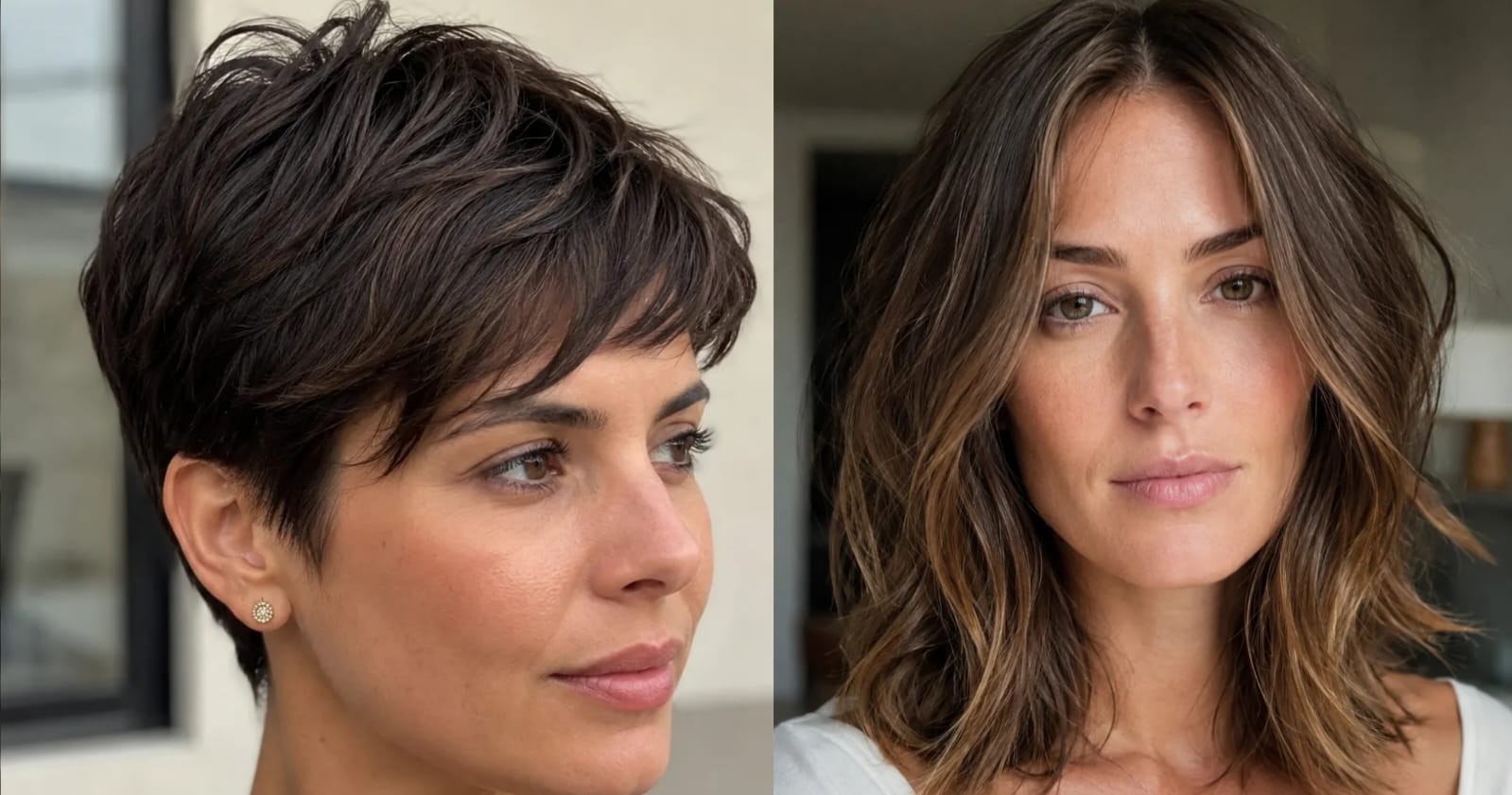
Fine hair holds a curl for about an hour before it’s back to flat, and that’s the real issue with most trendy cuts you find while scrolling. They photograph beautifully, but a lot of them need daily blow-drying, hot tools, and a full shelf of product just to look the way they did when you left the salon.
Some haircuts are simply built to work with fine hair’s texture instead of fighting it. The right cut creates the illusion of density, keeps your ends from looking wispy, and still looks put-together on day three without a full styling routine.
That’s the focus of this list. Below are 16 haircuts for fine hair worth bringing to your next appointment, each one chosen because it actually holds its shape between salon visits.
What Fine Hair Actually Hates
Before the list — one thing worth knowing.
Most people with fine hair ask for lots of layers thinking it’ll add volume. It usually does the opposite. Too many layers, especially short ones near the crown, strip out weight and leave ends looking stringy and thin.
What fine hair actually needs is density at the ends — cuts that let strands stack together instead of flying apart. Once that clicked for me, picking haircuts got a lot easier.
The 16 Best Haircuts for Fine Hair
1. The Blunt Bob

The single best trick I know for making fine hair look thicker. When all ends are cut straight across with no layers, they stack together and create real visual density. People will ask if you got a blowout when you literally just air-dried it.
Best length: jaw to collarbone. Shorter and you lose the swing. Longer and the weight drags everything flat.
✂️ Maintenance Tip: Trim every 6–8 weeks to keep the edge clean. Between trims, a quick flat iron pass on the ends takes 5 minutes and makes it look fresh.
👩 Best For: Oval, heart, and square face shapes. Anyone who wants to look polished with zero morning effort.
2. The Lob (Long Bob)

Collarbone to mid-chest length. The most forgiving haircut on this entire list — wear it straight, wavy, half-up, or in a bun depending on your mood.
Ask for a blunt or slightly graduated edge, not layers. The weight at the ends is what makes fine hair look full. Add heavy layers and that density disappears immediately.
✂️ Maintenance Tip: Trim every 8 weeks. Even at 10–11 weeks it still looks intentional, which makes it great when salon appointments slip.
👩 Best For: Every face shape, every lifestyle. The safest, most universally flattering cut for fine hair.
3. The Textured Pixie

Short hair on fine strands is genuinely underrated. Less length means less weight pulling everything down — which means natural lift at the roots that no product can fake.
A textured pixie with choppy, piece-y movement at the crown gives fine hair volume it rarely gets. Key word: textured. A sleek pixie can still look flat. You want deliberate messiness at the top.
✂️ Maintenance Tip: Trim every 5–6 weeks. Daily styling is a tiny amount of mousse through the crown — done in 2 minutes.
👩 Best For: Oval and heart-shaped faces. Busy women who are completely done spending time on their hair.
4. The Classic Pixie

Cleaner and more polished than the textured version. Tailored at the sides, a bit more length on top, very defined shape. Looks like you tried even when you didn’t.
Fine hair responds really well here because the length is too short for gravity to win.
✂️ Maintenance Tip: Trim every 5–6 weeks. Keep light-hold pomade handy for taming the top on humid days.
👩 Best For: Professional settings. Women who want to look “done” every day with minimal actual effort.
5. The French Bob

Shorter and rounder than a classic bob — sits right at or just below the jaw. Can come with soft wispy bangs, but works without them too.
The rounded shape adds fullness around the face. On fine hair, that extra volume at the sides makes a noticeable difference. Looks chic even when you’ve done absolutely nothing to it.
✂️ Maintenance Tip: Trim every 6 weeks. Mousse scrunched into damp hair, air dry, done. No heat tools needed.
👩 Best For: Round and oval faces. Women who love that effortless, slightly European look.
6. Curtain Bangs with a Lob

Curtain bangs are smarter for fine hair than full blunt bangs because they’re airier. Full bangs on fine hair can look thin or show the forehead through the fringe. Curtain bangs frame the face without the density problem.
Paired with a lob, this combination styles itself. Part them, let them dry naturally, and they fall into place on their own.
✂️ Maintenance Tip: Bang trim every 4–6 weeks — they grow faster than you expect. The lob can go 8 weeks easily.
👩 Best For: High foreheads, long and heart-shaped faces. Great “change without commitment” option.
7. The Shag

Layered, textured, lived-in. Been around since the 70s for good reason.
For fine hair, the layers need to start from mid-length down — not near the crown. High layers strip density from the top where fine hair needs it most. Also, ask for point cutting instead of razor cutting. Razor cutting thins the ends further, which fine hair doesn’t need.
✂️ Maintenance Tip: Trim every 8–10 weeks. Scrunch mousse through damp hair and air dry — the texture happens on its own.
👩 Best For: Naturally wavy fine hair. Bohemian, relaxed styles. Women who want a cut that leans into texture.
8. The Bixie

Between a bob and a pixie — usually chin-length with soft texture and movement. Casual rather than sharp.
What makes it great for fine hair is the length zone it sits in — enough volume to look full, short enough to have natural lift. It also handles grow-out better than almost any short cut. It just becomes a slightly longer version of itself.
✂️ Maintenance Tip: Trim every 6–7 weeks. DIY-friendly between visits — small shears to clean up the ends can buy you extra weeks.
👩 Best For: Women who want to go short but aren’t sure about a full pixie. Oval, heart, diamond faces.
9. The Collarbone Cut

Ends right at the collarbone with a blunt or slightly curved edge. A little longer than a lob, but that inch or two matters.
The collarbone is basically the last point where fine hair can still look dense at the ends without too much length dragging it flat. Stay at this length and the hair holds its structure beautifully.
✂️ Maintenance Tip: Trim every 8–10 weeks. One of the laziest-maintenance cuts on this list — even overdue, it still looks like a deliberate choice.
👩 Best For: Anyone transitioning from long hair. Women who want length they can still pull up but with real body when it’s down.
10. The Layered Bob with Face Framing

Layers only around the face and front sections — the back stays dense and heavy. You get softness and movement where it frames your features, without sacrificing volume through the rest of the hair.
It’s the middle ground between a strict blunt bob and a fully layered cut.
✂️ Maintenance Tip: Trim every 7–8 weeks. Blow dry only the front face-framing sections with a round brush — 5 minutes and the back handles itself.
👩 Best For: Oval and long face shapes who want softness without losing density. Great if a blunt bob feels too severe.
11. The Modern Bowl Cut

Not what you’re picturing. The modern version is textured, slightly uneven at the edges, and genuinely cool — nothing like the childhood photos in your head.
For fine hair, the even all-around length stacks strands together just like a blunt bob does. It’s bold, it’s low effort, and it’s surprisingly flattering.
✂️ Maintenance Tip: Trim every 5–6 weeks. Ask for point-cut edges — textured and modern, not blunt and helmet-like.
👩 Best For: Oval and round faces. Fashion-forward women who want a cut with real personality.
12. The Micro Bob

Right at or just below the jaw. Bold. Practical. At this length, gravity barely has time to flatten the hair before it runs out of room.
Morning routine with this cut: brush through it, maybe a spritz of texturizing spray. That’s genuinely it. No blowout, no tools required unless you want them.
✂️ Maintenance Tip: Trim every 5–6 weeks — small growth changes the shape noticeably at this length. A good texturizing spray is the one product worth buying for this cut.
👩 Best For: Strong jawlines, oval faces. Anyone who wants to look like they absolutely meant it.
13. Soft Waves on a Lob

A lob worn with soft, loose waves looks dramatically fuller than the same cut worn straight. Waves add physical dimension — they take up more space, move differently, and make fine hair appear far thicker than it is.
Fine hair actually holds soft waves well when they’re not too tight. Big, loose waves from a large barrel or overnight braids stay in longer than you’d expect.
✂️ Maintenance Tip: Trim every 8 weeks. Try overnight braids instead of heat — gentler on fine strands and the waves look more natural.
👩 Best For: Anyone who wants to look put-together without much effort. Great for occasions or just days you want to feel a little extra.
14. The Wolf Cut

A shag-pixie hybrid — heavily layered, deliberately messy, rock-and-roll energy that somehow looks intentional. Concentrate the shorter pieces and texture at the crown and face, and keep underlayers longer to preserve mid-length density.
Done right, it’s one of the most exciting cuts on this list.
✂️ Maintenance Tip: Trim every 8 weeks. Diffuse dry with a little curl cream. Skip the brush — finger styling only or you’ll kill the texture.
👩 Best For: Wavy fine hair. Women who want a cut with real personality and don’t want anything neat or conventional.
15. The Blunt Cut with Full Bangs

Straight-across bangs paired with a blunt bob or lob. Very deliberate, geometric, high-statement. But surprisingly easy day-to-day — the bangs do the styling work for you. Even on lazy days the fringe makes everything look intentional.
For fine hair, blunt bangs look genuinely full — all those ends lined up together create density that fine hair rarely gets to show.
✂️ Maintenance Tip: Bangs need trimming every 3–4 weeks — keep small shears at home for quick touch-ups. The rest of the cut is far more forgiving.
👩 Best For: High foreheads, oval and heart-shaped faces. Women who want to look styled every day without actually doing much.
16. The Grown-Out Pixie

When a pixie grows to about 3–4 inches on top with shorter sides still intact, you hit a sweet spot that’s genuinely its own thing. Full of natural volume, full of movement, and completely underrated as a style choice rather than just an awkward phase.
Ask your stylist to shape it rather than just grow it. The difference is everything.
✂️ Maintenance Tip: Clean up sides and nape every 5–6 weeks, let the top grow freely. A little soft wax through the top gives control without looking stiff.
👩 Best For: Anyone growing out a pixie who wants to look intentional through the transition. Also worth choosing as a starting point if you want maximum volume with minimal length.
What to Tell Your Stylist
Be specific — vague requests get vague results.
- Say: “I want a blunt or graduated cut, minimal layers”
- Say: “If we do layers, keep them starting from mid-length down”
- Say: “No razor cutting please”
- Bring a photo — your version of “low maintenance” and your stylist’s version might be completely different
Products That Actually Help
- Volumizing mousse at the roots while damp — lightweight, no buildup
- Dry texturizing spray — grip and grit without weight
- Light-hold hairspray — for when you need things to stay put
Avoid anything labeled “moisturizing,” “smoothing,” or “rich.” Great for coarse hair. For fine hair, they just flatten everything before you leave the house.
FAQ
Do I need layers if I have fine hair?
Not necessarily. Blunt cuts often look fuller. If you want layers, keep them long and starting from mid-length — never short layers near the crown.
How often should fine hair be trimmed?
Every 6–8 weeks for most cuts. Shorter styles like pixies need 5–6 weeks to maintain shape.
Is short or long hair better for fine hair?
Short to medium lengths generally look fuller because there’s less weight dragging everything down. Very long fine hair tends to look stringy at the ends.
Can fine hair air dry and still look decent?
Yes — especially with a blunt bob or lob. These cuts look intentional even fully air-dried with nothing in them.
Final Thoughts
Not every cut on this list will suit your face shape, texture, or the amount of time you’re realistically willing to spend in front of a mirror, and that’s fine. The goal isn’t to find the “best” haircut for fine hair, it’s to find the one that fits how you actually live.
If you take one thing to your next appointment, make it this: ask your stylist how the cut will look on day three, not just day one. A haircut that only works fresh out of the blowout isn’t low maintenance, no matter what it’s called.
Bring a photo, be honest about your styling habits, and let your stylist adjust the shape to your hair’s natural texture. That’s what makes a cut actually hold up — not the style itself, but how well it’s cut for you.

