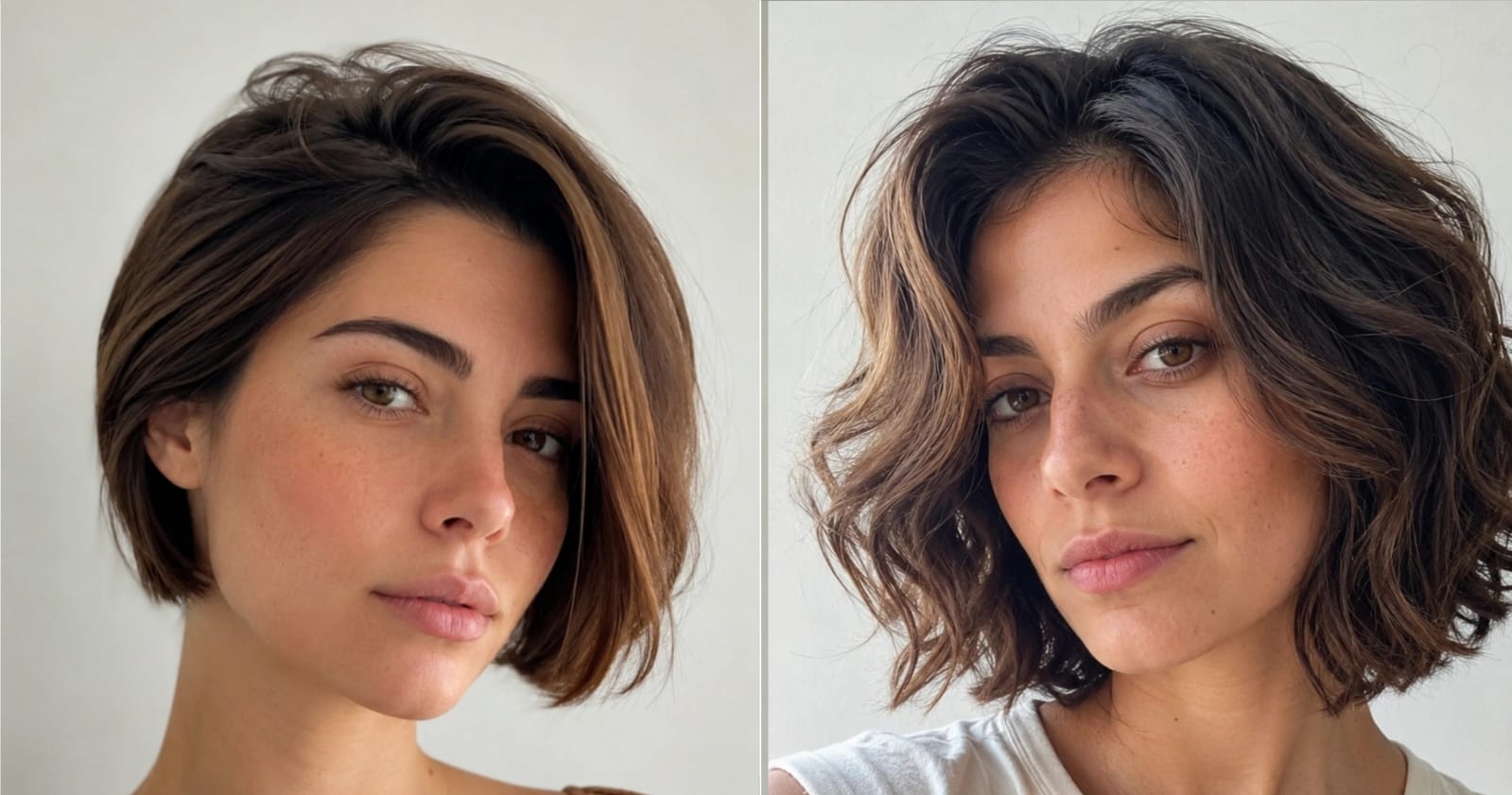
Italian bob haircuts are having a serious moment right now — and it’s not just about the length. Unlike a standard bob that sits heavy and blunt, this cut is built with internal texture and soft movement that makes it look like it’s doing something even when you haven’t touched it.. That structural difference is exactly why it photographs the way it does, and why it keeps showing up on everyone from women in their twenties to their fifties.
It also happens to solve one of the most common hair frustrations: that in-between phase where your hair feels too short to style but too long to leave alone. The Italian bob lives comfortably in that space — chin to collarbone, usually with some face-framing that does the heavy lifting for you. If you’ve been circling the idea of cutting your hair but want something that still feels like you, this is worth a serious look.
The 17 variations below cover the full range — from sleeker, more structured versions to relaxed, slightly undone styles that work well on waves and fine hair alike. If you’re still figuring out which bob length feels right before you commit, the shoulder length bob roundup is a helpful reference point to check first.
Table of Contents
What Makes a Bob “Italian”?
Good question — and one I get asked mid-consultation more often than you’d think. The Italian bob sits somewhere between jaw and collarbone, usually cut blunt or with very subtle layering. What makes it distinctly Italian is the texture play — it’s never stiff, never over-polished. There’s always a little movement, a little lived-in quality. Think less “just blow-dried” and more “walked off a Vespa.”
The cut itself leans on strong, clean lines at the bottom with intentional softness through the interior. It pairs beautifully with curtain bangs or grown-out fringe. The Italians don’t over-style — and that’s the whole philosophy baked into this haircut.
1. The Classic Blunt Italian Bob

This is the foundation. Chin to jaw length, cut straight across with a slight internal softness so it doesn’t look too geometric. The ends aren’t razor-sharp — they’re just clean. That’s what separates it from a standard blunt bob.
I’ve given this cut to women in their 20s who want a chic everyday look and to women in their 50s who are tired of complicated styling. If you’ve been looking at bob haircuts for fine hair, this classic blunt version is one of the most requested starting points — it works consistently across a wide age range.
Why it works: The clean line creates a visual weight that makes fine hair look fuller and thick hair look structured.
Common mistake: Going too short. If the bob sits at or above the chin on someone with a round face, it can make the face look wider. Always aim for at least jaw-level on rounder face shapes.
Quick Specs
- Best Face Shapes: Oval, long, heart
- Best Hair Texture: Straight, fine to medium
- Maintenance Level: Low–Medium
- Styling Difficulty: Easy
- Trim Frequency: Every 6–8 weeks
- Biggest Advantage: Clean, elegant look with minimal effort
- Potential Drawback: Can look boxy on very thick hair without thinning
2. Textured Italian Bob

This one is my personal favorite to cut. Instead of that perfectly straight blunt line, I use point-cutting and slide-cutting to break up the ends and create a lived-in, slightly undone texture. It moves. It breathes. It looks like something you were born with.
Clients who love short wavy haircuts but want something a little more refined consistently gravitate toward this version. This is the bob I recommend when clients say they want something easy but stylish. Air-dry it, scrunch a little cream through the ends, and you’re done.
Why it works: Texture removes that “I just got a haircut” stiffness and makes the bob feel natural rather than precise.
Common mistake: Using too much product and weighing down the texture. A light cream or mousse applied to damp hair is all you need.
Quick Specs
- Best Face Shapes: Oval, heart, long
- Best Hair Texture: Wavy, medium thickness
- Maintenance Level: Low
- Styling Difficulty: Easy
- Trim Frequency: Every 8–10 weeks
- Biggest Advantage: Effortlessly stylish, great for air-drying
- Potential Drawback: May not suit those who prefer a very polished look
3. Layered Italian Bob

When a client comes in with thick hair and says she wants a bob, I almost always steer toward a layered version. Without internal layers, thick hair at bob length can become a dense helmet. With layers, it moves, it lightens, it suddenly looks intentional.
The layers in an Italian bob aren’t dramatic. They’re subtle — mostly internal — designed to reduce bulk rather than create obvious visual layers from the outside. If you want to understand the difference, it helps to look at how layered bob haircuts generally work before your consultation, so you can communicate exactly how much or how little layering you want.
Why it works: Removes weight and adds movement without sacrificing length or the bob’s overall shape.
Common mistake: Over-layering. When there are too many layers, the bob loses that characteristic Italian fullness at the ends. The goal is a soft shape, not a shaggy mess.
Quick Specs
- Best Face Shapes: Oval, square, round (with the right layers)
- Best Hair Texture: Thick, wavy
- Maintenance Level: Medium
- Styling Difficulty: Moderate
- Trim Frequency: Every 6–8 weeks
- Biggest Advantage: Controls thick hair without sacrificing style
- Potential Drawback: Requires a skilled stylist to get the layers right
4. Italian Bob with Curtain Bangs

This combination has been absolutely everywhere in my salon for the past year. The curtain bangs part in the center and fall softly on either side of the face, creating a soft, romantic frame that works with nearly every face shape.
Paired with the Italian bob, it becomes a complete look. The bangs add dimension, soften strong jawlines, and give fine hair the illusion of more going on up front.
Why it works: Curtain bangs add face-framing softness that blunt bobs can sometimes lack.
Common mistake: Cutting curtain bangs too short. They need to be long enough to tuck behind the ear or blend into the bob. If they’re too short, you lose the curtain effect entirely.
Quick Specs
- Best Face Shapes: Most shapes, especially oval and heart
- Best Hair Texture: Straight to wavy
- Maintenance Level: Medium
- Styling Difficulty: Moderate
- Trim Frequency: Every 6–8 weeks for bangs
- Biggest Advantage: Instantly flattering and feminine
- Potential Drawback: Bangs require regular trims or they lose their shape quickly
5. Shaggy Italian Bob

Think of this as the rebellious cousin of the classic Italian bob. It has more texture, more layers, more deliberate undone-ness. I typically use a razor or heavy point-cutting to get that shaggy, piece-y finish.
I’ve noticed this version appeals to clients who love the wolf cut trend but want something a bit shorter and more refined. It gives you that cool-girl energy without going full shag.
Why it works: The shaggy texture adds personality and works beautifully with natural wave patterns.
Common mistake: Trying to smooth it out with a flat iron. This cut is meant to be worn with its natural texture. Fighting it defeats the whole purpose.
Quick Specs
- Best Face Shapes: Oval, long, heart
- Best Hair Texture: Wavy, coarse
- Maintenance Level: Low
- Styling Difficulty: Easy
- Trim Frequency: Every 8–10 weeks
- Biggest Advantage: Very low maintenance, naturally stylish
- Potential Drawback: Not appropriate for formal or corporate environments if texture is extreme
6. Asymmetric Italian Bob

One side longer than the other. It sounds dramatic, but when done subtly — we’re talking maybe an inch of difference — it creates a really interesting visual tension that makes this asymmetrical bob feel modern and edgy.
This is for clients who want something a little unexpected. I’ve done this on women who come in saying they feel like their look has gotten boring. The asymmetry instantly refreshes the whole thing.
Why it works: Creates visual interest and movement without requiring a completely different haircut.
Common mistake: Going too extreme with the length difference on round faces. If one side is dramatically shorter, it can create an uneven frame that emphasizes width rather than height.
Quick Specs
- Best Face Shapes: Oval, long
- Best Hair Texture: Straight, medium thickness
- Maintenance Level: Medium
- Styling Difficulty: Moderate
- Trim Frequency: Every 6–8 weeks
- Biggest Advantage: Modern, unique look
- Potential Drawback: Difficult to grow out evenly
7. Italian Lob (Long Bob)

Technically a lob, but cut with Italian bob principles — minimal layering, blunt or softly textured ends, worn with an undone wave. This is my go-to recommendation for clients who love the Italian bob aesthetic but aren’t quite ready to commit to the jaw-length version.
It sits right at or just below the collarbone, which flatters almost every face shape.
Why it works: The lob length is universally flattering and the Italian styling gives it a sophisticated, effortless quality.
Common mistake: Adding too many layers. The Italian lob should have weight and body at the ends. Over-layering turns it into a generic layered lob, which is a completely different vibe.
Quick Specs
- Best Face Shapes: All face shapes
- Best Hair Texture: Most textures
- Maintenance Level: Low–Medium
- Styling Difficulty: Easy
- Trim Frequency: Every 8–10 weeks
- Biggest Advantage: Universally flattering, easy transition into a shorter bob
- Potential Drawback: Not as impactful as the shorter bob version
8. Curly Italian Bob

Curly hair shrinks when dry, which is something to always account for when cutting a bob on curly clients. I always cut curly Italian bobs dry, or at minimum, I cut them stretched and then check the dry result. The final length should sit at jaw level when fully dry.
This version embraces the natural curl pattern and lets it create that organic, undone texture the Italian bob is known for.
Why it works: Curls naturally provide the texture and movement the Italian bob relies on. It’s almost a natural fit.
Common mistake: Cutting when wet without accounting for shrinkage. You can end up with a bob that’s far shorter than intended once the curls bounce up.
Quick Specs
- Best Face Shapes: Oval, long, heart
- Best Hair Texture: Curly, coily
- Maintenance Level: Medium
- Styling Difficulty: Moderate
- Trim Frequency: Every 8–12 weeks
- Biggest Advantage: Works beautifully with natural curl patterns
- Potential Drawback: Shrinkage can make length unpredictable — always consult a curl-experienced stylist
9. Italian Bob with Face Framing

This is the version I recommend to clients who are nervous about a full blunt bob. The face-framing pieces — slightly longer sections that fall forward around the face — soften the cut and make it feel more personalized.
It’s a small detail that makes a noticeable difference, especially for clients with stronger jaw or brow structures.
Why it works: Face framing creates a soft halo around the face and adds dimension to what could otherwise be a very uniform cut.
Quick Specs
- Best Face Shapes: Heart, square, oval
- Best Hair Texture: Straight to wavy, fine to medium
- Maintenance Level: Medium
- Styling Difficulty: Moderate
- Trim Frequency: Every 6–8 weeks
- Biggest Advantage: Highly flattering, very wearable
- Potential Drawback: Face-framing pieces can look scraggly if not maintained
10. Blunt Italian Bob with Middle Part

The middle part takes the classic Italian bob and makes it feel very editorial. It creates a perfect symmetry that works especially well on oval faces. This is the version you see on runways and in high-fashion editorials — clean, deliberate, beautiful.
Why it works: The center part emphasizes symmetry and gives the bob a graphic, modern quality.
Common mistake: Trying to force a middle part on a hairline that naturally wants to fall elsewhere. Work with your natural part whenever possible.
Quick Specs
- Best Face Shapes: Oval, long
- Best Hair Texture: Straight, fine to medium
- Maintenance Level: Low
- Styling Difficulty: Easy
- Trim Frequency: Every 6–8 weeks
- Biggest Advantage: Sleek, editorial, easy to style
- Potential Drawback: Very symmetrical — any unevenness in the cut becomes more noticeable
11. Beachy Italian Bob

Salt spray. A little scrunch. Air dry. Done. The beachy Italian bob is the one clients describe when they say they want hair that looks good without trying. The cut is textured at the ends, the styling is minimal, and the result looks like you just got back from a weekend somewhere with a coastline.
Why it works: The natural texture and undone finish is the entire point of the Italian bob philosophy.
Quick Specs
- Best Face Shapes: Oval, long, heart
- Best Hair Texture: Wavy, medium thickness
- Maintenance Level: Low
- Styling Difficulty: Easy
- Trim Frequency: Every 8–10 weeks
- Biggest Advantage: Zero-effort styling, endlessly cool
- Potential Drawback: Can look too casual for formal settings
12. Italian Bob with Wispy Ends

Rather than a blunt or heavily textured finish, this version uses point-cutting to create very fine, wispy ends that taper almost invisibly. It’s particularly flattering on fine hair because it removes any bluntness that can sometimes look heavy on thinner strands.
Why it works: Wispy ends create softness and movement that make the bob look very natural and refined.
Quick Specs
- Best Face Shapes: Most shapes
- Best Hair Texture: Fine, straight
- Maintenance Level: Low
- Styling Difficulty: Easy
- Trim Frequency: Every 8 weeks
- Biggest Advantage: Very flattering on fine hair
- Potential Drawback: Can look thin or sparse on already very fine hair if overdone
13. Stacked Italian Bob

The stacked bob is cut shorter at the back with stacking that creates roundness and shape at the crown. It’s a more structured interpretation of the Italian bob but retains the jaw-length front sections that give it that classic Italian quality.
I tend to recommend this one to clients who want more volume at the back of their head without losing the front length they love.
Quick Specs
- Best Face Shapes: Round, square (paradoxically — the back volume adds height)
- Best Hair Texture: Straight, fine
- Maintenance Level: Medium
- Styling Difficulty: Moderate
- Trim Frequency: Every 5–6 weeks
- Biggest Advantage: Creates volume and shape without extensions
- Potential Drawback: Requires frequent trims to maintain the stacked shape
14. Romantic Wavy Italian Bob

Loose, soft waves at the ends, worn with a slight center or side part. This is the most feminine interpretation of the Italian bob and one that translates beautifully to special occasions. I’ve seen clients wear this to weddings, gallery openings, date nights — it holds its own in any context.
Why it works: The wave adds softness and romance without sacrificing the clean structure of the bob.
Quick Specs
- Best Face Shapes: Oval, heart, long
- Best Hair Texture: Wavy, medium
- Maintenance Level: Low
- Styling Difficulty: Easy
- Trim Frequency: Every 8–10 weeks
- Biggest Advantage: Versatile enough for everyday and special occasions
- Potential Drawback: Waves may not last all day on very slippery straight hair without product
15. Italian Bob with Side Part

A side part shifts the weight of the bob to one side and creates an asymmetry that feels very classic Hollywood. It’s a subtle change from a middle part but it reads completely differently — slightly more vintage, a bit more glamorous.
Quick Specs
- Best Face Shapes: Most shapes, especially round (the side part creates length)
- Best Hair Texture: Most textures
- Maintenance Level: Low
- Styling Difficulty: Easy
- Trim Frequency: Every 6–8 weeks
- Biggest Advantage: Very wearable, slightly more versatile than the center part
- Potential Drawback: None significant
16. Sleek Italian Bob

The sleek version is blow-dried smooth with a round brush and finished with a flat iron for a polished, mirror-like finish. This is the dressier interpretation. It’s not the lazy Italian bob aesthetic, but sometimes clients want maximum polish, and this delivers it.
Why it works: The sleek finish allows the quality of the cut to really show — every line and angle is visible.
Common mistake: Skipping heat protectant. Sleek styling requires heat, and unprotected hair shows damage quickly at bob length.
Quick Specs
- Best Face Shapes: Oval, long
- Best Hair Texture: Straight, medium thickness
- Maintenance Level: Medium
- Styling Difficulty: Moderate
- Trim Frequency: Every 6–8 weeks
- Biggest Advantage: Incredibly polished and professional
- Potential Drawback: Requires heat styling, which takes time and can cause damage without proper protection
17. Undone Italian Bob

This is the one that started the whole trend resurgence. It’s purposely imperfect — slightly messy, softly waved, with ends that look like they haven’t been styled rather than have been styled to look unstyled (there is a difference). It’s the bob equivalent of a perfectly rumpled linen shirt.
I cut this one a lot for clients who are low-maintenance but still want to look like they have a signature style.
Why it works: It leans fully into that Italian beauty philosophy — the idea that beauty should look effortless even when it isn’t.
Quick Specs
- Best Face Shapes: Oval, long, heart
- Best Hair Texture: Wavy, coarse
- Maintenance Level: Low
- Styling Difficulty: Easy
- Trim Frequency: Every 8–10 weeks
- Biggest Advantage: Maximum style, minimum effort
- Potential Drawback: Can veer into looking neglected rather than intentional if not cut correctly
Styling Guide
Daily styling: For most Italian bob variations, the routine is simple. Work a pea-sized amount of lightweight cream or mousse through damp hair, scrunch or smooth depending on your texture, and air dry. That’s it for the majority of wearers. For more simple styling routines made for short hair, see the full guide.
Air-drying: Works best for textured, shaggy, beachy, and undone versions. Use a microfiber towel or an old cotton t-shirt instead of a terry cloth towel to reduce frizz.
Blow-drying: If you prefer a smoother finish, blow dry with a round brush, directing the hair downward to keep the ends smooth and add a slight curve. A medium-barrel brush works well at bob length.
Heat styling: For the sleek or romantic wavy versions, a 1-inch curling iron or flat iron does most of the work. Always apply heat protectant first. At bob length, damage shows quickly because you can’t just trim off a few inches and start fresh.
Product usage: Less is more. The Italian bob lives and dies on its natural finish. Heavy products ruin the texture. Stick to lightweight creams, salt sprays, or a tiny amount of serum for shine.
Product Recommendations
Lightweight styling cream: Look for something with flexible hold, not strong or sticky. Works for textured and undone versions. Apply to damp hair before air-drying.
Salt spray: The single best product for the beachy and undone Italian bob. Spritz onto damp or dry hair and scrunch. Adds texture, enhances natural wave, and that slightly matte, sea-salt finish is exactly what this cut was designed for.
Heat protectant spray: Non-negotiable for the sleek or curled versions. Choose a lightweight spray rather than a cream to avoid weighing the bob down.
Shine serum: A very small amount — literally one drop worked through the palms — applied to the ends of a finished style adds that Italian beauty polish without making the hair look greasy or overdone.
Dry shampoo: Good for second-day styling when the roots need a refresh but the ends still look fine. Use sparingly at the roots only.
FAQs
Q: What exactly makes a bob an “Italian” bob versus a regular bob?
The Italian bob is distinguished by its attitude as much as its cut. It typically sits between the chin and jaw, uses minimal layers, and is styled with a natural, slightly undone texture rather than a polished blowout. It’s the Italian philosophy of effortless beauty applied to a haircut.
Q: Is the Italian bob good for fine hair?
Yes, actually. Fine hair benefits from the blunt or lightly textured finish because the ends have weight and don’t look limp or thin. The key is avoiding too many layers, which can make fine hair look sparse.
Q: How long does an Italian bob take to grow out?
From a classic jaw-length Italian bob to a shoulder-length lob typically takes about 6–9 months, depending on your growth rate. The grown-out phase can actually look quite good if you keep up with light trims to maintain shape during the process.
Q: Can I get an Italian bob if I have naturally curly hair?
Yes, but always see a stylist who is experienced with cutting curly hair. The cut must be done with shrinkage in mind. What looks like the right length when wet can end up significantly shorter once the curls dry.
Q: What face shapes does the Italian bob suit best?
Oval and long face shapes are the most natural fit. Heart shapes work well too, especially with the curtain bangs version. Round and square face shapes can wear it but do best with a slightly longer version or added face-framing layers.
Q: How often do I need to trim an Italian bob?
For blunt versions, every 6–8 weeks is ideal. For textured or shaggy versions, you can stretch it to 8–10 weeks. The longer you wait, the more the shape breaks down.
Q: Can I style an Italian bob without heat?
Absolutely. The air-dried, naturally textured approach is actually the most authentic way to wear this cut. A little styling cream or salt spray on damp hair is all most clients need.
Q: Is the Italian bob high maintenance?
The daily styling routine is low-maintenance for most versions. Where it requires investment is in regular trims. Skip trims and you lose the shape quickly.
Q: What’s the difference between an Italian bob and a French bob?
The French bob typically sits higher — at or above the chin — and is often paired with blunt bangs. The Italian bob is a bit longer, looser, and less structured. It’s warmer and more romantic in feeling versus the sharper, more graphic French bob.
Q: Should I get the Italian bob if I’ve never had short hair?
If you’re nervous, start with the Italian lob — the longer version — before committing to the jaw-length cut. It gives you the aesthetic without the full commitment. Most clients who do this end up going shorter at their next appointment anyway.
Final Stylist Advice for Italian Bob Haircuts
Here’s what I tell every client who comes in with an Italian bob photo: this cut is forgiving, adaptable, and genuinely beautiful on a wide range of women. But like any cut, it works best when it’s tailored to you specifically — your texture, your face shape, your lifestyle, your actual styling habits on a Wednesday morning when you’re running late.
The 17 variations I’ve covered here represent the full range of what this style can be, from the sleek and polished to the completely undone. If you’re unsure where to start, bring your reference photos to your consultation and be honest with your stylist about how much time you realistically spend on your hair. That honesty will get you a better result than any photo alone.
The Italian bob isn’t a trend that’s going anywhere soon. It’s rooted in something timeless — that idea that beauty should feel natural, that a good haircut should do most of the work for you. When you get it right, it will.

