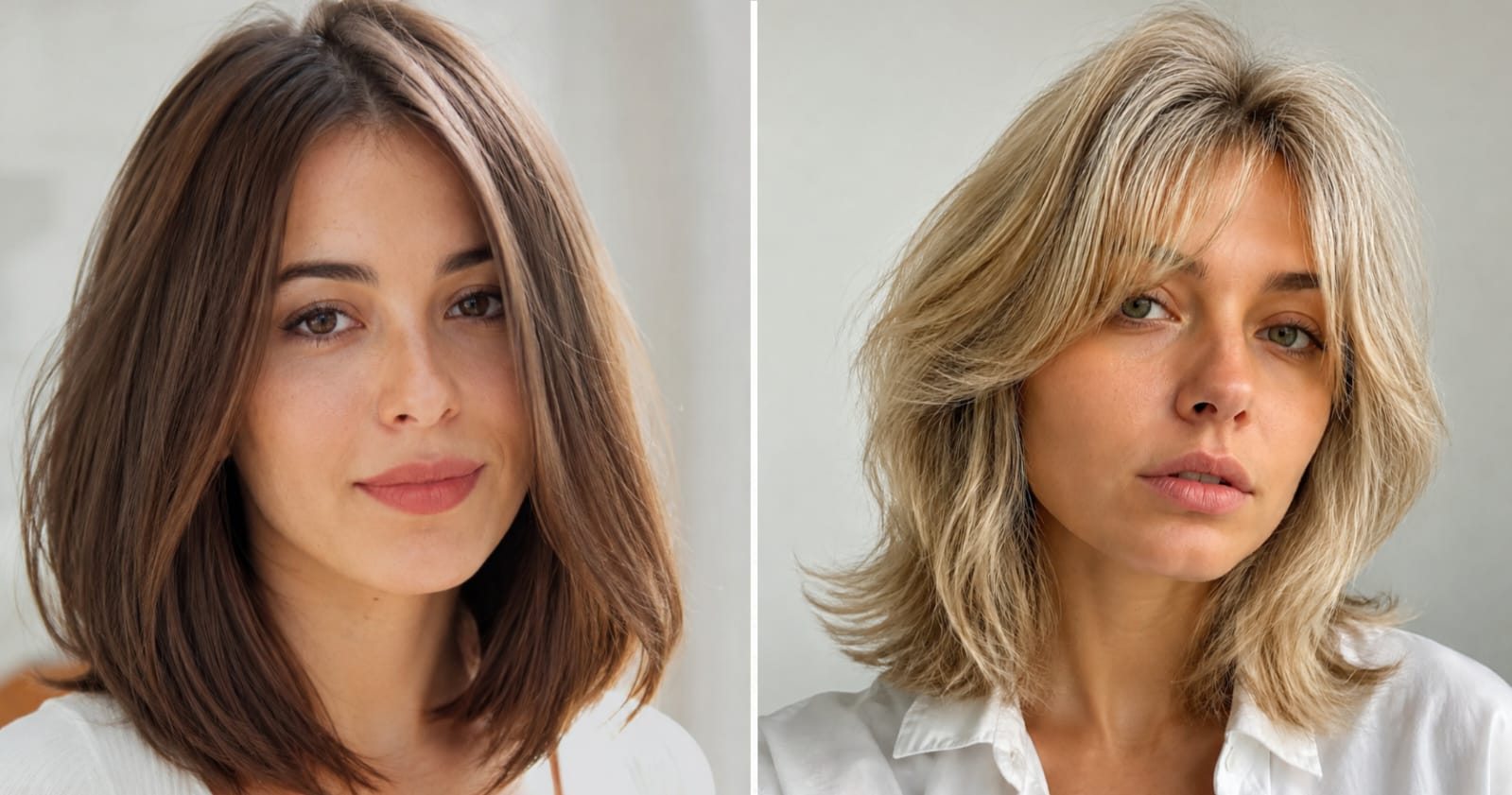
Shoulder length is one of the trickiest lengths to blowout well — not because the technique is hard, but because the cut underneath determines almost everything. At this length, gravity pulls the hair down exactly where you want volume the most: the mid-shaft and ends. If the cut isn’t distributing weight correctly for your specific hair density, no amount of round-brush work will hold that shape past hour two.
Hair density — the number of individual strands per square inch on your scalp — is the variable most blowout guides skip entirely. Fine, low-density hair needs cuts with removed weight and internal layers so the blowout doesn’t collapse under its own flatness. Thick, high-density hair needs strategic bulk removal at the right points so the blowout doesn’t puff outward into a triangle. The shoulder length bob you see on Pinterest was almost certainly cut for a specific density — and that’s why it may or may not be working on yours.
This list is organized to help you match the right cut to your density before you book the appointment. Each entry explains the structural reason the cut works — not just what it looks like. If you’re also weighing whether to go shorter, the layered bob has its own density dynamics worth understanding first.
Quick Takeaways
| Hair Type | Best Cuts |
|---|---|
| Fine Hair | #1, #2, #4, #7, #10, #13 |
| Thick Hair | #3, #5, #6, #9, #12, #15 |
| Medium Hair | #8, #11, #14 |
| Low Maintenance | #2, #6, #11 |
1. Face-Framing Layered Blowout (Fine Hair)

The defining feature here is internal layers that start at the cheekbone and graduate toward the ends — not layers stacked throughout, but specifically placed to redirect volume toward the face. For fine, low-density hair, a blowout collapses fastest at the crown and behind the ears. By removing weight only in the front sections, the stylist creates the illusion of fullness where the eye lands first while leaving enough density in the back to hold the blowout’s shape.
The technique pairs with this cut because the layers give the round brush something to “catch” as it lifts. Without them, the brush slides straight through fine strands with no grip and no lasting bend. If you’ve tried blowouts that look great for 20 minutes then go pin-straight, this is likely the structural fix — not a product issue. Explore related options in our bob haircuts for fine hair guide.
2. Collarbone-Skimming Blunt Cut Blowout (Fine Hair)

A blunt perimeter at exactly collarbone level does something counterintuitive for fine hair: it concentrates all the hair’s visual weight into one clean line, making the ends appear thicker than they are. For a blowout, this means the style reads as full even when density is low, because there are no wispy graduated ends to expose the sparseness.
The blowout on this cut is also the most forgiving to maintain. Because the ends are all one length, re-smoothing with a paddle brush on day two doesn’t require sectioning work — you’re just re-activating the shape. Fine-haired readers who want a low-maintenance haircut will find this the easiest shoulder-length blowout to sustain between salon visits.
3. Textured Curtain-Bang Blowout (Thick Hair)

Thick, high-density hair at shoulder length tends to blowout into a wide oval shape — volume that goes sideways rather than up and back. Curtain bangs solve this at the front by directing the eye toward the center part and downward at the sides of the face, which visually narrows the silhouette. The key is that the bangs need to be texturized — point-cut at the ends — or the blowout pushes them flat and wide across the forehead.
For the main body of the blowout, this cut usually requires the stylist to remove internal bulk underneath (sometimes called undercutting or thinning at the nape) so the ends don’t flip outward from excess weight. If your thick hair consistently blows out into a triangle shape, the fix is almost never technique — it’s internal weight distribution in the cut. Check the haircuts for fine hair article for comparison if you’re trying to understand where you fall on the density spectrum.
4. Butterfly-Layered Blowout (Fine to Medium Hair)

Butterfly layers — shorter layers sitting in the interior crown that blend into longer layers underneath — were originally designed for wavy and curly hair, but they translate exceptionally well to blowouts on finer textures. The shorter interior layers create a shelf of volume at the crown that the blowout can build on, rather than the hair lying flat from root to ends.
What makes this work specifically for a blowout (rather than an air-dry style) is that the round brush can lift those interior layers independently of the perimeter. The result is a blowout with visible height at the crown that isn’t artificially dependent on dry shampoo or teasing. For similar structural logic applied to a different length, the butterfly haircut for medium hair is worth comparing directly.
5. One-Length Graduated Blowout (Thick Hair)

A slight graduation at the back — where the interior hair is cut slightly shorter than the perimeter — removes bulk exactly where thick hair tends to build up: the occipital area. For a blowout, this means the back section sits closer to the head and doesn’t push volume outward, while the sides and front retain length for movement.
Most thick-haired women don’t realize their blowout’s puffiness at the back is a cut problem. A one-length cut with no graduation leaves all that weight to expand. The graduation fixes the silhouette structurally, so the blowout is doing volume management, not just moisture sealing.
6. Razored-End Blowout (Thick Hair, Lived-In Look)

Razor cutting removes bulk from the ends rather than from the interior, creating ends that are thinner and more movement-friendly than scissor-cut ends. For thick hair, this is significant for blowouts: scissor-cut ends on thick hair tend to curl under heavily at the ends (the classic helmet blowout), while razored ends move and bend more naturally.
The trade-off is longevity — razored cuts can feel drier at the ends and may need more hydration. But for thick-haired women who want a blowout that doesn’t look stiff or overdone, the razored perimeter is one of the most effective structural tools a stylist has. This cut also requires less daily re-styling effort, making it one of the better low-maintenance blowout options for high-density hair.
7. Voluminous Shag Blowout (Fine Hair)

The shag’s defining element — lots of layers throughout, including at the crown — makes it one of the few cuts where fine hair can achieve genuine blowout volume without product overload. Each layer acts as a separate lift point for the round brush, multiplying the apparent fullness across the whole head rather than concentrating it in one spot.
The challenge with a shag blowout on fine hair is framing: too many short layers without proper blending can make fine hair look sparse at the sides. The cut needs to be calibrated with your specific density in mind, not pulled from a generic shag template. For shag specifics, our short shag haircuts article covers the layer placement logic in more detail.
8. C-Curl Blowout with Mid-Length Layers (Medium Density)

The C-curl blowout — where the ends curve smoothly under rather than flipping — requires a specific layer structure to work at shoulder length. Layers that end at the collarbone give the round brush a natural breaking point where the hair can turn under without forcing it. Without this, the hair often gets the under-curl at the salon and loses it by the next morning.
Medium-density hair is actually the easiest for this style because it has enough weight to hold the curl’s shape but not so much that it flips the ends back out. The layer placement is doing the work, not the heat — which is why this blowout tends to last longer than it does on either fine or thick extremes.
9. Blunt Bob Blowout at Shoulder Bone (Thick Hair)

A blunt cut at the shoulder — no layers, no graduation — is often recommended for fine hair, but it can also work strategically for thick hair when the goal is a sleek, high-polish blowout rather than a voluminous one. The weight line created by the blunt perimeter acts as a natural tension point that keeps thick hair from expanding outward.
The blowout technique on thick blunt hair is all about sectioning: working in thin horizontal sections from nape to crown with a paddle brush (rather than a round brush) produces a smooth, flat finish that doesn’t fight the hair’s density. If you’re thick-haired and the round-brush blowout always ends in frizz, this structural approach to both cut and technique is worth considering.
10. Wispy-End Layer Blowout (Fine Hair)

Wispy, point-cut ends on shoulder-length fine hair create micro-movement at the ends that reads as texture and life — things fine hair naturally lacks in a standard blowout. The wisps aren’t the same as thinning (which removes too much and makes fine hair look sparse); they’re specific to the final inch or two, creating a feathered finish that catches light differently than blunt ends.
For the blowout, this means the ends require less product to look polished, because the texture disguises any flatness. Fine-haired women who feel their blowouts look limp at the ends despite doing everything right are often fighting a blunt-cut perimeter that needs this adjustment.
11. Soft Wave Blowout with Interior Channels (Medium Density)

Interior channels — thin vertical sections removed from the mid-shaft interior — are a lesser-known technique that creates built-in movement for a blowout without relying on layers that reach the surface. The surface hair stays smooth and one-length in appearance, but underneath, the removed sections allow the blowout to move and wave naturally rather than sitting flat.
Medium-density hair benefits most from this because the surface layer is substantial enough to conceal the interior work. The result is a blowout that looks naturally wavy and high-volume without the maintenance demands of a heavily layered cut.
12. Thick-Hair Blowout with Nape Undercutting

Undercutting at the nape — removing a small, hidden layer of hair close to the scalp at the back of the neck — is specifically designed for thick-haired women whose blowouts create bulk at the nape that lifts the rest of the hair upward and outward. This hidden removal doesn’t affect the visible shape but eliminates the underlying volume source.
For the blowout, the result is a back section that lies smoother and closer to the head, allowing the style to sit in a more controlled silhouette. It’s one of the most effective density management tools that thick-haired women rarely know to ask for by name.
13. Piece-y Blowout with Disconnected Layers (Fine Hair)

Disconnected layers — layers that don’t blend seamlessly into each other but instead create distinct sections of length — give fine hair an architectural quality that continuous layers can’t. Each section of the blowout sits at a slightly different level, creating depth through structure rather than volume.
This works specifically for fine hair blowouts because it avoids the puffed-out round shape that evenly blended layers can create on low-density strands. Instead, the piece-y separation reads as deliberate texture, which disguises the hair’s natural flatness.
14. Bixie-Length Blowout with Top-Heavy Layering (Medium Density)

The bixie — sitting between a bob and a pixie — has a specific layering strategy at shoulder length: heavier layers concentrated in the top third of the hair, with a longer perimeter underneath. For a blowout, this top-heaviness creates crown lift that medium-density hair can sustain, while the longer perimeter provides the shoulder-grazing length the style is named for.
Medium-density hair is the ideal candidate because there’s enough strand count to support top-heavy layers without the crown looking sparse, and the blowout volume stays proportional. The bixie cut guide covers variations of this layering approach in more detail.
15. Volume-Stacked Blowout with Back-Elevation (Thick Hair)

Stacking — where the back of the hair is cut progressively shorter from the nape upward, creating a stacked visual effect — builds structure into the back of the blowout that thick hair often fights against. The elevation in the cut means the back naturally holds lift without depending on round-brush volume, which tends to over-inflate thick hair.
For the front and sides, the cut leaves the hair longer and flatter, so the overall silhouette is controlled: voluminous where the cut dictates, smooth where it needs to be. This is one of the most structurally sophisticated shoulder-length blowout options and the one thick-haired women most often don’t know exists until they ask specifically for it.
Why Your Blowout Length Is Working Against You
Shoulder length sits at a mechanical disadvantage for blowouts that most guides never address. At this length, the hair is long enough to carry real weight but short enough that it has nowhere to fall except straight down — directly against the volume you’re trying to build. Longer hair distributes weight across a greater surface area. Shorter hair doesn’t have enough length to pull itself down at all. Shoulder length catches the worst of both.
The second issue is the collarbone contact point. At shoulder length, the ends of your hair physically rest against your collarbone and shoulders throughout the day. Every time you move, that friction disturbs the blowout’s shape at exactly the spot where the style is most fragile — the ends. This is why shoulder-length blowouts that look perfect in the salon lose their shape faster than the same blowout done at mid-back length or chin length.
The fix isn’t more product or higher heat. It’s understanding that the cut has to do structural work before the blowout begins — correct weight distribution, the right layer placement for your density, and ends that are shaped to resist friction rather than collapse under it. A blowout at this length that lasts is almost always the result of the right cut, not better technique.
FAQ
How do I know if my hair is fine or low-density before I book? These are two different things. Fine refers to the diameter of individual strands — test it by holding a single strand up to light: fine hair is nearly invisible. Density refers to how many strands per inch — check by pulling your hair into a ponytail: under an inch in circumference is low density. You can have thick individual strands at low density, or fine strands at high density. Your blowout problems are usually density-driven, not fineness-driven.
Why does my shoulder-length blowout always lose volume behind the ears first? The behind-the-ear area has the least structural support from the cut — it’s where most perimeter layers run out before they can provide lift. Cuts that specifically address this have layers that start at or just above the ear rather than below it, giving the round brush a lifting point exactly where the flatness begins.
Can a blowout structurally last longer than one day without dry shampoo? Yes, but it requires the right cut. Cuts with interior layers (not just surface layers) maintain their shape longer because the structure is built into the hair rather than sitting on top of it. Blunt cuts with no layers rely entirely on the product layer and heat — both of which degrade overnight. Ask your stylist specifically about interior vs. surface layering.
What’s the most common mistake with shoulder-length blowouts on thick hair? Using a round brush that’s too large. A large-barrel round brush works on fine and medium hair because it creates volume without adding extra curl. On thick hair, it creates indiscriminate fullness that the hair’s natural weight then pushes outward. A medium barrel with deliberate sectioning produces a much more controlled result.
Does the blowout technique change depending on the cut, or is it always the same? The technique should absolutely change. Blunt cuts need a paddle or Denman brush for tension and smoothness. Layered cuts need a round brush that can grip the layers individually. Razored cuts need lower heat and less tension or the ends will over-frizz. If your stylist uses the same tool on every client regardless of cut, that’s worth noting.
Final Thoughts
Shoulder-length blowouts aren’t a one-size technique problem — they’re a structural cut problem that technique then either solves or fails to compensate for. Matching your hair density to the right cut architecture means the blowout works with your hair’s natural behavior rather than against it, and the results hold longer with less daily effort. Before your next appointment, identify where your density actually sits, and ask your stylist specifically how the cut they’re recommending manages weight distribution for a blowout. That single conversation will do more for your results than any product recommendation.

