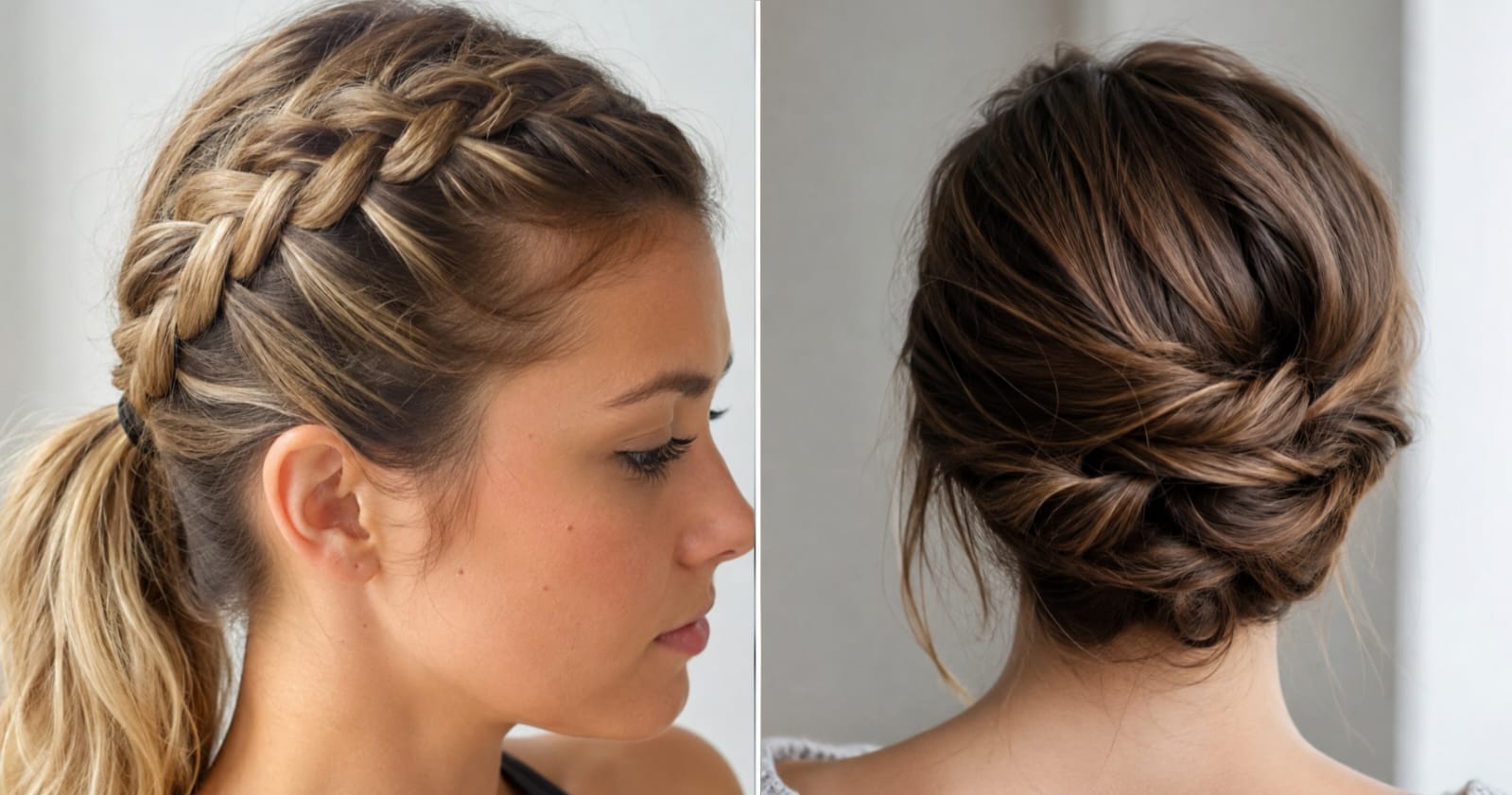
Humidity doesn’t just make hair “frizzy” in some vague way — it physically changes the hair shaft. When moisture in the air is higher than the moisture inside your hair, the cuticle lifts and lets water vapor in, which swells the strand and breaks the temporary hydrogen bonds that were holding your blowout or curl in place. That’s why a style can look perfect at 8 a.m. and be unrecognizable by noon, especially on medium-length hair, where the ends are heavy enough to fall but still light enough to catch wind and moisture from every angle.
Medium hair is actually one of the trickier lengths for humidity. It’s too short to twist into a heavy, low-tension bun the way long hair can, but too long to “shake and go” the way a pixie or bob can. The styles that hold up aren’t the ones that look the most done — they’re the ones that physically limit how much surface area is exposed to the air, or that use tension and structure to fight the swelling instead of relying on product alone.
This list focuses on styles built around that logic: braids, twists, and contained updos that work with humidity instead of against it. If you’ve been bookmarking summer hair trends hoping one of them survives a humid commute, this is the more practical version of that list.
Quick takeaways:
- Best for all-day heavy humidity (90%+): Sleek Low Bun, Twisted Low Chignon, Braided Bun
- Best if your medium hair is wavy or textured: Single French Braid, Dutch Braid Into a Ponytail, Fishtail Braid
- Best for a polished, no-frizz finish without heat tools: Slicked-Back High Ponytail, Wet-Look Slicked Pony
- Best for quick mornings (under 5 minutes): Claw Clip Twisted Half-Up, Two Low Braids (Pigtails)
1. Sleek Low Bun

A low bun works in humidity for a structural reason: it minimizes how much hair is left loose and airborne. Every strand that’s twisted into the bun is under tension, which physically resists the cuticle-swelling that causes frizz, while the strands left out (if any) are kept short and close to the face where they’re less exposed to moving air.
This is one of the few styles that actually improves with a little humidity, since the slight moisture helps smooth flyaways into the bun rather than lifting them away from it. It’s a strong choice if you’ve already linked humid-weather looks like a shoulder length bob and want an updo option for the same hair.
2. Single French Braid

A French braid pulls new sections of hair in as it goes, which means each piece is locked under tension before it has a chance to absorb ambient moisture and swell. That’s different from leaving hair down, where every strand is exposed and free to expand individually, creating that diffuse, frizzy halo.
Medium hair is actually a good length for this — long enough to braid securely, short enough that the braid doesn’t have a heavy, loose tail flopping around and catching humidity at the ends. It pairs especially well with the wavy texture covered in wavy haircuts, since the braid pattern can hide natural frizz instead of fighting it.
3. Dutch Braid Into a Ponytail

A Dutch braid sits on top of the hair rather than blending into it, which means it creates a slightly raised, textured barrier that’s harder for ambient moisture to penetrate evenly. Braiding the top section, then gathering everything into a ponytail, also reduces the total amount of loose hair exposed to air compared to wearing it fully down.
This is a smart pick on humid days when you still want movement, since the ponytail tail can be left to fall naturally. If you like this combination of texture-on-top, movement-below, it’s worth comparing against the half up half down hairstyles for non-humid days, where you have more flexibility.
4. Slicked-Back High Ponytail

A slicked ponytail works in humidity because the smoothing step happens before the moisture has a chance to act on the hair — gel or cream coats the cuticle and physically blocks some of the water vapor absorption that causes lift. The high placement also keeps hair off your neck, where body heat and sweat add a second source of moisture on top of the air’s humidity.
The key detail is product placement: smoothing product belongs at the root and mid-lengths, not just the ends, since that’s where most of the visible frizz and flyaways start in humid weather.
5. Double Dutch Pigtail Braids

Splitting hair into two braids instead of one halves the amount of hair in each section, which means less bulk to swell and frizz per braid. Dutch braiding (under, rather than over) also keeps the braid pattern raised and tight to the scalp, so there’s less loose surface area exposed along the part line where frizz typically starts first.
This style holds particularly well through exercise or outdoor activity, since the braids stay anchored even with movement, unlike a single loose braid that can work itself looser as you move.
6. Fishtail Braid

A fishtail uses thinner sections than a standard braid, which creates more cross-over points per inch. More cross-over points means more friction holding each strand in place, which makes the braid more resistant to humidity-driven slippage than a three-strand braid with fewer, larger sections.
The tradeoff is that fishtails on medium hair can look slightly looser by design, which actually works in your favor in humid weather — a style that’s meant to look a little undone won’t read as “ruined” the way a sleek style does the moment it frizzes.
7. Twisted Low Chignon

A chignon is essentially a twisted, pinned knot, and twisting hair before pinning it does something a simple bun doesn’t: it compresses the strands together, reducing the surface area exposed to air per strand. Less exposed surface area means less opportunity for individual hairs to absorb moisture and separate from the group.
This style holds for hours because the tension is distributed across multiple bobby pins rather than a single hair tie, so even if a few strands shift, the overall shape doesn’t collapse the way a loose updo can.
8. Braided Crown (Half-Up)

Braiding only the crown section and pinning it across the head creates a structural “cap” that resists humidity exactly where most people frizz first — at the root and hairline, where new growth and shorter strands are most reactive to moisture. The rest of the hair left down isn’t under the same tension, but the crown braid keeps the overall shape from collapsing.
This is a good option if you want something more polished than a basic half-up but don’t want a fully contained updo for the day.
9. Bubble Ponytail

The elastics spaced down a ponytail in a bubble style do more than create the rounded shape — each segment acts as its own mini containment zone, limiting how far any one section of hair can expand outward before it hits the next elastic. That segmentation is what keeps a bubble ponytail looking structured in humidity, long after a plain ponytail would have gone flat and fuzzy.
It’s a low-effort way to add humidity resistance to a basic ponytail without committing to a full braid.
10. Braided Bun (Braid Wrapped Into a Bun)

This combines two humidity-resistant mechanics in one style: the braid itself locks strands under tension, and wrapping it into a bun afterward removes any loose tail that could otherwise catch moisture and frizz. The result is one of the most humidity-resistant styles on this list, since almost no hair is left exposed and unsecured.
It holds especially well for medium hair, which is often just long enough to braid fully but not so long that the bun becomes bulky or hard to pin.
11. Low Side Braid

A side braid keeps hair gathered to one side and off the back of the neck, where heat and sweat from your skin add extra moisture beyond what’s in the air. Less moisture contact at the nape means less of the cuticle-swelling reaction that causes frizz to start there first.
This is also a practical pick for layered medium cuts, since shorter face-framing pieces are tucked into the braid’s tension rather than left to frizz separately near your face.
12. Wet-Look Slicked Pony

This style essentially uses product to pre-saturate the hair shaft in a controlled way, so there’s less “room” for ambient humidity to cause further swelling once you’re outside. The slicked-down cuticle also reflects light evenly, which is part of why this look reads as sleek rather than damp once it dries.
It’s a strong choice for hot, sticky days specifically — the wetter your styling product, generally, the less additional humidity can change the finished look.
13. Claw Clip Twisted Half-Up

Twisting hair before securing it with a claw clip adds tension at the root, which is where frizz and flyaways are most visible on medium hair. The twist also means the clip is holding compressed, organized hair rather than a loose gathered ponytail, which is part of why this style tends to stay neat through a full humid day with almost no upkeep.
It’s one of the fastest options here, and it works well as a transitional style between a fully down look and a full updo.
14. Two Low Braids (Pigtails)

Worn low rather than high, this version reduces bounce and movement throughout the day, which limits the friction-based frizz that comes from hair rubbing against itself as you walk or turn your head. Combined with the tension from braiding, this makes for one of the lowest-maintenance humidity styles on the list.
It also works well layered under a hat or headband if you’re spending the day outdoors, since the braids won’t shift the way loose hair would.
15. Headband Braid Wrap

Wrapping a section of hair around a headband and securing it with bobby pins creates a hidden anchor point that keeps the crown smooth even as humidity affects the rest of your hair. This targets the same problem area as the braided crown style, but with less time investment, since you’re not braiding the full section.
It’s a practical pick if you want a polished front view without committing to a full braid or updo in the back.
16. Pinned-Back Twist Updo

Twisting sections back and pinning them individually distributes tension across multiple small points rather than one central knot, which means the style can flex slightly with humidity-driven movement without fully collapsing. This makes it more forgiving than a single bun if you’re going to be outside for hours.
It’s a good match if you’ve been looking at cute updo hairstyles for an event and need something that will photograph the same at 7 p.m. as it did at 2 p.m.
The Science Behind It: Why Containment Beats Product
Trichologists generally agree that frizz isn’t really a styling failure — it’s a moisture exchange problem. Hair is hygroscopic, meaning it naturally absorbs and releases water vapor from the air to reach equilibrium with its environment. In low humidity, that’s barely noticeable. Once ambient moisture climbs above your hair’s internal moisture level, the cuticle layer lifts to let vapor in, the cortex underneath swells, and any style held together by hydrogen bonds (a blowout, a curl, a flat-iron pass) starts to lose its shape almost immediately — often within 20–30 minutes in heavy humidity.
This is why dermatologists and trichologists who study hair-fiber behavior tend to recommend mechanical solutions over purely topical ones: anti-humidity sprays and silicones can slow vapor absorption, but they create a partial barrier, not a complete one. Braiding, twisting, and tying hair under tension does something products can’t — it physically restricts how much any individual strand can expand and separate, even if some moisture still gets in. That’s the underlying logic behind every style on this list: the goal isn’t to keep moisture out entirely, it’s to control what happens to the hair once it gets in.
FAQ
How do I know if my hair reacts more to humidity than the average? Try the strand test: take a clean strand from your brush, drop it in a glass of water, and watch what it does. If it sinks within a minute or two, your hair is more porous and absorbs moisture (and humidity) faster, meaning contained styles like braids and buns will hold noticeably better on you than loose styles.
Why does medium-length hair seem to frizz worse than long or short hair in humidity? At medium length, the ends are usually layered and lighter, so they have less weight pulling them down and more surface area relative to their length — both of which make them easier for ambient moisture to lift and separate.
Do anti-humidity sprays actually work, or is the style doing most of the work? They help, but they’re a supplement, not a fix — most anti-humidity sprays create a temporary barrier that slows moisture absorption, while the style itself (braided, twisted, or contained) is what determines how visible any frizz that does get through actually is.
Should hair be fully dry before braiding it for a humid day? Yes — braiding damp hair traps existing moisture inside the braid, which continues to interact with humidity in the air and tends to cause more frizz by the afternoon than braiding fully dry hair.
Does color-treated medium hair behave differently in humidity? Often yes — chemical processing raises the cuticle slightly, which is part of why color-treated hair frequently has higher porosity and absorbs moisture faster, making contained, low-tension styles even more useful than they are on virgin hair.
Final Thoughts
Fighting humidity with more product is a losing battle if the style underneath isn’t built to handle it — the styles that actually hold are the ones that limit how much hair is exposed to the air in the first place, whether that’s through braiding, twisting, or simple containment. Pick based on how much of that exposure you’re comfortable controlling, and the humidity stops being something you’re fighting all day.

