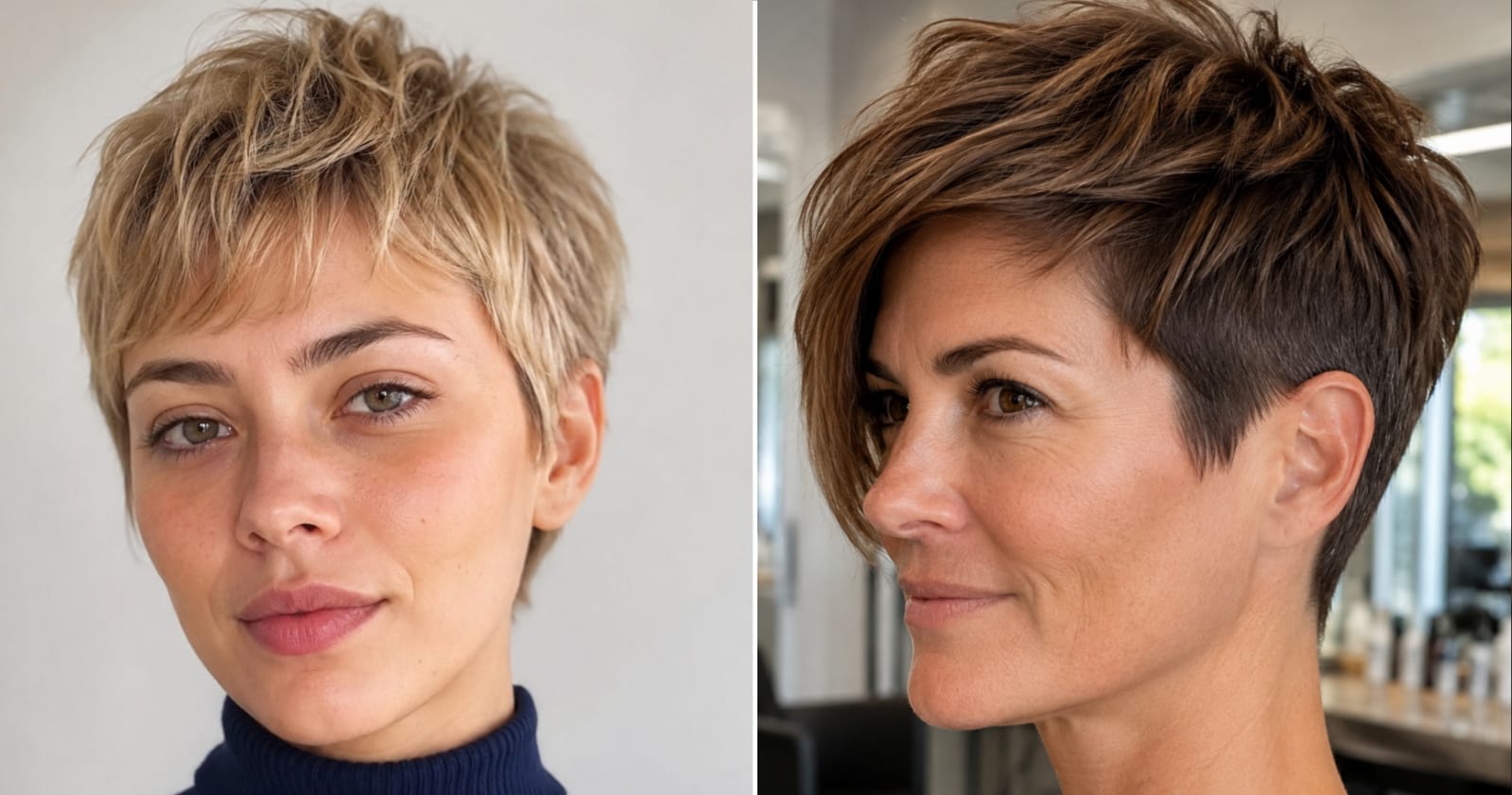
Most pixie cut articles spend all their time telling you what each style looks like. What they rarely explain is why a pixie cut works the way it does — specifically, how the weight distribution in a short cut shapes your face more dramatically than any longer style can. When hair is removed from below the jaw, the eye travels differently. The proportions shift. That’s the real reason a well-chosen pixie feels transformative rather than just “short.” Keep that structural logic in mind as you browse these 20 looks — it’s what separates a pixie that flatters from one that fights you every morning.
Whether you’re considering your first chop or you’ve been rocking short hair for years, 2026 is a genuinely good moment for the pixie. Texture is back at the center of the conversation, and that works in your favor: modern pixies are less about perfection and more about deliberate shape. You’ll find edgy options, softer alternatives, and a few styles that sit in interesting territory between the pixie and something longer — including the bixie, which deserves its own conversation.
1. The classic pixie with texture

The classic pixie earns its place on this list first because it’s the clearest illustration of that weight-distribution principle. Hair is cut close at the sides and back, with slightly more length left on top — and that contrast is what creates the visual lift that makes the face look more defined. It isn’t magic; it’s proportion. This version adds deliberate texture through point-cutting or razor work, so the top doesn’t lie flat. The result is something you can shake into place in under two minutes.
How To Style
- Start with slightly damp hair and work a pea-sized amount of texturizing cream through the top section.
- Blow-dry using your fingers, directing hair forward and slightly to one side to build soft movement.
- Once dry, use a small amount of matte paste — focus on the ends rather than the roots.
- Finish with a light-hold spray and use your fingertips to separate pieces where they’ve clumped.
Best For: Oval, heart, and oblong face shapes / medium to thick hair density
Tools & Products: Round brush or diffuser, matte texturizing paste, flexible hold spray
2. Long bang pixie

The long bang pixie keeps more length in the front than a traditional cut, with fringe that sweeps across the forehead rather than sitting above the brow. This extra length does real structural work: it interrupts the forehead-to-chin line and creates a horizontal visual break that shortens the appearance of a long face or softens a wide forehead. It also gives you something to work with on days when the rest of the cut feels too minimal. You can push those bangs back, sweep them to the side, or let them fall forward — three different looks from one wash.
How To Style
- Apply a heat protectant and rough-dry the rest of the cut first, leaving the bangs for last.
- Use a small round brush to roll the fringe under slightly at the tips for a soft, curved finish.
- Alternatively, blow back and away from the face for a more open, lifted version.
- Lock the style with a light-hold hairspray applied with your hand rather than directly from the can.
- Use a fine-tooth comb to refine the part if you want something more polished.
Best For: Round and square face shapes / straight to wavy hair
Tools & Products: Small round brush, heat protectant, fine-tooth comb, light-hold spray.
3. The undercut pixie

An undercut pixie shaves or clips the hair very close at the nape and sides, then leaves significantly more length on top. The contrast between those two sections is where the drama lives — and it also has a practical function. Because the heaviest, densest hair is removed from below, the top section appears thicker and has more natural lift without any product. If you’ve ever felt like your hair lies flat no matter what you do, the undercut pixie often fixes that problem structurally rather than cosmetically.
Check out our edgy pixie cuts page for more looks that use contrast and shape this deliberately.
How To Style
- On the top section, apply a volumizing mousse from root to mid-length.
- Blow-dry upward using a Denman brush or your fingers to build height at the crown.
- Define the perimeter of the undercut with a small amount of edge control or firm-hold pomade if you want the line to read clearly.
- Leave the top slightly undone for a modern finish rather than slicking it smooth.
Best For: Oval and heart face shapes / medium to thick density
Tools & Products: Volumizing mousse, Denman brush, edge control or firm pomade
4. Curly top pixie

For naturally curly hair, the pixie cut works differently than it does on straight or wavy textures. The curl itself creates volume and shape — so the structural goal shifts from building lift to controlling where that volume sits. A curly top pixie clips or tapers the sides close while leaving the top length long enough for the curl pattern to form fully. The result is a silhouette that’s taller than it is wide, which is genuinely flattering across a range of face shapes.
If you’ve been curious about more curl-specific cuts, our curly pixie haircuts guide goes deeper on this.
Quick Styling Note: Avoid brushing or combing the top section after your curl-defining product is in — that disrupts the curl pattern and creates frizz. Scrunch upward to encourage coils, not outward to separate them.
5. Platinum micro pixie

The micro pixie takes length down to the shortest possible point across the entire head — sides, back, and top all close-cropped. What makes the platinum version distinct is that the color does most of the visual work. At this length, there’s no texture or movement to rely on for interest, so the high-contrast blonde against your skin tone becomes the statement. This isn’t a casual choice; it requires commitment to regular touch-ups (platinum fades and brassiness is visible faster on very short hair) and a face shape confident enough to go unframed.
How To Style
- On dry hair, rub a small amount of pomade between your palms and press lightly over the entire head to control any flyaways.
- Use a fine-bristle brush to smooth the hairline for a clean finish.
- That’s genuinely it — the cut and color carry this look.
Best For: Oval face shapes / all hair types (including very fine hair, which benefits from the shorter length)
Tools & Products: Light pomade, fine-bristle brush, purple toning shampoo for at-home maintenance
6. Asymmetrical pixie

One side longer than the other — that’s the core of the asymmetrical pixie. The longer side typically sweeps past the cheekbone and can be tucked behind the ear or left to fall forward. What the asymmetry does structurally is create diagonal movement across the face, which draws the eye across rather than straight down, making it one of the more interesting options if you have an oblong or very even face shape.
Quick Styling Note: The longer side needs more maintenance than the shorter side — factor in a trim every 4-5 weeks to keep the length differential visible, otherwise the cut starts reading as a lopsided grow-out rather than an intentional style.
7. Shaggy layered pixie

The shaggy pixie is the most forgiving version of the cut because the layers remove some of the precision pressure. Instead of a sharp, architectural shape, this style relies on lots of choppy layers through the top and crown, with a softer, less-defined perimeter. For fine hair, this is one of the more practical options because the layers create the visual illusion of density. For medium hair, it’s just a good-looking cut that requires minimal daily effort.
How To Style
- Apply a small amount of sea salt spray to damp hair and scrunch lightly.
- Diffuse on a low heat setting, scrunching throughout to encourage wave and texture.
- Once dry, rake a tiny amount of matte paste through the top to separate the layers visually.
- Resist over-styling — the slightly undone quality is exactly the point.
Best For: Fine to medium hair / oval, round, and heart faces
Tools & Products: Sea salt spray, diffuser, matte paste
8. Sleek side-parted pixie

Where most pixies lean into texture and informality, the sleek side-parted version is deliberately polished. A deep side part directs all the top-section hair to one side, and the goal is smooth, close-lying hair with no intentional texture. The effect is very different from the shaggy or spiky versions: more sophisticated, more structured, closer to Old Hollywood in its references. It works beautifully for occasions where you want your short hair to feel dressed-up rather than casual.
Quick Styling Note: This style works against thick, coarse hair unless you have a smoothing balm strong enough to control it — factor that into your product choice before committing to the look.
9. Pastel toned pixie

A pastel pixie — lavender, dusty rose, mint, butter yellow — uses color as the main design element of the cut. The style itself can be any classic pixie shape; the transformation happens through the tone. Pastels on short hair look dramatically different from pastels on long hair because there’s so much less surface area — the color feels more concentrated and intentional. The structural angle worth knowing: lighter pastels visually emphasize the volume and shape of the cut itself, so it’s worth investing in a precise shape if you’re going this route.
Quick Styling Note: Pastel pigment fades faster than natural shades, and on a short cut that means touch-ups every 4-6 weeks. Budget for that before committing — a faded pastel on a pixie reads more tired than a faded pastel on longer hair does.
10. Tapered nape pixie

The tapered nape pixie graduates the hair smoothly from the longest point at the top down to a tight taper at the neckline — no hard line, no undercut contrast, just a clean fade. It’s one of the more wearable options for someone trying a short cut for the first time because the taper feels less abrupt than an undercut. It also grows out more gracefully, which matters if you’re not 100% sure you’ll want to maintain something very short.
How To Style
- Apply a small amount of volumizing foam to damp roots and work through the mid-lengths.
- Blow-dry using a vent brush, lifting at the crown to prevent the top from lying flat.
- Finish with a soft-hold pomade or styling balm, working from the perimeter inward.
- Smooth the nape with a damp palm to keep the taper clean.
Best For: Heart and oval faces / fine to medium hair
Tools & Products: Volumizing foam, vent brush, soft-hold pomade
11. Root lift pixie

This isn’t a dramatically different shape from a classic pixie — it’s more about how the cut is styled. Every technique is aimed at building vertical lift at the root, which creates the impression of density and height. For anyone whose fine or flat hair has felt like a limiting factor, this approach addresses the structural problem directly: instead of adding length (which adds weight and drag), you remove it strategically and use the cut’s shape to redirect how the hair sits.
Quick Styling Note: The biggest mistake with a root lift pixie is applying too much product — even a half-pump too much of mousse and the hair weighs down instead of lifting. Start with less than you think you need.
12. The bixie

The bixie sits between a pixie and a bob — long enough that a few curtain bangs or face-framing pieces fall toward the chin, short enough that the nape and sides are clearly pixie-length. It’s an interesting structural choice because it offers the face-framing advantages of a bob (the longer front pieces soften jaw lines and cheekbones) while keeping the low-maintenance quality of a pixie at the back.
Our full bixie cuts guide and the 90s bixie haircuts article cover the variations in more detail.
How To Style
- Focus styling attention on the front pieces — blow-dry them using a round brush to curve them inward toward the face.
- Leave the back section more natural with just a light texturizing spray.
- A small amount of serum on the face-framing pieces adds polish without weight.
- Finish by tucking one side behind the ear for an asymmetric look, or leaving both forward for symmetry.
Best For: Oval and square face shapes / all hair densities
Tools & Products: Round brush, texturizing spray, lightweight serum
13. Spiky textured pixie

Point the ends upward and outward — that’s the spiky pixie in its simplest form. What it does structurally is add perceived height and make the overall silhouette feel bigger and more dramatic than the actual length would suggest. The spiky direction draws the eye up, which works well for rounder face shapes that benefit from added vertical emphasis. It also reads as more daring than other pixie variations, which is either a plus or a consideration depending on your context.
Quick Styling Note: Use a firm-hold paste rather than a gel for this look — gel creates a crunchy texture that reads dated, while paste keeps the spikes defined but still touchable.
14. Wispy fringe pixie

A wispy fringe is feather-light bangs that barely graze the brow — the opposite of a heavy blunt fringe. On a pixie, they create a softening effect around the upper face that’s genuinely useful for angular or strong-featured faces. The wispiness matters: a dense fringe on a pixie can feel heavy and reduce the airy quality that makes the cut work. Keep the fringe thin, keep it textured, and trim it slightly longer than you think you want — it always looks shorter once it dries.
Quick Styling Note: Wispy fringes need point-cutting to maintain their feathered quality. A blunt trim turns them into a fringe that no longer reads wispy — so if you’re trimming at home, use scissors held vertically, not horizontally.
15. Salt and pepper pixie

Gray hair and the pixie cut have a long, successful relationship — and in 2026 that relationship has never been more stylish. The salt and pepper pixie leans into natural gray growth rather than fighting it, which means zero bleach damage and a much easier maintenance routine. What it does offer structurally is contrast: the mix of dark and silver tones creates texture and depth even without any cut-based layering. If you’ve been considering growing out your gray, a pixie is one of the most flattering shapes to do it in.
Quick Styling Note: A purple shampoo applied once a week keeps silver tones bright rather than yellowing — but don’t leave it on longer than the packaging suggests, or the purple can actually deposit visibly on lighter hair sections.
16. Bowl-cut inspired pixie

The bowl-cut influence shows up in a heavy, horizontal weight line around the perimeter of the cut — like a bowl placed over the head and cut along the edge. It’s a graphic, architectural look that references the early 2000s while feeling very current in 2026. The weight line sits at or just above the ear, which creates a geometric frame for the face. It suits angular features better than very round faces, where the horizontal line can emphasize width rather than balance it.
Quick Styling Note: The perimeter line requires regular trims to read as intentional — let it grow out without a cut for more than five weeks and the graphic quality of the line softens into something that just looks overgrown.
17. Wet look pixie

A wet look pixie isn’t actually wet — it’s a dry cut styled to appear slicked and glossy using high-shine products. The visual effect is editorial and polished in a way that works well for occasions or photoshoots, but it’s equally wearable day-to-day if you like a more groomed aesthetic. Because there’s no texture to rely on, the clean shape of the cut does all the work — this is a look that rewards a precise haircut more than most.
How To Style
- Start with dry, product-free hair.
- Distribute a small amount of high-shine pomade or glossing cream through your palms and press it through the hair from root to tip.
- Use a fine-tooth comb or your fingers to smooth everything in one direction.
- Add a second layer of the same product if you want more intensity.
- Finish with a light spritz of shine spray held about 12 inches from the head.
Best For: All hair types / oval, heart, oblong faces
Tools & Products: High-shine pomade or glossing cream, fine-tooth comb, shine spray
18. Choppy mohawk pixie

This is one of the more committed looks on this list: the sides are cropped close, and the center section runs from the forehead to the nape with more length, cut into choppy disconnected pieces rather than a single smooth block. The choppiness softens the mohawk silhouette so it reads as fashion-forward rather than punk, though it still has real presence. The structural logic here is entirely about vertical emphasis — height is maximized, width is minimized.
Quick Styling Note: This look benefits from root-to-tip product distribution on the center section — not just the ends — because the choppiness needs definition throughout the whole length, not just at the tips.
19. Side-swept undercut

The side-swept undercut combines two techniques: an undercut at one or both sides, and a dramatic diagonal sweep of the top section across the head. The sweep creates strong directional movement that’s entirely different from the symmetrical shapes most pixies use. What it does for the face is interesting — the diagonal line cuts across the forehead at an angle, which can optionally draw attention away from face shape entirely and put focus on the hair itself.
How To Style
- Apply a medium-hold styling cream to damp hair before blow-drying.
- Blow-dry the top section completely to one side, working against the natural growth direction to build tension and hold.
- Use a boar-bristle brush to smooth the swept section for a clean, intentional look.
- Apply a small amount of pomade along the swept line to keep it from shifting throughout the day.
Best For: Oval and oblong face shapes / medium to thick hair
Tools & Products: Medium-hold styling cream, boar-bristle brush, firm pomade
20. Soft pixie with face-framing pieces

The softest look on this list and, for many people, the most approachable entry point into a pixie. Instead of a clean perimeter or deliberate texture, this version keeps a few longer pieces around the ears and temples that curve gently toward the face. Those pieces do the framing work that longer hairstyles typically rely on, which is why this option tends to feel less severe than a classic crop. It’s a good first pixie, a good grow-out transition, and a strong permanent choice if soft, low-drama styling is what you’re after.
Quick Styling Note: Resist trimming the face-framing pieces at the same rate as the rest of the cut — keeping them slightly longer over time is what gives this style its character. Ask your stylist to leave an extra quarter-inch there at each appointment.
Why Pixie Cuts Work the Way They Do
Every style in this list is doing the same foundational thing in slightly different ways: redistributing visual weight away from the jaw and cheekbones and toward the crown. That’s why a good pixie can feel like it changes your face shape — in a sense, it genuinely does, by altering where the eye lands. The sides and back are stripped of volume, the top retains length and structure, and the face gets framed rather than hidden.
The variations above — undercuts, tapers, asymmetry, fringe — are all adjustments to that basic equation. More contrast between the sides and top means more drama. Softer gradations mean more gentleness. Longer pieces at the front bring the softening quality of longer hair into a short cut. Understanding that structural logic makes it much easier to figure out which version will work for your face, your hair type, and your lifestyle before you sit down in the chair.
FAQ
How do I know which pixie cut will suit my face shape?
The most reliable guideline is that rounder or wider face shapes benefit from cuts with more vertical height — undercuts, spiky styles, or styles with lift at the crown. Longer or more angular faces suit softer options with fringe or face-framing pieces. That said, face shape guidelines are a starting point, not a rule — most pixie cuts can be adjusted at the cutting stage to suit different features.
How often do you need to trim a pixie cut?
Most pixie cuts need a trim every 4-6 weeks to maintain their shape. Shorter, more precise versions (micro pixie, bowl-cut inspired, undercut) need trims at the 4-week end of that range. Shaggier or softer versions can stretch to 6-8 weeks before the shape starts to read as overgrown rather than intentionally textured.
Can a pixie cut work for thick hair?
Yes — thick hair can be an advantage with a pixie cut because it holds shape well and doesn’t flatten as easily as fine hair does. The key is that thick hair usually needs more deliberate thinning and texturizing during the cut itself, otherwise the volume can make the style feel bulky rather than intentional. Communicate that with your stylist upfront.
What’s the difference between a pixie and a bixie?
A pixie is cut short throughout — sides, back, and top are all relatively close to the head. A bixie keeps more length in the front and around the face, creating pieces that can fall toward the chin or cheekbones, while the back stays pixie-length. The bixie is generally a more forgiving option if you’re not sure how you’ll feel about going fully short.
Is the pixie cut high-maintenance?
The cut itself requires regular trims, but the daily styling is typically very low effort — most pixie styles take 2-5 minutes to style and use a small amount of product. The maintenance investment is at the salon rather than in your morning routine, which many people find a worthwhile trade.
Can you wear a pixie cut with glasses?
Yes, and the combination often looks great. Frames and a pixie cut create two strong visual elements that balance each other. Glasses with bold frames tend to work especially well with softer pixie variations (wispy fringe, face-framing pieces) because the glasses provide the definition that the hair deliberately avoids.
Final Thoughts
A pixie cut in 2026 isn’t one thing — it’s a whole spectrum of lengths, textures, and shapes, from the barely-there micro to the bixie’s borderline-bob. The right version for you depends on your face shape, your hair type, and honestly how much time you want to spend thinking about your hair in the morning. The structural principles are straightforward once you understand them, and that understanding makes the conversation with your stylist a lot more productive. Pick the version that speaks to you, save this list, and bring it to your next appointment.

