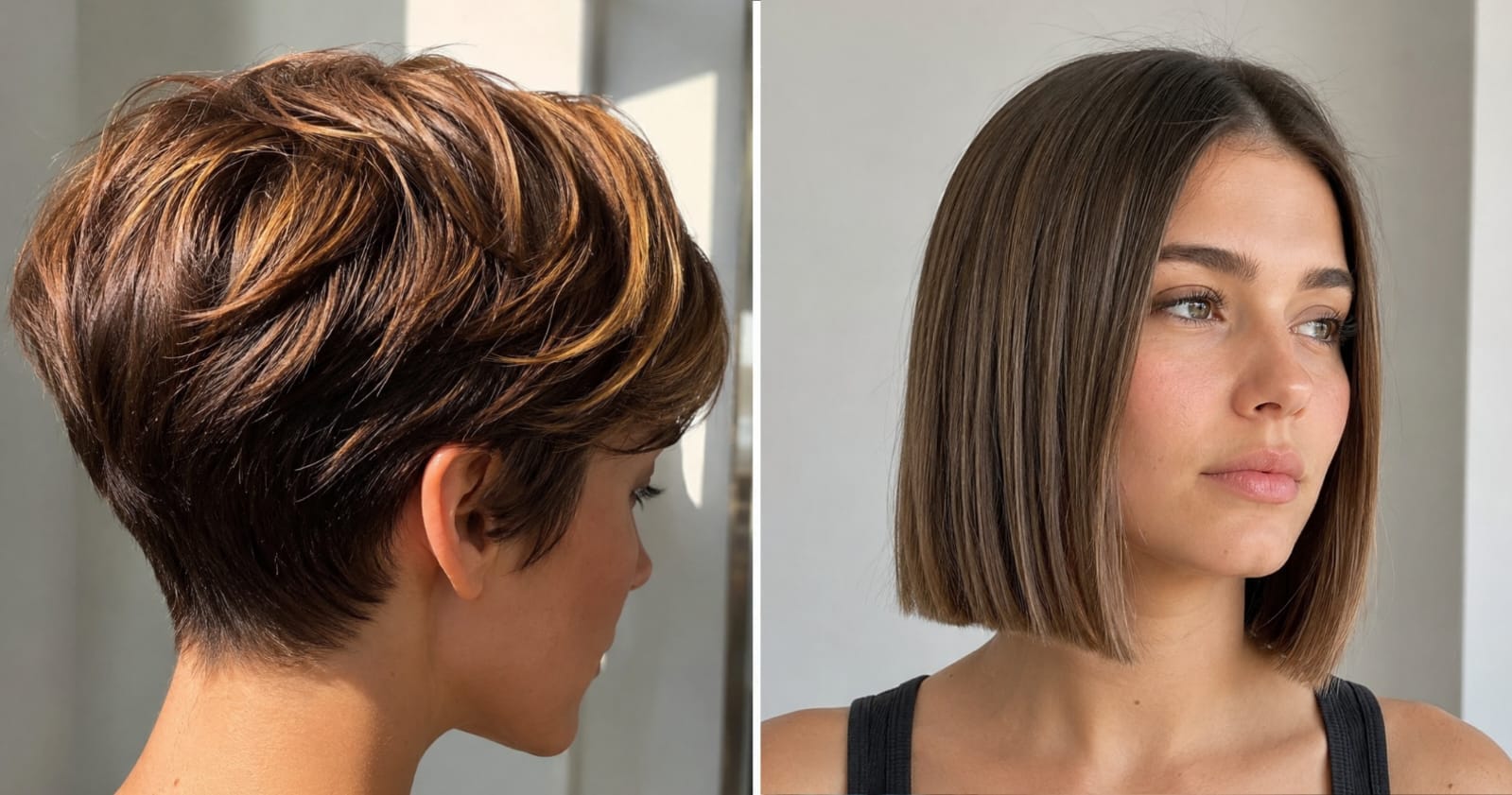
Most hairstyle guides show you pretty pictures and tell you what looks good. What they almost never explain is why a specific cut works on your particular face and hair — the structural reasons a style flatters or fights your features. That gap is exactly what gets people walking out of salons disappointed, holding a photo of someone else’s life on their phone. If you’ve ever chosen a hairstyle purely by trend and regretted it, this guide is written for you.
The unique angle here: choosing a hairstyle isn’t really about face shape alone or hair type alone — it’s about the interaction between the two. A bob that’s perfect for someone with a round face and thick hair becomes a triangle of volume for someone with a round face and fine hair. Most articles separate these two variables. This one connects them, because that’s where the real decisions happen.
Before you even open Pinterest, check out some starting points on the site — haircuts for round faces, low maintenance cuts for fine hair, and wolf cut hairstyles 2026 give a strong visual foundation. And if you’re working with thinning hair, hairstyles for thin fine hair over 60 is worth a look too.
Quick Takeaways
| If you have… | Focus on… |
|---|---|
| Fine or thin hair | Density-first thinking (items 3, 6, 9) |
| A round face | Length and vertical line strategies (items 2, 5) |
| Curly or wavy texture | Shrinkage factor and cut geometry (items 4, 7) |
| A busy lifestyle | Maintenance honesty (items 10, 11, 13) |
| Color-treated hair | Structural compatibility (items 8, 12) |
1. Learn the Difference Between Face Shape and Face Proportion

Before anything else, you need accurate information about your face — and face shape is only half the picture. Proportion matters just as much. A heart-shaped face on someone with a long neck and high forehead looks completely different than the same shape on someone with a shorter neck and closer-set features. Take a photo with your hair pulled back and look at two things: the outline of your face, and the distance from your hairline to chin relative to the width at your cheekbones.
How To Identify Your Face Shape and Proportion:
- Pull all hair back tightly and take a straight-on photo — no chin tilt.
- Trace your face outline with a finger on the screen — note where it’s widest.
- Compare forehead width to cheekbone width to jaw width.
- Measure (roughly) the length from hairline to chin against the widest point.
- Use these two pieces of data together — shape plus proportion — before reading any hairstyle recommendations.
Tip: I spent two years choosing hairstyles based on face shape charts alone and kept getting cuts that felt off. When I finally factored in my long forehead, everything clicked.
2. Understand What Your Hair Density Actually Does to a Cut

Density — how many strands per square inch — changes how any haircut behaves more than almost any other factor. Fine hair with high density can pull off blunt cuts beautifully. Fine hair with low density needs layers or it falls flat. Thick hair with high density builds width whether you want it or not. Most stylists ask about texture (straight, wavy, curly) but forget to discuss density explicitly, and that’s where mismatches happen.
How To Assess Your Hair Density:
- Take a one-inch section of hair at the crown and hold it between two fingers.
- If you can barely pinch it, density is low. If it feels like a thick rope, density is high.
- Now note if your strands themselves are fine (thin individual hairs) or coarse (thick individual hairs).
- Remember: fine strands and low density together means almost no volume without product. Coarse strands and high density means the opposite problem.
Tip: My stylist finally said “your density is doing the opposite of what that cut needs” and it explained three years of bad bobs..
3. Match Your Lifestyle to the Maintenance Level Before the Style

A haircut you love that you can’t maintain is a haircut you’ll hate by week three. Pixie cuts look incredible — they also require trims every 5-6 weeks or they lose their shape entirely. Balayage grows out beautifully; solid color at the roots shows in four weeks. Before you commit to a look, honestly calculate how much time you spend on your hair each morning and how often you’re willing to go to a salon. Short haircuts for women can be high or low maintenance depending on the specific cut — knowing the difference matters.
How To Evaluate Maintenance Honestly:
- Write down your current morning hair routine in minutes.
- Decide the maximum you’re willing to spend (be honest — not aspirational).
- Ask your stylist how often this cut needs trimming to stay intentional.
- Ask what happens if you go two extra weeks — does it fall apart or grow gracefully?
- Choose the cut that fits your real life, not your ideal one.
4. Know Your Hair’s Natural Movement Before Choosing Length

Your hair has a natural movement pattern — the direction it falls, any tendency to curl at the ends, whether it has a natural part — and that movement is amplified or suppressed at different lengths. Hair that has a slight wave might look straight at shoulder length but curl unpredictably at chin length, because shorter hair has less weight pulling the curl down. This is why the same cut behaves completely differently on two people with “wavy” hair.
How To Read Your Hair’s Natural Movement:
- Wash your hair and let it air dry with zero product.
- Watch where it falls naturally — note any bends, flips, or swirls.
- Pay attention to the ends: do they curve under, flip out, or curl?
- Consider how your current length affects this behavior.
- Ask yourself if a shorter or longer length would work with this movement or fight it.
Tip: My ends flip out at collar length and tuck under at shoulder length — knowing this let me finally choose lengths that cooperate.
5. Use the “Triangle Test” to Predict Volume Placement

Every haircut creates a silhouette that’s either wider at the top, wider at the bottom, or balanced. This matters enormously for face shape flattery. A round face generally needs volume at the crown and narrowness at the jaw. An oblong face needs the opposite. A square face needs softness at the jaw and nothing that adds angular width. The triangle test: sketch or visualize the triangle your hair creates — is the widest point where you want it?
How To Apply the Triangle Test:
- Find a photo of the haircut from the front.
- Trace the outline of the hair from crown to ends.
- Identify where the silhouette is widest.
- Compare that to where your face is widest.
- Choose cuts where the hair’s widest point is opposite to your face’s widest point.
Tip: This single visual test has saved me from more bad haircuts than any face-shape chart.
6. Understand How Bangs Change the Perceived Length of Your Face

Bangs aren’t just a style choice — they’re a proportion tool. Curtain bangs lengthen a round face by creating a vertical center part. Blunt bangs shorten a long face by visually cutting its length. Side-swept bangs soften angular jaw lines. The mistake most people make is choosing bangs based on whether they like them in a photo, without checking whether they need what that bang shape does to the face.
How To Choose the Right Bang for Your Face:
- Identify what you want to change about the perceived proportions of your face.
- Match that goal to bang shape: blunt = shorten/widen; curtain = lengthen/narrow; side-swept = soften angles.
- Consider your forehead height — very high foreheads can hide behind bangs; low foreheads struggle with them.
- Check your hair texture: blunt bangs on wavy hair require daily straightening.
- Ask your stylist to cut bangs slightly longer than intended — they always shrink when they dry.
Tip: I asked for curtain bangs and got blunt bangs by accident once — they completely killed the length my face needed. Always bring reference photos.
7. Look at Your Jawline Before Deciding on Bob Length

The most common bob mistake: choosing the length based on what looks good on the model, without checking where that length hits your jaw. A chin-length bob is one of the most flattering cuts available — but only if the cut ends at or below your jaw. If it hits mid-jaw on you, it creates a horizontal line right across the widest part of your face. The jaw-to-length relationship is specific to your proportions, not a standard measurement.
How To Find Your Bob Length:
- Tie your hair back and place a finger horizontally across your face at chin level.
- Move it slightly up and down to find where it hits your jaw bone.
- A bob that ends at the jawline = horizontal emphasis. Below = slimming. Above = angular.
- For round or square faces, aim for the cut to end just below the jaw.
- Bring this information to your consultation rather than just a length reference.
Tip: I learned this the hard way with a bob that sat perfectly mid-jaw and made my round face look wider than it ever has.
8. Factor In How Your Hair Behaves in Humidity

If you live anywhere with seasonal humidity, this changes your entire hairstyle decision. Layered cuts with lots of texture frizz in humidity unless they’re on curl-friendly hair. Smooth blunt cuts hold up better because there’s no internal layering to catch moisture and expand. Curly and wavy hair actually often looks better in humidity — but fine, straight hair with lots of layers can become a cloud. Ask yourself honestly: what does your hair look like in August, not in January?
How To Account for Humidity in Your Cut Choice:
- Think about your worst hair day — likely a humid day. What’s happening?
- If frizz is the issue, avoid heavy layering in the mid-lengths.
- If limpness is the issue, avoid blunt one-length cuts that remove volume.
- Prioritize cuts with shape that works with your hair’s humid behavior, not against it.
- Ask your stylist what cuts their clients with your hair type use in humid climates.
Tip: I switched to a lob with minimal internal layers after years of fighting summer frizziness — completely changed my relationship with warm weather.
9. Test Colors Before You Change Them — Even Subtly

Hair color changes the perceived shape of your head as dramatically as a cut does. Dark hair recedes visually; light hair advances. That means dark roots on a round face draw attention to the top third of your face and can make it look rounder. Highlights through the mid-lengths add brightness and width right where many faces need it least — or most. Before committing to any color, hold pieces of paper in the intended color next to your face in natural light to get a rough preview of the effect. Hair color ideas 2026 has strong reference points for current palettes.
How To Preview a Color Change:
- Buy a few sheets of colored paper closest to your target color.
- Hold them next to your face in natural outdoor light.
- Note how the color affects your skin tone — warmer or cooler?
- Check whether the placement would add width to problem areas.
- For major changes, ask for a partial application first to test before committing fully.
Tip: Warm golden highlights looked amazing on me in photos but completely washed out my complexion in person — the paper test would have caught this.
10. Consider Your Neck and Shoulder Line for Short Cuts

Short haircuts don’t just interact with your face — they expose your neck and shoulder line, which becomes part of the overall silhouette. A pixie cut on a very long, slender neck can look elegant and architectural. The same cut on a shorter neck can feel like it shortens the overall appearance. Nape shape matters too: a round nape works beautifully with tapered cuts; a flat nape benefits from more length kept at the back. Pixie cut hairstyles show a wide range of nape treatments worth studying.
How To Evaluate Your Neck and Nape for Short Cuts:
- Pull all hair up and look at your nape in a mirror — is it rounded, flat, or angular?
- Measure roughly how long your neck looks when hair is up.
- A shorter neck benefits from cuts that don’t taper too aggressively at the back.
- If you have broad shoulders, pixie cuts that are fuller at the crown balance the silhouette.
- Discuss nape shape explicitly with your stylist — most will appreciate the specificity.
Tip: Nobody told me to think about my nape before my first pixie cut. My stylist guessed correctly, but I wish I’d gone in with that knowledge myself.
11. Use the Weight Line Strategically for Fine or Thin Hair

Fine and thin hair needs help creating the illusion of density, and the primary tool is the weight line — the point in the cut where hair is left longest and bluntest, creating a visual edge that reads as thickness. Placing the weight line at the right spot makes hair appear fuller. Too many layers removed from fine hair reduces the weight line and leaves it looking wispy. The key is knowing where you want that solid edge to sit for both flattery and the illusion of body.
How To Work With the Weight Line:
- Ask your stylist where the weight line will fall in the cut they’re proposing.
- For fine hair, resist the temptation to add lots of layers — they remove the very density you need.
- A lob (long bob) with a strong weight line at the ends is one of the most flattering cuts for fine hair.
- If you want movement, ask for face-framing layers only — keep the weight at the bottom.
- Request texturizing at the ends only, not throughout the mid-section.
Tip: I spent years asking for layers to add volume and getting flatter hair each time. The weight line concept changed everything.
12. Don’t Ignore the Part Line — It Shifts Your Entire Silhouette

The part line is one of the most underestimated styling tools you have. A center part creates symmetry and works best on symmetrical faces — it highlights balance but also highlights asymmetry if you have it. A side part creates diagonal movement across the face and adds the appearance of width and lift on the side where the hair is swept over. A deep side part is particularly effective for round faces because it breaks up the circular outline and draws the eye diagonally. Changing your part costs nothing and can make an existing haircut feel completely new.
How To Find Your Best Part:
- Wet your hair and let it fall naturally — where does it naturally want to part? That’s often a strong option.
- Try a center part and assess: does it highlight features you love or ones you’d rather minimize?
- Try a deep side part and check the effect in three lighting conditions (bright, dim, natural).
- If your face is asymmetrical, part on the side that places your stronger features in front.
- Discuss part placement with your stylist before they cut — it affects where layers need to fall.
Tip: Shifting from a center part to a deep side part is the closest thing to a face lift I’ve found that doesn’t cost anything.
13. Know the Difference Between What Photographs Well and What Works in Real Life

Social media has made this problem worse. Certain haircuts look extraordinary in professional photos with perfect lighting and a talented photographer — and ordinary in bathroom mirror lighting. Blunt bobs photograph dramatically. Curtain bangs look effortless in photos taken at golden hour. Shaggy, textured cuts photograph as artful when styled — but in day-to-day life they require deliberate styling or they look undone in the wrong way. Choose a cut that you can actually reproduce in your own bathroom with your own time constraints.
How To Check Real-Life Wearability:
- Find candid photos of the style — not editorial shoots — ideally outdoors or in natural light.
- Look for “day two” or “day three” photos: how does this cut behave when it’s not freshly washed?
- Read comments or reviews on the style — real people share real maintenance realities.
- Ask your stylist to show you the style without extensive blow-drying or styling, so you see the base shape.
- Consider how much time you realistically have in the morning and work backward.
Tip: I got a shag cut that looked incredible in every photo and took me 45 minutes every single morning to make intentional-looking. Not sustainable.
14. Have a Real Conversation With Your Stylist — Bring Numbers, Not Just Photos

Photos give a stylist a direction. Specifics give them a target. Instead of handing over a photo and hoping for the best, come with measurements: “I want to keep it at least X inches long,” “I want to lose about two inches,” “I want layers starting from the chin, not above it.” The more concrete your language, the less room there is for interpretation gaps. A good stylist will push back if your request won’t work — that pushback is worth listening to.
How To Have a Productive Consultation:
- Bring two or three reference photos — not one. More photos show the range of what you like.
- Bring a “what I don’t want” photo too — negative examples narrow the target as much as positive ones.
- State any non-negotiables upfront: length minimums, no thinning shears, keep the weight line.
- Ask your stylist to explain what they’re going to do before they do it.
- Ask: “What happens to this cut as it grows out?” — the grow-out phase is part of the commitment.
Tip: “No shorter than my collarbone” saved me from a cut that would have ended up at my chin. Exact language matters.
15. Revisit Your Hairstyle Every Time Your Life Stage Changes

Hair that worked in your thirties may not serve your forties, and it’s not about looking “younger” — it’s about changing biology. Hair texture, density, growth rate, and how it reacts to products all shift over time. Many women notice hair getting finer or changing curl pattern after pregnancy, after menopause, or after periods of stress. That’s not a reason to grieve the old texture — it’s a reason to work with what your hair actually is now, not what it used to be.
How To Reassess Your Hairstyle for a Life Stage Change:
- Do the density test again (step two above) — has it changed?
- Air dry your hair and check the movement pattern — is it the same as it was two years ago?
- Take stock of your morning routine needs — have they changed with your life?
- Book a consultation rather than a cut — ask your stylist what they observe about your current hair health.
- Explore options before committing: hairstyles for thin fine hair over 60 and pixie haircuts for older women both show how to work with changed texture beautifully.
Tip: My hair went from medium density to quite fine over three years. The moment I stopped trying to style it as if it were still thick, I found cuts that actually worked.
Products and Tools: Protein-strengthening treatment, volumizing dry shampoo, lightweight styling cream.
Why the Face-Type Interaction Is the Missing Piece
Most hairstyle advice treats face shape and hair type as separate checklists. In reality, they operate as a system — and it’s the interaction between them that determines whether a cut flatters or frustrates you.
A round face with thick, coarse hair and a round face with fine, low-density hair have almost nothing in common from a styling standpoint, despite the same face shape category. The first person has a different problem (controlling volume and width) than the second (creating the illusion of volume and structure). Giving them the same advice — “avoid bobs that add width at the jaw” — helps one and harms the other.
The tips in this guide work because they push toward specificity: not “what face shape are you?” but “where is your face widest relative to your hair’s natural behavior?” Not “do you have fine hair?” but “what is your density doing to the cut’s weight line?”
When you choose a hairstyle using both axes together, the decision gets clearer. The cut either serves both needs simultaneously — or you identify a trade-off and choose which one matters more to you. Either way, you’re choosing with information rather than hope.
FAQ
Does face shape really determine what haircut suits me? Face shape is a useful starting point, but it’s not the whole answer. Hair density, texture, natural movement, and even your neck length all influence how a cut looks on you. Think of face shape as one variable in a larger equation.
What’s the most common mistake people make when choosing a new hairstyle? Choosing based on how a style looks on someone else without accounting for differences in hair density, face proportion, and morning styling time. A cut that’s low maintenance on thick, naturally wavy hair can be high maintenance on fine, straight hair.
How do I know if a cut will suit my fine hair? Look for cuts that preserve the weight line — a solid, visible edge where the hair ends. Avoid heavy internal layering throughout the mid-lengths, which removes weight fine hair can’t spare. Ask your stylist specifically where the weight line will fall.
Should I change my hairstyle as I get older? Not necessarily “change,” but reassess — yes. Hair texture and density do shift over time, and the cut that worked in your thirties may fight your hair’s current behavior rather than work with it. Updating your style to match current texture is practical, not vanity.
Can bangs suit every face shape? Different bang shapes suit different faces, but there’s a version of fringe that works for almost everyone. The key is matching bang function to face goal: blunt bangs shorten long faces; curtain bangs lengthen round faces; side-swept bangs soften angular features.
How often should I get my haircut? It depends entirely on the cut. A pixie needs trimming every 4-6 weeks to stay sharp. A lob or long style can go 8-12 weeks between trims. Ask your stylist at the appointment: “When does this cut start to lose its shape?”
Final Thoughts
The right hairstyle for you isn’t a style that looked good on a celebrity or trended on your feed — it’s the one that’s been designed with your actual face, actual hair, and actual lifestyle in mind. These fifteen approaches give you the framework to have that more specific, more honest conversation with yourself and your stylist. Browse related cuts on the site whenever you want to see these principles in action: short haircuts for women, layered bobs, and haircuts for fine hair are all strong next steps.

