Fine hair has a specific problem in professional settings that thicker hair doesn’t face: styles that look perfectly put-together at 8 AM often go flat, lose their shape, or start slipping by midday. This isn’t a product problem or a technique problem — it’s a structural one. Fine hair has a smaller diameter per strand, which means less friction between strands, less natural grip, and less ability to hold volume against gravity over time. Add a full workday of movement, humidity from air conditioning, and the weight of any product you’ve applied, and collapse is almost inevitable unless the style is designed to work with these limitations.
The hairstyles on this list are chosen specifically because they either don’t rely on volume to look polished (so there’s nothing to lose), use tension and anchoring to hold their shape structurally, or take advantage of fine hair’s natural smoothness as a feature rather than fighting it. Each one can be done in under 10 minutes and holds up through a full office day without needing a midday touch-up.
Why Fine Hair Struggles to Hold Office Hairstyles
Fine hair isn’t weak — it’s structurally different in three specific ways that affect how styles behave through a workday.
Lower strand-to-strand friction. Fine strands have a smoother cuticle surface than coarse or medium hair. That smoothness is why fine hair looks shiny — but it’s also why braids loosen, buns slip, and ponytails slide down over a few hours. There’s simply less grip between strands to keep anything anchored.
Volume collapses under its own weight. Fine hair can be lifted at the root, but each strand weighs so little that there’s minimal structural resistance to gravity. Any style that depends on volume to look polished loses that volume progressively. By midday, the shape is gone.
Oil travels faster down the shaft. Sebum migrates from the scalp down the hair shaft, and on fine hair it reaches the mid-lengths faster because there’s less hair mass slowing it down. This is why fine hair can look fresh at 8 AM and flat or stringy by early afternoon — it’s not excess oil production, it’s the speed of migration.
Every style on this list is chosen with at least one of these three factors in mind.
Quick Takeaways
- Best for back-to-back meetings where you need zero maintenance: #2, #5, #9, #13
- Best if your hair is fine AND short (chin to shoulder): #3, #6, #10, #14
- Best for fine hair that also gets oily by afternoon: #1, #7, #11, #15
- Best if you want to look styled without looking like you tried too hard: #4, #8, #12
1. Low Twisted Bun

This is one of the most reliable styles for fine hair in professional settings because it works with the hair’s natural smoothness rather than against it. A low bun sits at the nape of the neck, which means gravity is pulling the hair toward the anchor point, not away from it — so the style actually tightens slightly as the day goes on rather than loosening. Twist the hair before coiling it into the bun rather than simply gathering it; the twist adds internal tension that compensates for the lack of grip between fine strands. Secure with bobby pins inserted horizontally through the bun, not just around the outside. No volume required, no volume to lose.
2. Sleek Low Ponytail With a Wrapped Base

A ponytail on fine hair fails at the office for one specific reason: the elastic creates an indent and the tail itself goes limp. Fix both problems at once by wrapping a small section of hair around the elastic to hide it, then securing the wrapped piece with a single bobby pin underneath. This adds the visual impression of thickness at the base while the wrapped section acts as a brace that keeps the ponytail sitting higher on itself. Keep it sleek and close to the nape — a low ponytail on fine hair has more structural integrity than a mid-height one because the shorter lever arm means less weight pulling the style down. If oiliness is also a concern by afternoon, this pairs well with a light-hold wax applied just to the top layer before smoothing.
If you want a variation with more visual interest, check out these formal hairstyles for medium hair that use similar low-anchoring principles.
3. French Tuck Braid Into a Bun

A French braid’s mechanics make it particularly well-suited to fine hair: as you braid, you’re pulling sections of hair from the scalp outward and locking them in place with each cross. This distributes tension evenly across the whole head rather than concentrating it at one elastic point — which is why French braids on fine hair stay neat for hours when a simple ponytail wouldn’t. Stop the braid at the nape and coil the remaining length into a small bun, securing with pins. The result is a style that has multiple structural anchor points along the entire length of your head rather than one, which is why it outlasts most other options for fine hair on long workdays. Works particularly well on hair that’s at least chin-length.
4. Side-Parted Blowout (No Curl, Just Volume at the Root)

This one works differently from the rest of the list — it’s a wear-down style, which means it needs to hold shape without any pins or elastics. The key for fine hair is that you’re not trying to create volume along the length of the hair (it won’t hold), only at the root. Apply a volumizing mousse from root to mid-length only, then blow dry sections upward at the root using a round brush, and finish with the dryer pointed downward along the length to smooth it. This gives you lift where it’s structurally supported by the scalp and smoothness where the hair’s natural fineness actually looks like a feature. Avoid touching the roots after drying — the oils from your hands will collapse root lift within the hour.
5. Pinned Half-Up With a Flat Twist

The half-up is a reliable office style on fine hair because it addresses the main failure point of wear-down styles: the framing pieces around your face go flat and stringy first. Pulling the top section back removes that problem entirely. A flat twist — where you twist two sections of hair over each other while picking up new hair from the sides, similar to a French braid but with two strands instead of three — creates a neat, textured panel across the crown that lies flat without adding bulk. Pin the end of the twist behind the ear or at the back of the crown with a single bobby pin. The flat twist holds its form because it’s lying against the scalp with consistent tension, not floating in the air where fine hair loses structure.
6. Textured Bob Styling (For Short Fine Hair)

If your hair is short — chin to shoulder — a smooth, styled bob actually performs better on fine hair in professional settings than most updos, because there’s less length to go limp. The technique that matters: after blow drying, use a flat iron not to straighten but to add a very slight bend (about 20 degrees inward) at the ends only. This gives the tips enough direction to look intentional throughout the day. Fine hair responds to flat iron work more precisely than thicker hair because each strand heats through faster and holds the shape more cleanly. Finish with a tiny amount of lightweight serum on the outside layer only — not to add shine but to prevent the static that makes fine hair look disheveled by afternoon.
For more short hair ideas that maintain their shape, see bob haircuts for fine hair and low maintenance haircuts for fine hair.
7. Chignon With a Sock or Donut Form

Fine hair chignons collapse when the bun runs out of mass to hold itself together — which happens fast when you don’t have much hair to work with. A foam donut or sock bun form solves this mechanically: the form provides the structure and the hair just wraps around it, meaning the chignon’s shape isn’t dependent on hair volume at all. Wrap your hair smoothly over the form and tuck the ends underneath, securing with pins. The result looks as full as someone with twice the hair density because the shape comes from the form, not the hair. This is also one of the most appropriate styles for client-facing office environments because it reads as deliberately styled rather than casually pulled back.
8. Straight Center Part, Hair Down

This only works for fine hair if you understand what it’s actually asking of your hair: nothing structural, just smoothness. Fine hair is naturally better at lying flat and reflecting light than coarse hair, and a straight center part with hair worn smooth plays directly to that. The professional risk with fine hair worn down is that it starts to separate and look stringy as the day goes on. Prevent this by applying a light leave-in conditioner to damp hair before drying, which binds the strands slightly and prevents the separation that causes the stringy look. Keep the length at or below the collarbone — the shorter the length, the less the weight works against you. This style also reads differently depending on context; for settings where you want a polished but approachable look, it’s one of the cleanest options on this list.
9. Low Side Braid

A side braid sits along the shoulder and front of the body rather than hanging down the back, which changes the structural equation for fine hair considerably. When a braid hangs behind you, movement and gravity gradually loosen the sections from the bottom up. When it lies forward over one shoulder, the braid is resting on a surface (your chest or shoulder) that limits how much each section can shift. Fine hair benefits from this more than thick hair because the strands have less friction holding the braid tight on their own. Braid it loosely rather than tightly — fine hair braided too tightly looks thin and stringy. A slightly relaxed braid on fine hair actually looks more deliberate and effortless than an overworked tight one.
10. Sleek Bun With a Claw Clip (Structured, Not Casual)

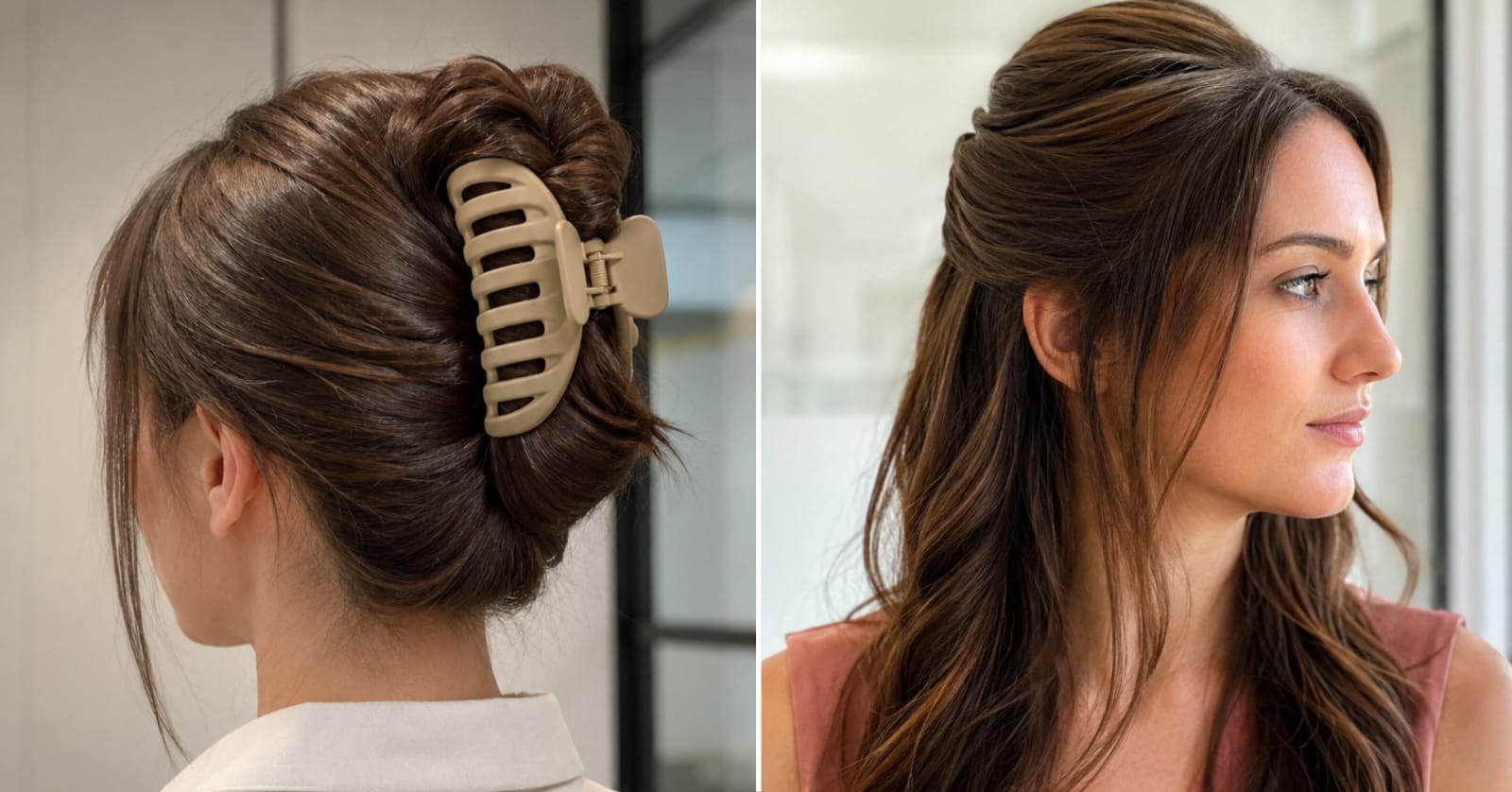
Claw clips have a reputation as a casual style, but on fine hair they’re one of the most structurally sound office options because of how they distribute grip. A hair elastic concentrates all the tension at one ring around the ponytail, which is exactly where fine hair is weakest (the compression point). A claw clip grips along a wider surface area and from multiple angles at once, which spreads the load. The key to making it look professional rather than hasty is to twist the hair into a low knot before clipping rather than just clipping a gathered handful. Smooth the top layer before twisting and make sure no sections are falling loose. A large clip in a neutral color (black, tortoise, or dark brown) reads as intentional; a small or brightly colored one reads as an afterthought.
11. Top Knot on Fine Hair (Done Correctly)

The top knot fails on fine hair for a specific reason: people try to make it large and it immediately collapses because there isn’t enough hair mass to fill the shape. The fix is to accept a smaller knot and make it intentionally tight and neat rather than trying to create a voluminous shape. Gather all the hair to the crown, twist it tightly, and coil it into the smallest, neatest knot you can. Secure with pins pushed through the knot horizontally. The tighter and more structured the knot, the more professional it looks on fine hair — a large, loose top knot reads as casual; a small, sculptural one reads as intentional. Use a tiny amount of edge control or light-hold gel on the hairline before pulling it up to keep the framing smooth throughout the day.
12. Pinned-Back Curtain Bangs

If you have curtain bangs (or are considering them — they work particularly well on fine hair because they frame the face without adding mass), office styling is about pinning them back during the busiest part of the day without it looking like an afterthought. The technique is to twist each side of the bangs back and pin them flat against the head using a bobby pin pushed downward into the hair so the pin is hidden underneath. This creates a half-back look that keeps fine hair out of your face during focused work without losing the softness of the framing style. It’s also reversible — unpin the bangs at lunch if you have client meetings in the afternoon. Curtain bangs on fine hair fall beautifully when they’re down because the hair’s natural smoothness gives them a clean, swept shape.
If you’re thinking about a cut that works with this styling approach, haircuts for fine hair covers the structural cuts that make daily styling easier.
13. Low Braided Bun

This is the combination style that solves the two main fine-hair office problems at once — lack of volume and lack of hold. Braid the hair first (one three-strand braid from the nape), then coil the braid into a bun and pin it. The braid creates texture and body that raw fine hair doesn’t have on its own, so the resulting bun looks fuller than it would if you’d simply coiled unbraided hair. The braid also gives the bobby pins something to grip against — the interlocked sections of a braid provide more surface friction than smooth fine hair — so the bun holds throughout the day rather than gradually sliding. This is a particularly good option on days when hair is clean and slippery (which is when fine hair holds styles the least).
14. The Twisted Half-Up Ponytail

Take the top third of your hair, split it into two sections, twist each section toward the center, then join them into a low ponytail at the back of the crown. The two twists add tension and visual texture to the top of the head without requiring volume, and they work as anchoring points that hold the ponytail from sliding down throughout the day. On fine hair, this style works better than a straight half-up because the twists distribute the pulling tension across a wider section of the scalp — rather than one elastic pulling on a thin section of hair, you have two twisted panels holding the style from multiple angles. Keep the ponytail itself short if your hair allows; a shorter tail has less weight working against the elastic.
Also worth exploring: half up half down hairstyles for variations on this structure.
15. Smooth Low Pigtail Buns

Two buns instead of one isn’t just a style choice for fine hair — it’s a structural strategy. When you split the hair into two sections, each bun contains half the hair mass, which means each bun has half the weight to hold up. Fine hair that can’t form one polished bun at the nape often holds two smaller ones effortlessly, because the reduced mass per anchor point means each section requires less grip to stay in place. Keep both buns low (at or below ear level) and smooth, without pulling them loose or piecey. The style looks professional when the buns are neat and symmetrical; it reads as casual when they’re voluminous or textured. Secure each bun with two or three pins rather than one, and make sure the section of hair on the scalp between the two buns is perfectly smooth before you secure.
FAQ
How do I know if volume collapse or oil production is the main reason my office hairstyle fails?
Test it on a freshly washed, product-free day. If the style collapses within two hours even when your hair is clean, the problem is structural — fine strands simply can’t hold the shape you’re asking for. If the style holds well in the morning but becomes flat and stringy specifically in the afternoon, oil production from your scalp is the likely cause, not the style itself. These require different fixes: structural collapse means choosing styles from this list that don’t depend on volume (#1, #2, #7, #13); oil-related afternoon collapse means adding a dry shampoo at the roots before styling (not after), which creates a barrier that slows oil migration down the hair shaft.
Why do bobby pins stop holding in fine hair by the end of the day?
Bobby pins lose grip in fine hair when they’re inserted parallel to the hair shaft — the smooth strands just slide through the pin as the day goes on. Insert pins at a slight angle to the direction of the hair (crossing the grain rather than running with it), and open-side down rather than open-side up, so the ridged side grips against the hair. For styles that need stronger hold, criss-cross two pins over each other in an X formation — the intersection creates a locking point that resists sliding far better than a single pin can. If you’re still having problems, lightly mist the pin itself with hairspray before inserting; the tackiness gives it something to grip.
Does fine hair actually benefit from using less product, not more?
Yes, for most styles. Fine hair gets weighed down by product faster than coarser textures because each strand has less mass to absorb and carry product weight. A product that adds 0.1 grams of weight to a coarse strand barely affects it; the same amount on a fine strand can visibly change how it falls. The exception is at the root — volumizing mousse applied to the root only (not the length) can increase friction between fine strands and the scalp, which helps styles hold longer without adding weight to the length. When in doubt, use less product than you think you need and concentrate it where gravity is working hardest against you: the root area.
Final Thoughts
Every style on this list works specifically because it either removes the need for volume, uses structure and tension to hold shape, or takes advantage of what fine hair actually does well — lying smooth and reflecting light cleanly. The consistent failure mode for fine hair in office settings is choosing a style that looks great with thick hair and hoping it translates. It usually doesn’t, not because of how you’re styling but because the style itself assumes a hair property you don’t have. Work with your hair’s actual behavior and most of these will hold reliably from morning through your last meeting.
If you want to explore cuts that make daily styling significantly easier, haircuts for fine hair and low maintenance haircuts for fine hair are both worth browsing. And if you’re looking for something more elevated for a formal office event, formal hairstyles for medium hair and cute updo hairstyles have options that follow the same structural logic.

