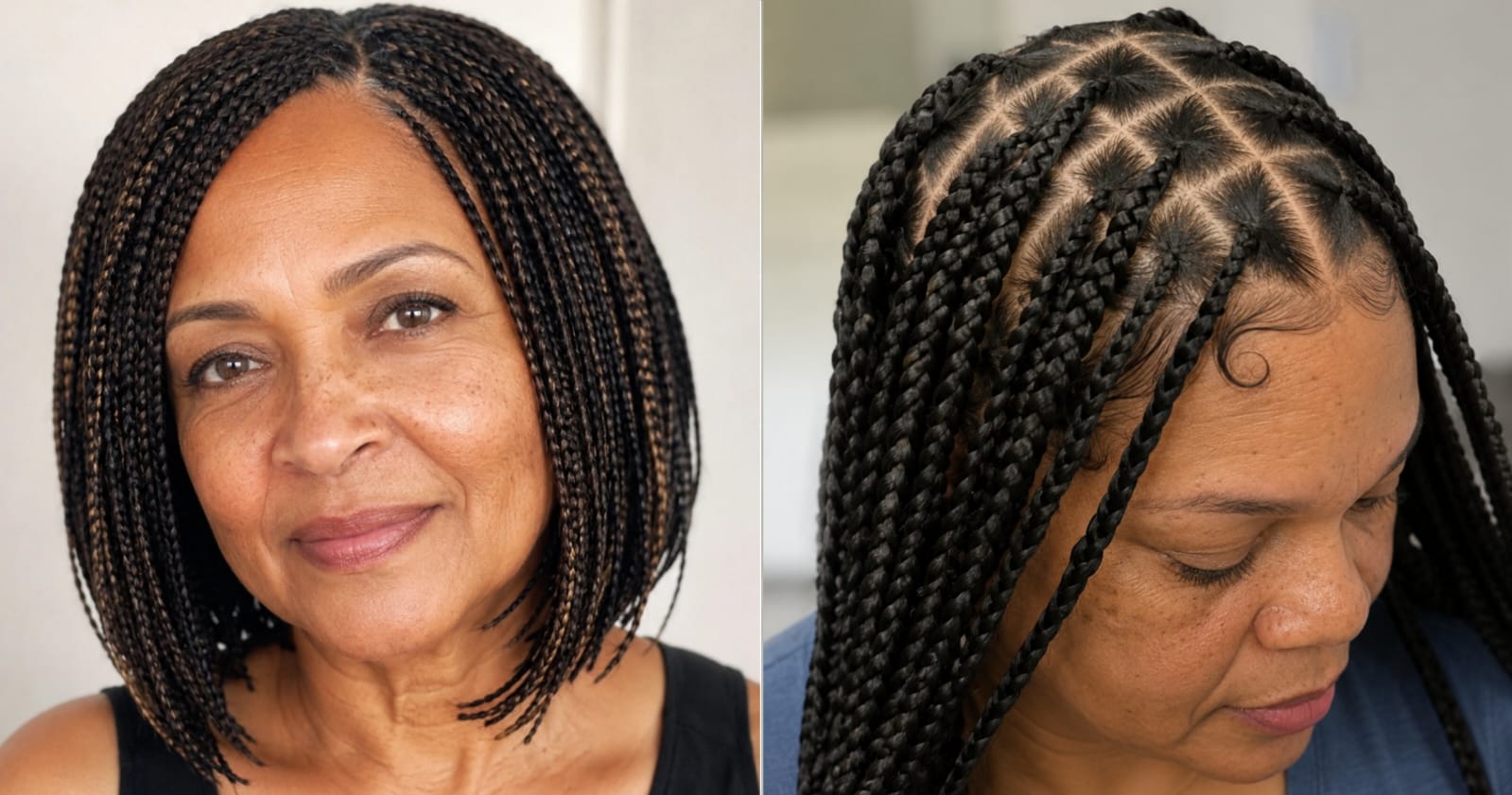
Protective braids don’t have an age limit — that’s a myth worth setting aside before you scroll any further. Somewhere along the way, a quiet assumption crept in that braids belong to younger women, and that choosing them past 50 means you’re reaching for something that isn’t yours. It’s not true, and it never was.
For Black women especially, braids are a legacy style. They protect your hair, reduce daily manipulation, and give your strands a real chance to retain length and moisture — benefits that only become more valuable as your hair’s texture and needs evolve over the years. The 16 styles below are chosen specifically with that in mind: manageable tension, realistic install times, and looks that feel intentional rather than like an afterthought. If you’re also weighing shorter options alongside braids, the roundup of short hairstyles for Black women is worth a look too.
1. Classic Box Braids (Shoulder Length)

A 61-year-old client — natural hair, some crown thinning — was convinced box braids would look “too young” on her. Medium thickness, shoulder length, deep side part. She cried in the chair. Not because it looked young. Because it looked her.
For mature hair, medium to thick braids are the move. Fine micro braids stress older hairlines. Shoulder length keeps weight manageable and tension minimal.
- Face shape: Oval, round, heart
- Hair texture: 4A–4C
- Maintenance level: Medium
- Touch-up: Every 6–8 weeks
- Styling difficulty: Easy
- Cost range: $150–$250
- Installation time: 4–6 hours
- Best hair density: Medium to thick
- Thinning edges: Okay if braider uses light tension
- Weight: Medium
- Daily maintenance: Spray scalp with diluted jojoba oil every 2–3 days. Satin bonnet every night.
2. Knotless Box Braids

The myth: knotless braids are a trend for younger women. The truth: they’re genuinely better for scalp health at any age. Traditional box braids create immediate tension at the knot. Knotless braids feed hair in gradually, distributing tension across the length. According to Healthline, excessive tension on hair follicles is a leading cause of traction alopecia — a condition that hits harder on follicles that have already weakened with age. I switched most of my clients over 50 to knotless. Their edges at takedown looked noticeably healthier every time.
- Face shape: All face shapes
- Hair texture: 3C–4C
- Maintenance level: Medium
- Touch-up: Every 6–8 weeks
- Styling difficulty: Easy
- Cost range: $180–$300
- Installation time: 5–7 hours
- Best hair density: Works on all densities
- Thinning edges: Yes — one of the best options
- Weight: Medium (lighter than traditional box braids)
- Daily maintenance: Light scalp oil every few days. Silk scarf or bonnet at night. Avoid heavy edge control — it builds up fast.
3. Cornrow Updo

Before: Mid-60s client, thinning edges, three years in wigs, convinced she’d aged out of braids. After: flat cornrows along the sides feeding into a gathered bun at the nape. No extensions — just her own hair. She sent a photo from her granddaughter’s wedding two weeks later. She was the best-dressed woman in the room.
Cornrow updos are one of the lightest, lowest-tension options available. No extension weight pulling on the scalp at all.
- Face shape: Oval, long
- Hair texture: 4A–4C
- Maintenance level: Low
- Touch-up: Every 4–6 weeks
- Styling difficulty: Medium
- Cost range: $80–$180
- Installation time: 2–3 hours
- Best hair density: Works on thin to medium density
- Thinning edges: Yes — excellent choice
- Weight: Light
- Daily maintenance: Moisturize scalp at the parts twice a week. Re-wrap with a satin scarf nightly to keep edges smooth.
4. Senegalese Twists

The myth: twists are too casual for formal occasions. False. I’ve watched clients in Senegalese twists outshine everyone at rehearsal dinners, milestone birthdays, and job interviews. The key is fiber quality — silky Kanekalon gives that sleek, polished finish. On women over 50, warm brown or subtly highlighted tones look rich without being loud.
- Face shape: Oval, heart, square
- Hair texture: 3C–4C
- Maintenance level: Low-Medium
- Touch-up: Every 8 weeks
- Styling difficulty: Easy
- Cost range: $150–$250
- Installation time: 4–6 hours
- Best hair density: Medium to thick
- Thinning edges: Okay with loose root tension
- Weight: Medium
- Daily maintenance: Hot water seal on ends lasts longer than burnt ends. Refresh scalp with a light oil spray. Bonnet every night — twists frizz fast without one.
5. Passion Twists

Passion twists look effortless — loose, wavy, bohemian. But here’s what I tell every client before installation: effortless-looking doesn’t mean tension-free. Make sure your braider isn’t pulling tight at the root just because the finished style looks relaxed. The install tension still matters. Loose roots, moisture before installation, satin bonnet every night — those three things keep your scalp happy for the full six to eight weeks.
- Face shape: Round, oval, heart
- Hair texture: 3C–4C
- Maintenance level: Medium
- Touch-up: Every 6–8 weeks
- Styling difficulty: Easy
- Cost range: $150–$220
- Installation time: 4–5 hours
- Best hair density: Medium density works best
- Thinning edges: Moderate — avoid if edges are very fragile
- Weight: Light to Medium
- Daily maintenance: Finger-detangle gently at ends if frizzing. Light oil on scalp every 3 days. Never sleep without a bonnet — wavy texture mats overnight.
6. Feed-In Braids (Jumbo)

I’ve noticed over the years that clients who come back with the healthiest hairlines after protective styles are almost always the ones who got feed-ins. A 55-year-old client with significant front hairline thinning from years of tight styles thought she was done with braids for good. Jumbo feed-ins, loose at the root, scalp moisturized before installation. Six weeks later at takedown, she said her hairline looked better than it had in years. That’s just better technique doing its job.
- Face shape: All face shapes
- Hair texture: 4A–4C
- Maintenance level: Low
- Touch-up: Every 4–6 weeks
- Styling difficulty: Medium
- Cost range: $100–$180
- Installation time: 3–4 hours
- Best hair density: All densities, including thin
- Thinning edges: Yes — one of the safest options available
- Weight: Light to Medium
- Daily maintenance: Scalp spray at the parts every 2–3 days. Satin bonnet required. Avoid pulling braids into tight ponytails — defeats the whole point.
7. Lemonade Braids (Side-Swept)

Before: Late-50s client, Pinterest photo of classic lemonade braids, thinning temples. The standard starting point for this style would have put direct tension right on her most fragile area. After: same silhouette, partings started a half inch further back, angled to avoid her temples entirely. Same side-swept drama, zero edge stress. You’d never know we adjusted anything. That’s the whole point of experience — knowing when to modify.
- Face shape: Oval, heart
- Hair texture: 4A–4C
- Maintenance level: Medium
- Touch-up: Every 4–6 weeks
- Styling difficulty: Medium
- Cost range: $120–$200
- Installation time: 3–5 hours
- Best hair density: Medium to thick
- Thinning edges: Only with a skilled braider who adjusts the parting
- Weight: Medium
- Daily maintenance: Sleep on a satin pillowcase or bonnet — the side-swept pattern shifts overnight otherwise. Light oil on scalp twice a week.
8. Ghana Braids (Straight Back)

Before you sit down for Ghana braids, tell your braider two things: medium tension at the root, and no yanking at the nape. I’ve seen clients walk out with tension headaches that lasted two days because the braider rushed the first section. Ghana braids — raised, sculptural cornrows running straight back — are one of the boldest styles I offer. Byrdie notes they’re among the oldest braiding techniques originating from West Africa . They look powerful and intentional on women at any age. Just advocate for yourself in that chair.
- Face shape: Oval, long, square
- Hair texture: 4A–4C
- Maintenance level: Low
- Touch-up: Every 4–6 weeks
- Styling difficulty: Hard
- Cost range: $100–$160
- Installation time: 2–4 hours
- Best hair density: Medium to thick
- Thinning edges: Proceed carefully — temple area needs special attention
- Weight: Light
- Daily maintenance: Scalp oil at the parts every few days. Wrap with a satin scarf at night to keep the raised braids from flattening.
9. Braided Bob

The easiest way to get a protective style that’s chic and genuinely manageable: go shorter. A braided bob removes every problem that comes with longer styles — no weight on the scalp, no extensions dragging on the hairline, no awkward sleeping situation. Ask your braider to cut the ends after installation for a blunt, clean finish. That one step makes the whole look sharper and more intentional.
- Face shape: Oval, heart, square
- Hair texture: 3C–4C
- Maintenance level: Low
- Touch-up: Every 6–8 weeks
- Styling difficulty: Easy
- Cost range: $120–$200
- Installation time: 3–4 hours
- Best hair density: All densities
- Thinning edges: Yes — shorter length means less tension on the hairline
- Weight: Light
- Daily maintenance: Virtually none. Light scalp oil twice a week. Bonnet at night. This is genuinely the lowest-maintenance option on this list.
10. Goddess Braids

I’ve done goddess braids on women from 45 to 71 and the mirror moment is always the same — shoulders back, chin up. Not younger-looking. Just settled. Goddess braids are oversized raised cornrows, usually two to six running across the scalp, sometimes with loose curly ends. They’re low-tension by nature because thick braids mean fewer anchor points and less cumulative scalp stress. For women who want something striking without a complex upkeep routine, this is the one I reach for first.
- Face shape: All face shapes
- Hair texture: 4A–4C
- Maintenance level: Low
- Touch-up: Every 3–4 weeks
- Styling difficulty: Easy to Medium
- Cost range: $80–$150
- Installation time: 2–3 hours
- Best hair density: Medium to thick
- Thinning edges: Yes — thick braids distribute tension well
- Weight: Light to Medium
- Daily maintenance: Scalp oil at the parts every 2–3 days. Re-wrap at night. Shorter refresh cycle means this needs rebooking sooner than most styles.
11. Fulani Braids

The myth: accessories — beads, gold cuffs, cowrie shells — are for younger women. Completely false. Adornment has no expiration date. Fulani braids, rooted in West African Fula tradition, feature a center braid, side braids, and decorative details that make them one of the most personally expressive styles in braiding. When I add thin gold cuffs to a client’s Fulani braids, she doesn’t look like she’s trying to be younger. She looks like a woman who knows her own style. There’s a big difference. Wear the cuffs.
- Face shape: Oval, heart
- Hair texture: 4A–4C
- Maintenance level: Medium
- Touch-up: Every 6–8 weeks
- Styling difficulty: Hard
- Cost range: $160–$280
- Installation time: 5–7 hours
- Best hair density: Medium to thick
- Thinning edges: Moderate — center part can stress hairline if too tight
- Weight: Medium
- Daily maintenance: Keep accessories secure by tightening cuffs gently if they loosen. Light oil on scalp. Bonnet that’s roomy enough not to flatten the center braid pattern.
12. Micro Braids (With Caution)

Micro braids are beautiful and I’ll still do them — but here’s exactly what I say before we start: if you have any hairline thinning, any traction history, or any scalp sensitivity, we’re going medium-micro at the absolute smallest. Not super fine. And if your braider is yanking at the root, you speak up or you leave. The American Academy of Dermatology is clear that repeated follicle tension can cause permanent hair loss over time. Permanent. No style is worth that. Go in with clear boundaries.
- Face shape: All
- Hair texture: 3C–4C
- Maintenance level: High
- Touch-up: Every 4–6 weeks
- Styling difficulty: Easy once installed
- Cost range: $200–$400
- Installation time: 8–12 hours
- Best hair density: Thick density only
- Thinning edges: No — not recommended
- Weight: Light (but high anchor-point tension)
- Daily maintenance: Daily scalp moisturizing is non-negotiable — tiny braids dry out fast. Bonnet every night. Check edges weekly for stress signs.
13. Stitch Braids

If you want a protective style that needs zero daily effort and still looks sharp at week three, stitch braids are worth knowing about. The horizontal stitch effect between cornrows lies flat, stays cleaner longer, and requires no product between appointments. Wash routine while installed: diluted shampoo in an applicator bottle, applied directly to the scalp, rinse, dry. That’s the entire routine. For women who want their hair to work with their schedule instead of against it, these make complete sense.
- Face shape: Oval, round
- Hair texture: 4A–4C
- Maintenance level: Low
- Touch-up: Every 4–6 weeks
- Styling difficulty: Hard
- Cost range: $120–$200
- Installation time: 3–5 hours
- Best hair density: Medium to thick
- Thinning edges: Okay — flat technique is relatively gentle
- Weight: Light
- Daily maintenance: Almost none. Scalp oil at parts twice a week. The geometric pattern holds its shape well — just protect with a satin wrap at night.
14. Triangle Box Braids

Before: A client, 54, two years of classic box braids, ready for something that felt more current without being a dramatic change. After: same medium thickness, same shoulder length, same protection — but triangular partings instead of square. Completely different visual texture. More modern, more geometric, more interesting in photos. She said, “It’s the same but it’s not the same at all.” Sometimes the smallest technical adjustment is all it takes to fall back in love with a style.
- Face shape: Oval, heart, long
- Hair texture: 4A–4C
- Maintenance level: Medium
- Touch-up: Every 6–8 weeks
- Styling difficulty: Medium
- Cost range: $160–$260
- Installation time: 5–7 hours
- Best hair density: Medium to thick
- Thinning edges: Okay with light tension
- Weight: Medium
- Daily maintenance: Same as classic box braids. Scalp oil every 2–3 days. Bonnet nightly. The triangular parts can open slightly over time — a light edge gel keeps them neat.
15. Crown Braid / Halo Braid

In ten-plus years I’ve noticed that the styles producing the biggest emotional reactions aren’t always the most complex. The crown braid consistently delivers the most powerful mirror moments in my salon. Women from 45 to 72 — every single one: shoulders back, chin up, something quiet and certain settles in. It’s not about looking younger. It’s recognition. A truly well-suited hairstyle stops lying and starts reflecting.
- Face shape: All — genuinely universal
- Hair texture: 3C–4C
- Maintenance level: Low
- Touch-up: Occasion-based, not regular
- Styling difficulty: Hard
- Cost range: $100–$180
- Installation time: 2–3 hours
- Best hair density: Medium to thick for fullest effect
- Thinning edges: Yes — halo placement avoids direct hairline tension
- Weight: Light
- Daily maintenance: Minimal — this is an event style. Pin any loose sections before bed if wearing overnight. Re-wrap with a satin scarf to preserve the shape.
16. Braided Updo with Curly or Wavy Ends

For women who love protection but feel like fully braided styles look too severe: don’t go fully braided. Leave the ends loose. Neat braids at the root handle the protective work; loose wavy ends soften the whole look and frame the face. I use water wave extension hair for the ends — it moves naturally, doesn’t look synthetic, and photographs beautifully. Half-up, full updo, low bun with a few loose pieces — all three work. All three look intentional.
- Face shape: All face shapes
- Hair texture: 3C–4C
- Maintenance level: Medium
- Touch-up: Every 6–8 weeks
- Styling difficulty: Medium
- Cost range: $160–$280
- Installation time: 4–6 hours
- Best hair density: Medium to thick
- Thinning edges: Yes — updo placement keeps tension away from the hairline
- Weight: Medium
- Daily maintenance: Refresh wavy ends with a light water-based curl spray every 2–3 days. Pin the updo loosely at night rather than leaving it fully down. Bonnet every night without exception.
Scalp Care While in Braids (Especially Over 50)
Moisturize your scalp two to three times a week — diluted jojoba oil in a small spray bottle, applied directly through the parts. Satin or silk bonnet every single night. Byrdie reports that satin bonnets significantly reduce overnight friction, which contributes to breakage and moisture loss — friction that does more damage as hair naturally loses density with age.
Eight weeks maximum, no matter how good they look at week nine. I know the temptation. I’ve seen what twelve-week-old braids do to a hairline. It’s not worth it.
FAQ
Can older Black women with thinning edges still wear braids? Yes — but technique is everything. Knotless braids, feed-in braids, cornrow updos, and goddess braids are all low-tension options that work well around fragile hairlines. Tell your braider exactly where your edges are sensitive before installation starts.
How long do braided styles typically last for women over 50? Six to eight weeks with proper care. Don’t push past eight — your natural hair needs to breathe, be moisturized, and be checked for breakage regularly.
Are knotless braids actually better than traditional box braids for mature hair? In my experience, yes. The gradual feed-in technique puts significantly less tension on the scalp and hairline. For anyone with traction history or scalp sensitivity, knotless is my default recommendation.
What’s the best daily care routine while braids are in? Scalp oil or spray two to three times a week. Satin bonnet every night. No heavy products directly on the braids — buildup makes takedown harder and damages your natural hair underneath.
Braids at any age are a statement — not of youth, but of self-possession. The women who sit in my chair at 55, 62, 68 aren’t chasing something they’ve lost. They’re wearing something they’ve earned.
Book the appointment. Bring your photos. Have an honest conversation with your braider about where your hair is right now. The right style won’t just protect your hair — it’ll remind you exactly who you are when you look in the mirror.
And that’s always worth sitting in the chair for.

