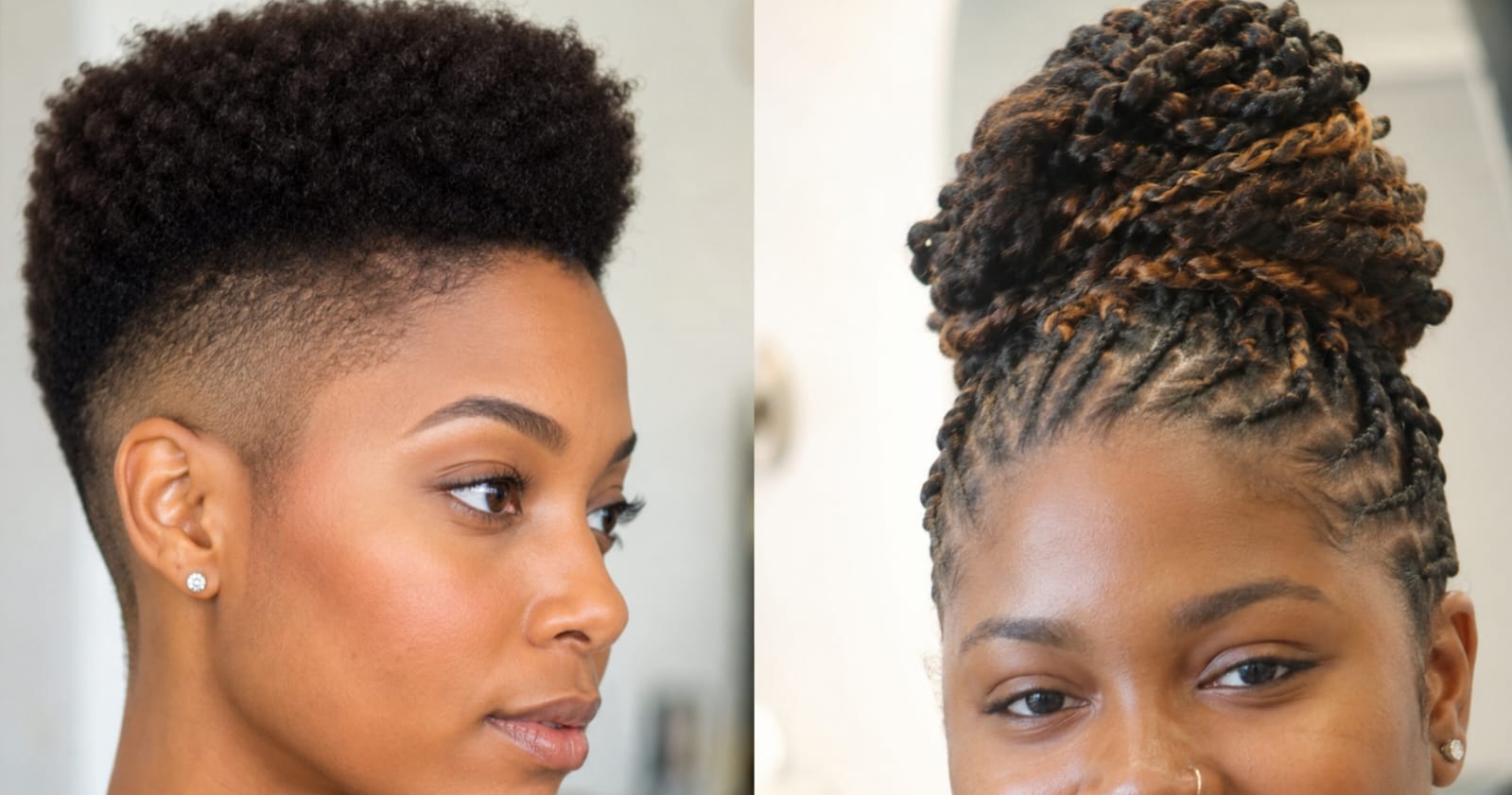
Most “short natural hairstyle” roundups are written by people who have never had to detangle 4c hair before 7am on a workday. That’s the gap this list tries to close. Every style below gets evaluated not just on how it photographs, but on what it actually takes to maintain — wash day time, product cost, how it holds up under a bonnet, and how forgiving it is if you mess up week one. If you’ve ever loved a style in a photo and then hated it by day three, that’s usually a maintenance mismatch, not a “your hair doesn’t do that” problem. Knowing which short natural styles are low-effort versus deceptively high-effort is the actual unlock here, and it’s the angle most lists skip entirely.
Before diving in, it helps to have a sense of where you’re starting from. If your hair is still growing out from a recent chop, a piece on the grown-out pixie cut phase might be useful context. If you’re choosing natural styles specifically because you want something with less daily upkeep, our low-maintenance haircuts for fine hair piece covers some adjacent logic, even though it’s written for a different hair type. And if face shape is a bigger factor for you than texture, short haircuts for women with a round face is worth a look before you commit to a cut.
Quick Takeaways
| Style | Maintenance Level | Best Hair Type |
|---|---|---|
| TWA | Low | 4a–4c |
| Wash and Go (short) | Medium-High | 3c–4a |
| Finger Coils | Medium | 4a–4c |
| Tapered Cut | Low-Medium | All natural types |
| Mini Twist Out | Medium | 3c–4b |
1. The Classic TWA (Teeny Weeny Afro)

The TWA gets treated like a “starter style,” but it’s actually one of the more demanding short cuts to keep looking intentional rather than just short. The appeal is real — it puts your face shape and features front and center, and it works on basically every natural hair type from 3c to 4c. What most people don’t realize is that a TWA needs shape maintenance every 2-3 weeks even though there’s barely any length to cut; without that, it grows out unevenly and starts looking patchy rather than full. It suits round, oval, and heart-shaped faces especially well, since the close crop draws attention upward to cheekbones and eyes.
How To Style:
- Apply a curl cream to damp hair, working from scalp to ends.
- Use a pick to lift roots gently for volume.
- Define curls with fingers rather than a brush to avoid frizz.
- Let air dry or use a diffuser on low heat.
Best For: Round, oval, or heart face shapes; works on all natural curl patterns.
Tools & Products: Wide-tooth pick, lightweight curl cream, edge brush for hairline cleanup.
2. Wash and Go on Short Hair

This is the style with the biggest gap between how it looks online and how long it actually takes in your bathroom. A short wash and go can look effortless in photos, but on shorter length, shrinkage is more dramatic, so you’re often working with less visible curl definition than you’d get on longer hair — and getting even definition takes practice with product layering. It works best on 3c to 4a textures with a fairly uniform curl pattern; looser patterns tend to look more “done” with less effort, while tighter coils need more product to avoid looking dry by midday.
Quick Styling Note: Layer a leave-in, then a curl cream, then a gel on soaking-wet hair — skipping the leave-in is the most common reason wash and goes look frizzy by afternoon rather than defined.
3. Short Finger Coils

Finger coils are often shown as a quick five-minute style, but the real time investment is in the prep — detangling and sectioning evenly is what separates coils that hold shape from ones that frizz out by day two. Each coil is twisted individually around a finger using a curling product, creating a more sculpted, uniform look than a twist-out. This works particularly well on 4a-4c hair, and it’s genuinely one of the more affordable styles on this list since it requires no extensions or added hair.
How To Style:
- Section hair into small, even parts.
- Apply a curling custard or gel to each section.
- Twist hair around your index finger, working from root to tip.
- Release gently and let set, ideally overnight under a scarf.
Best For: Square or oblong face shapes benefit from the volume coils add at the temples; works best on shorter 4a-4c hair.
Tools & Products: Edge control, curling custard, satin scarf for overnight setting.
4. The Tapered Natural Cut

The tapered cut is one of the few styles on this list that’s genuinely low-maintenance day to day, because the structural shaping is doing most of the work rather than relying on daily styling. Hair is cut shorter at the nape and sides, gradually lengthening toward the crown, which creates the illusion of more volume up top without much daily effort. This shape flatters most face shapes because the longer top length can be angled to balance a wider or narrower jawline, and it transitions well between curly, coily, and even straightened looks if you ever blow it out.
How To Style:
- Apply a light styling cream to towel-dried hair.
- Scrunch curls at the crown for lift.
- Smooth the tapered sides with a soft brush.
- Set with a light-hold spray.
Best For: Most face shapes, since taper length can be adjusted to balance jawline width; works on 3b-4c textures.
Tools & Products: Light styling cream, soft bristle brush, flexible-hold spray.
5. Mini Twist Out

A mini twist-out takes noticeably longer to install than a regular twist-out simply because there are more sections, but it rewards that time with a curl pattern that holds its shape longer and looks less “twist-shaped” once unraveled. The smaller sections mean tighter, more defined curls once unraveled, and the style typically lasts longer before needing a refresh than larger twists would. It works well on 3c to 4b hair and is a solid option if you want curl definition without committing to a permanent wash-and-go routine.
Quick Styling Note: Twist on slightly damp, not soaking-wet hair — twisting on fully saturated hair extends drying time significantly and is the main reason mini twist-outs sometimes don’t fully dry overnight.
6. Short Bantu Knots

Bantu knots are frequently styled for a knot-out the next day, but on shorter hair the knots themselves can look intentional and finished left in, which most guides don’t mention. Sections of hair are twisted and then wrapped around themselves at the base to form a small coiled knot. This works on nearly all natural textures, though finer or looser-pattern hair may need a stronger hold product to keep knots from loosening overnight.
Quick Styling Note: Smaller, more numerous knots create tighter curls when unraveled; fewer, larger knots create looser waves — choose based on the curl size you actually want, not just convenience.me.
7. The Short Afro Puff

The afro puff is often framed as a five-minute “lazy day” style, and for some textures it genuinely is — but for finer or looser natural hair, getting a full, rounded puff shape on short length actually takes more product and edge work than people expect. Hair is gathered and secured at the crown or back, and the result is a versatile, low-commitment look that works for nearly any occasion. It’s especially flattering on oval and heart face shapes, since the volume at the crown elongates the face slightly.
How To Style:
- Gather hair into a ponytail using a seamless elastic.
- Use a rat-tail comb to smooth the front.
- Pull small sections loose if you want a fuller silhouette.
- Set edges with light edge control.
Best For: Oval and heart face shapes; works on 4a-4c hair, looser textures may need extra hold product.
Tools & Products: Seamless elastic, edge control, rat-tail comb.
8. Flat Twist Updo

This is one of the most underrated styles for protecting hairline edges, since the twists lie close to the scalp and don’t pull at the root the way some braided updos can. Two or more sections are twisted flat against the scalp and pinned or twisted together at the back. It tends to last 1-2 weeks with proper care, making it one of the better options if you want a break from daily styling without committing to braids or locs.
Quick Styling Note: Twist direction should follow your natural hair growth pattern rather than a uniform direction across your whole head — fighting the growth pattern is the most common reason flat twists lift or frizz at the edges within days.
9. Short Sisterlocks or Microlocs

Sisterlocks and microlocs are sometimes marketed as “no maintenance,” which isn’t accurate — the upkeep shifts rather than disappears. Instead of daily styling, you’re looking at retightening appointments every 4-6 weeks, and the starting process itself can take several hours depending on hair density. This is a longer-term commitment compared to most other styles on this list, but it offers genuine versatility once established, since locs can be styled in updos, half-ups, or worn loose.
Quick Styling Note: Choose a certified loctician for installation — improperly sized locs at the start are difficult and sometimes impossible to correct later without starting over.
10. Defined Curl Mohawk

A curl mohawk works by leaving more length and curl definition down the center while the sides are cut shorter or shaved, and the structural contrast is what makes it read as edgy rather than just “short hair with extra height.” It suits oval, square, and heart face shapes particularly well, since the vertical emphasis can elongate a rounder face. This is a higher-commitment cut because of the contrast between sides and center — regrowth on the shaved sides will need touch-ups every 2-3 weeks to maintain the look.
How To Style:
- Apply curl cream to the center section while damp.
- Twist or finger-coil the center for definition.
- Smooth the sides with a light gel if not shaved.
- Set with a light-hold spray for hold without stiffness.
Best For: Oval, square, or heart face shapes; works best on 3c-4c hair for the center section.
Tools & Products: Curl cream, edge control for the sides, light-hold spray.
11. Frohawk

The frohawk is essentially a styled-up version of an afro rather than a haircut, which means it’s one of the more flexible options here — you can wear the same length as a full afro most days and pull it into frohawk shape for a specific occasion. Sides are pinned or twisted back while the center is left full and round. It’s a strong choice if you want one haircut that can read as two different styles depending on the day.
Quick Styling Note: Bobby pins alone often aren’t enough to hold thicker hair back — a flexible wrap or thin scarf underneath the pins holds shape significantly longer, especially through humidity or activity.
12. Short Box Braids or Knotless Braids

Short box braids and knotless braids look similar at a glance, but the actual difference matters for scalp comfort: knotless braids start with your natural hair and feed in extensions gradually, which puts less tension on the root than traditional box braids that start with a knot at the base. For shorter natural hair specifically, knotless tends to be the better starting choice if you’ve had tension or breakage issues with braids before. Both styles can last 4-6 weeks with proper care, and the choice mostly comes down to how much initial tension your scalp can tolerate.
Quick Styling Note: Knotless braids put less initial tension on the hairline, making them the better choice if you’ve experienced edge thinning from braids before.
13. Shaved Sides with Natural Top

This style draws a hard structural line between two textures and lengths, which means the contrast — not the cut itself — is what makes it work. The natural top can be worn as a puff, twist-out, or loose curls, while the shaved sides require touch-ups every 1-2 weeks to stay crisp. This is genuinely one of the higher-maintenance styles on this list because of the regrowth on the sides, even though the top itself is low-effort.
How To Style:
- Style the top texture as desired (puff, twist-out, or loose curls).
- Use a brush to smooth any flyaways near the shaved sides.
- Apply a light shine product to the shaved sides for polish.
- Touch up sides every 1-2 weeks at the barber.
Best For: Most face shapes, since the contrast itself is the focal point rather than length placement.
Tools & Products: Clippers (or barber visits), light shine serum, smoothing brush.
14. Short Locs with Color

Color on short locs behaves differently than color on loose natural hair, since the twisted structure of a loc means lightener or dye doesn’t always saturate evenly through the full rope without deliberate technique — patchy color on locs is a common result of treating them like loose strands. Lighter colors in particular can be more drying on locs than on loose hair, so a stronger moisture routine afterward isn’t optional. This works well on locs that are at least a few months mature, since very young locs can be more prone to slipping or unraveling under chemical treatment.
Quick Styling Note: Test color on one or two locs first and wait a few days — locs absorb and process color unevenly compared to loose strands, so a small test avoids an unexpected result across your whole head.
15. The High-Top Fade with Natural Texture

The high-top fade is a cut-driven style rather than a texture-driven one, meaning most of the “work” happens at the barber rather than at home. The sides and back are faded close while length and curl pattern are preserved on top, creating sharp contrast similar to the shaved-sides look but with a more graduated, blended transition. Because fades grow out visibly at the line within 1-2 weeks, this is one of the highest-maintenance cuts on the list in terms of barber visits, even though daily styling at home is minimal.
How To Style:
- Style the top with curl cream or twist-out method of choice.
- Use a brush to define the fade line if it’s softening.
- Apply light shine to the faded sides.
- Schedule fade touch-ups every 1-2 weeks.
Best For: Square, oval, and round face shapes; the visual height at the crown can balance a shorter face.
Tools & Products: Clippers, curl cream, shine spray, edge brush.
Why Maintenance Level Matters More Than the Photo
Every style above looks great in a still photo — that’s not actually a useful filter when you’re choosing a cut for your real week. The more useful filter is where the maintenance time actually goes: into daily styling (wash and go, afro puff), into periodic upkeep (TWA shaping, sisterlocks retightening), or into barber maintenance for a clean structural line (shaved sides, high-top fade, frohawk-adjacent fades). A style that’s “low effort” on the wrong axis for your schedule will frustrate you no matter how good it looks in someone else’s photos. If you’re someone who can get to the barber every two weeks without fail but hates doing anything to your hair at home, a fade or shaved-side style will serve you better than a wash and go, even if the wash and go photographs better. Matching the maintenance type to your actual routine — not just picking the style you like the look of — is the difference between a haircut you keep and one you regret by week three.
FAQ
Do short natural styles work on all hair types?
Most of the styles above work across a range of natural textures, from looser 3c curls to tighter 4c coils, but technique and product choice often need to shift based on your specific pattern.
How often do I need to redo a twist-out or finger coil style?
Most twist-outs and finger coils last 3-5 days before needing a refresh, depending on how well you protect them at night.
Are shaved-side or fade styles harder to maintain than fully natural cuts?
Generally yes — any style with a defined line, like a fade or shaved side, needs touch-ups every 1-2 weeks, while fully natural shapes like a TWA can stretch to 2-3 weeks between maintenance.
Can I switch between several of these styles without damaging my hair?
Yes, as long as you’re gentle with detangling and avoid excessive heat or tension between style changes; locs and braided styles are the exception since they require a longer-term commitment.
Is a wash and go actually low maintenance?
Not necessarily — while there’s no twisting or braiding involved, achieving even definition can take more product layering and time than expected, especially on shorter length.
Final Thoughts
Short natural hair is not a limitation — it is honestly one of the most versatile hair situations you can be in. You can go from sleek and polished on Monday to bold and artistic on Friday without any heat, without extensions, and without a three-hour routine.
Pick one style from this list, gather your products, and give it a genuine try. You might surprise yourself.

