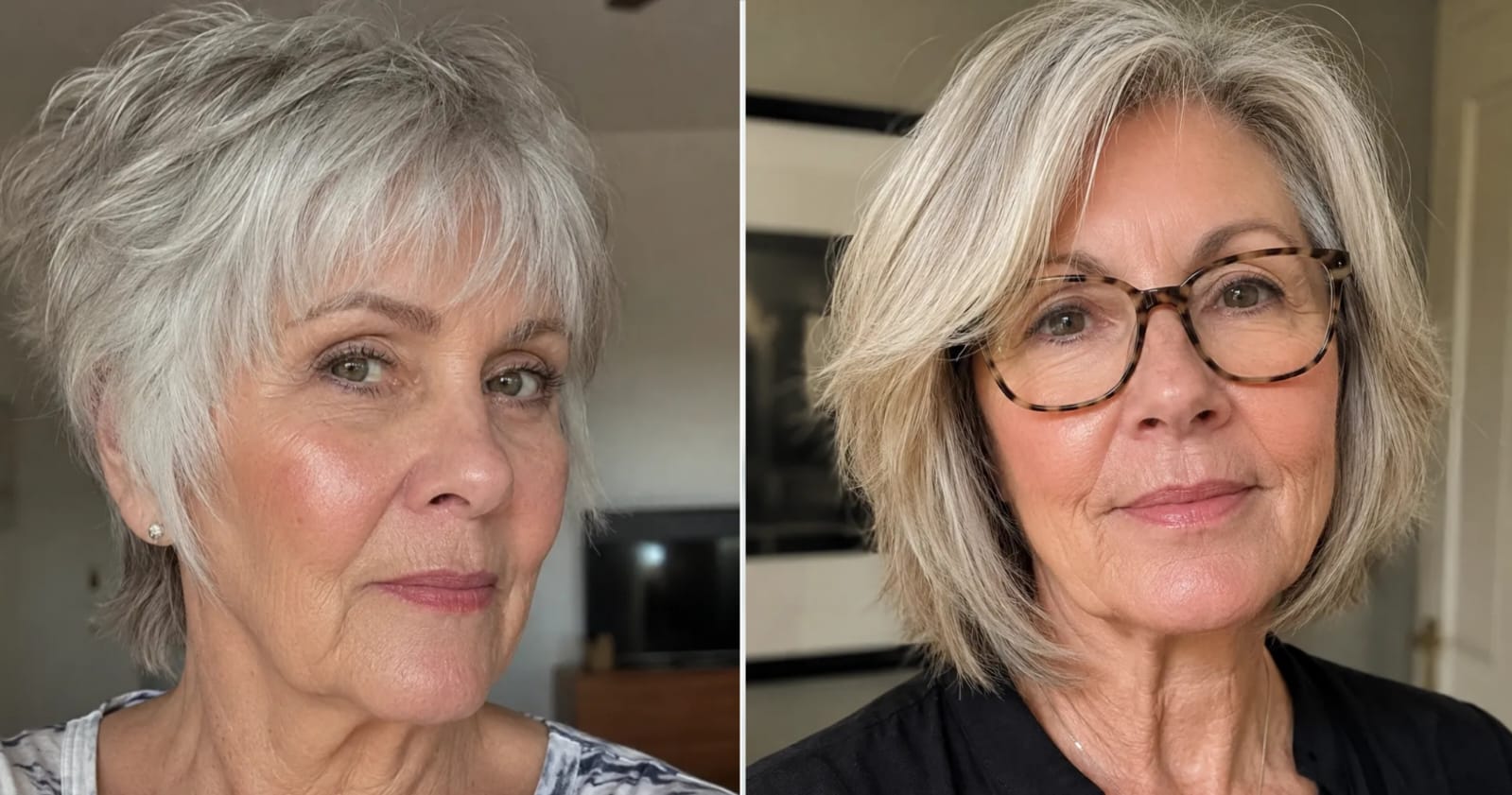
Fine hair doesn’t get easier to style as the years go on — it gets thinner, loses elasticity, and tends to fall flat by midday no matter what you do. But that’s less about age working against you and more about using the wrong cut. The right haircut does the structural work your hair used to do on its own, creating the appearance of fullness without relying on products or heat styling to hold it up.
Volume starts at the cutting table. Layers, graduation, and strategic length all play a role in how lifted and dense your hair looks — and the 17 styles ahead are specifically chosen because they deliver on that. Whether your hair is straight and silky, naturally wavy, or somewhere in between, there’s a shape here that works with your texture rather than fighting it. If you’re already curious about going shorter, it’s also worth a look at these pixie haircuts for older women — a great companion to what you’ll find below.
Why Hair Changes After 70 — And Why Your Cut Needs to Change Too
Before we get into the styles, let’s talk honestly about what’s happening with your hair. Understanding this changes the way you shop for a cut.
After 70, most women notice:
- Reduced density — fewer active follicles means fewer hairs overall
- Finer individual strands — each hair shaft becomes thinner and more fragile
- Less natural scalp oil — leading to drier, more brittle hair that breaks more easily
- Slower growth rate — so a bad cut takes longer to grow out than it used to
- Gray or white tones — which actually reflect light beautifully and can look incredibly luminous
Here’s what stylists don’t always say out loud: thinner hair can look MORE luxurious with the right cut. Volume is about structure, not just raw thickness. The right haircut creates the illusion of fullness, lifts your face, and requires minimal effort to look polished every day.
“Most of my clients over 70 come in thinking their hair is the problem. It’s not. The cut is the problem. Once we design something around the hair they have — not the hair they had — everything changes.” — Sandra M., Licensed Cosmetologist
The 17 Best Haircuts for Women Over 70
1. The Modern Pixie Cut

Not your grandmother’s pixie. The modern version has longer layers on top — sometimes 3 to 4 inches — with tapered sides and back. This gives you texture and movement without looking severe or blunt.
Why it tends to work well: It lifts the face immediately. The length on top draws the eye upward, which can help counter any drooping around the jawline or neck area.
Best for: Fine to medium hair, oval and heart-shaped faces.
Stylist note from Sandra: “Ask for ‘graduated layers on top with a tapered neckline’ — don’t just say pixie. That one phrase tells a stylist exactly what you want and saves a lot of back and forth.”
2. The Silver Bob with a Soft Undercut

A classic bob reimagined. The undercut underneath removes bulk and weight at the nape, while the top layers stay full and glossy. It swings beautifully and looks intentional rather than accidental.
Why it tends to work well: The undercut removes the “helmet” look that heavy bobs can create on fine hair. You get the structure of a bob without the weight dragging everything down.
Styling tip: A little mousse at the roots and a round brush while blow-drying. That’s genuinely all you need most mornings.
Best for: Medium-density hair, round and oval faces.
3. The Shaggy Layered Cut

Think 70s rock chic — refined and modernized. Lots of layers, face-framing pieces, and a slightly undone texture that looks artistic rather than messy. This tends to work surprisingly well on gray and white hair because the layers catch light differently at each level, creating natural-looking dimension.
Why it tends to work well: Layers create the illusion of volume and density where fine hair may lack it.
Celebrity reference: Look up Helen Mirren’s textured layered cuts over the years. That’s roughly the energy this style goes for.
For more ideas in this direction, short shag haircuts has 25 variations worth browsing — several work beautifully on mature hair.
4. The Soft Fade Pixie

Similar to the modern pixie but with a gradual fade on the sides — almost like a women’s barbershop-inspired cut. It can read bold but tends to look incredibly feminine when styled with soft waves or curls on top.
Why it tends to work well: Clean, architectural, and genuinely low-maintenance. The fade grows out more neatly than a standard scissor cut.
Stylist note from Sandra: “Always ask specifically for a women’s fade. Some stylists will go too short unless you clarify you want a gradual fade — not a buzz cut. Bring a photo. This one especially needs a reference image.”
5. The French Bob — Blunt, Chin-Length

Straight across, chin-length, sometimes paired with a fringe. It’s sharp, Parisian, and genuinely timeless. The blunt cut makes fine hair look instantly thicker and more substantial.
Why it tends to work well: The blunt edge creates an optical illusion of density. When all the ends sit at the same length, the hair reads as fuller than it actually is.
One honest warning: This requires regular trims every five to six weeks to maintain the shape properly. If you’re not into frequent salon visits, it can get straggly faster than other cuts. For fans of this style, our short French bobs roundup shows 15 gorgeous variations — including some that are a little more forgiving to grow out.
6. The Long Pixie

The sweet spot between a pixie and a bob — sometimes called a “pixie-bob” or “bixie.” You get length at the front and crown, but the back and sides stay short and neat. It’s forgiving on face shape and surprisingly versatile for day-to-day styling.
Why it tends to work well: You can style it slicked back, tousled, or swept to one side — three totally different looks from one cut, with no extra length to manage.
Styling idea: A small amount of texturizing cream worked through dry hair gives a natural, piece-y finish without looking like you tried too hard.
7. The Textured Crop with Bangs

A cropped cut paired with soft, side-swept or curtain bangs. The bangs are the secret weapon — they soften the forehead, frame the eyes, and create an immediate sense of youthfulness without doing anything drastic to the rest of the hair.
Why it tends to work well: Bangs genuinely change the proportions of the face. They draw attention upward — toward the eyes — which many women find flattering.
Important: Go for soft, wispy bangs rather than blunt, heavy ones. Heavy fringe can sit too harshly against mature skin. Wispy or curtain-style bangs move naturally and look more relaxed.
8. The Layered Lob (Long Bob)

If you’re not ready to go short, the lob is a reliable middle ground. It sits anywhere between the chin and the collarbone, with layers throughout for movement and body.
Why it tends to work well: It’s flattering across almost every face shape and neck length. It’s also one of the easiest styles to grow out later if you decide to change direction.
Styling trick: A large barrel curling iron — around 1.5 inches — gives beautiful loose waves that add volume without looking overdone. Finger-comb after curling to soften the waves into something more natural.
Also see short layered haircuts for women over 60.
9. The Wedge Cut

Remember Dorothy Hamill? The wedge is back — but it’s been updated. The back is graduated, meaning shorter underneath and building to longer on top, while the sides can be worn tucked behind the ear or blown out for fullness.
Why it tends to work well: The graduation at the back creates impressive volume in exactly the place most women over 70 need it — the crown and upper back. If you have a flat crown, this cut can make a noticeable difference.
Stylist note from Sandra: “The wedge is underrated for mature clients. It’s architecturally brilliant for fine hair — the stacking at the back lifts the whole profile of the head.”
10. The Choppy Pixie

Different from the soft pixie — this one has intentionally uneven, choppy layers that give a slightly edgy, artistic feel. It’s for the woman who isn’t afraid to stand out a little.
Why it tends to work well: The choppy texture reads as deliberate and fashion-forward rather than messy, especially on silver and white hair where the tonal variation makes each layer look dimensional.
Who might love this: Women with natural gray or white hair who want something modern and conversation-starting. This is not a “blend in” cut — and that’s entirely the point.
For more bold short options, edgy pixie cuts has 18 ideas worth exploring.
11. The Side-Parted Silver Bob

A sleek bob with a deep side part instead of a center part. Such a small change on paper, but it completely transforms the feel of the face. The asymmetry creates visual sophistication that a straight center part often can’t.
Why it tends to work well: Asymmetry draws the eye naturally and creates the kind of visual interest that lifts an otherwise simple cut. It also helps conceal a widening part line — something many women experience as hair thins.
Quick tip: A deep side part also tends to give the illusion of more volume at the crown. Part your hair when it’s wet and let it dry in place to train the direction.
For a deeper look at this style family, the bob haircuts for fine hair guide covers 15 bob variations that work particularly well on thinner hair textures.
12. The Natural Curly Cut

If you have naturally curly or wavy hair, working with your natural pattern rather than against it can genuinely change your relationship with your hair. A curly-specific cut — sometimes called a DevaCut, a technique developed by Devachan Salon — is cut dry, curl by curl, to suit your actual curl pattern.
Why it tends to work well: Fighting your curl pattern often causes frizz, breakage, and endless frustration. Cutting with the curl pattern gives you bounce and shape that doesn’t require heat styling.
Finding the right stylist: Look for someone trained in the DevaCut method, or at minimum someone who specializes in curly hair. Not every stylist has this training, and it really does make a substantial difference in the result.
13. The Feathered Bob

Soft, face-framing layers that feather outward at the ends — think a refined version of the 70s Farrah Fawcett energy. It’s romantic, light, and tends to be incredibly flattering around the face.
Why it tends to work well: The feathered layers lift the sides of the face without adding bulk or weight. The outward movement draws the eye wide and open.
Styling note: A medium-barrel curling iron — around 1 inch — flipped outward at the ends gives the classic feathered effect in under 10 minutes. A light-hold hairspray keeps the movement without stiffness.
14. The Tapered Neckline Pixie

A short pixie with a precise, tapered neckline — clean and sharp at the back. This is probably the most genuinely low-maintenance option on this entire list, which makes it worth mentioning even if it’s not the flashiest.
Why it tends to work well: The tapered neckline grows out cleanly instead of looking unkempt. You can go longer between salon visits without the style falling apart on you.
Best for: Women who want maximum ease with minimum upkeep. If your goal is truly wash-and-go hair, this one deserves serious consideration.
15. The Blunt Pixie with Volume on Top

Similar to the French bob philosophy applied to a pixie — blunt edges create the appearance of density. This version keeps the ends clean and blunt all over, while volume is built into the crown through blow-drying technique or a light volumizing mousse.
Why it tends to work well: The bluntness reads as thick, healthy hair even when the actual density is lower. It’s a bit of a visual trick that works consistently well.
Product suggestion: Try a lightweight volumizing mousse like Not Your Mother’s Curl Talk or Kenra Platinum Silkening Mist at the roots before blow-drying. Flip your head upside down while drying the crown for extra lift.
16. The Asymmetrical Cut

One side slightly longer than the other — could be a bob, a pixie, or anything in between. It’s modern, artistic, and more wearable than it might sound if you’ve never tried it.
Why it tends to work well: The asymmetry creates visual movement that static, even cuts sometimes lack. It also means the longer side can be swept forward to frame the jaw or neck if that’s something you’d like.
Fair warning: This one really does require a skilled stylist. It looks striking when done right and noticeably off when done wrong. Bring reference photos — multiple, from different angles. This is not the cut to describe verbally and hope for the best.
For more structured short cuts with that same architectural quality, inverted bob hairstyles is worth a browse.
17. The Wash-and-Wear Custom Cut

This last one isn’t a specific named style — it’s a design philosophy. A wash-and-wear cut is whatever shape works for YOUR specific hair texture, density, and face, engineered to look intentional with zero effort. No blowout required. No curling iron needed. Air-dry and go.
Why it tends to work well: Because real life is busy. Some mornings you need to shake your hair and walk out the door and still feel put-together.
How to ask for it: Tell your stylist specifically — “I want something I can wash, let air-dry, and still look like I meant it to look that way.” A good stylist will ask follow-up questions and design something precisely for your hair. For more ideas, see these low-maintenance haircuts for fine hair.
The wash-and-wear cut is honestly the highest-skill cut I do. It has to account for how your specific hair dries, moves, and falls naturally. There’s no hiding behind hot tools. When it’s done right, though, it’s life-changing for my clients.” — Sandra M., Licensed Cosmetologist
Common Mistakes Women Over 70 Make When Choosing a Haircut
Even with the best intentions, a few patterns come up repeatedly:
Asking for the cut they wore in their 40s. Hair changes. A cut that was perfect at 45 may not suit the hair you have at 72. Starting fresh — even if that means letting go of a style you loved — often leads to better results.
Going too short out of practicality. Very short cuts can absolutely be stunning. But some women go shorter than they actually want just because they assume it’s easier. Ask your stylist to walk you through the actual daily maintenance of any cut before you commit.
Avoiding layers out of fear. Layers feel risky if you’ve had a bad experience. But for fine hair, the right layers are often what creates the volume and movement that makes a cut look alive. Be specific about what you want — “soft, blended layers” versus “choppy, disconnected layers” — so your stylist knows what you’re comfortable with.
Skipping the consultation. Sitting down and jumping straight to “just cut it” skips the most important part. Even a five-minute conversation before the scissors come out can prevent a result you have to live with for months.
FAQ
Should women over 70 avoid long hair?
Not at all. Long hair is about the health and condition of the hair itself — not the age of the person wearing it. If your hair is healthy enough to carry length and you love it long, wear it long. There’s no rule that says otherwise.
What’s the easiest haircut to maintain at this age?
The tapered neckline pixie and a well-designed wash-and-wear bob are probably the two lowest-maintenance options. Both look intentional with minimal daily effort.
How often should women over 70 get a haircut?
Every six to eight weeks for shorter cuts, and every eight to twelve weeks for longer styles. Regular trims actually help hair look thicker and healthier — split ends travel up the shaft and cause more breakage over time.
Does gray hair look better short or long?
Genuinely either. Long gray hair with beautiful layers has a quiet elegance that’s hard to match. Short gray cuts are classic and chic. It really comes down to your lifestyle, face shape, and personal preference rather than any rule about length.
Will cutting my hair shorter actually make it look thicker?
In many cases, yes. Shorter hair has less weight pulling it down, so it naturally has more body and lift at the roots. This is especially true for fine hair. That said, the cut itself matters more than just the length — a badly layered short cut can still look flat.
What products actually work for fine hair over 70?
Lightweight volumizing products are your friend — heavy creams and oils can weigh fine hair down quickly. Look for words like “volumizing,” “lightweight,” or “thickening” on the label. Mousse, light spray, and dry shampoo tend to work better for this hair type than serums or butters.
How do I find a stylist who actually knows how to cut mature hair?
Ask specifically during the phone consultation. Ask how much of their clientele is over 60 or 70. Ask if they have experience with fine or thinning hair. A stylist who works regularly with mature clients will answer these questions comfortably and in detail. If they hesitate or redirect, keep looking.
A Final Word — On Confidence, Style, and What “Age-Appropriate” Should Actually Mean
Getting older doesn’t shrink your options. If anything, there’s more freedom now to wear something bold, something simple, or something completely unexpected. explore more short haircuts for older women
The women who tend to look the most beautiful — at any age — share one thing: they chose a style that fits their actual life, not the life they thought they were supposed to have by now.
So skip the tight perm. Skip the haircut someone else told you was “appropriate.” Book a consultation with a stylist you trust, bring reference photos, and be honest about what you actually want.
Your hair is still yours. Wear it like it.

