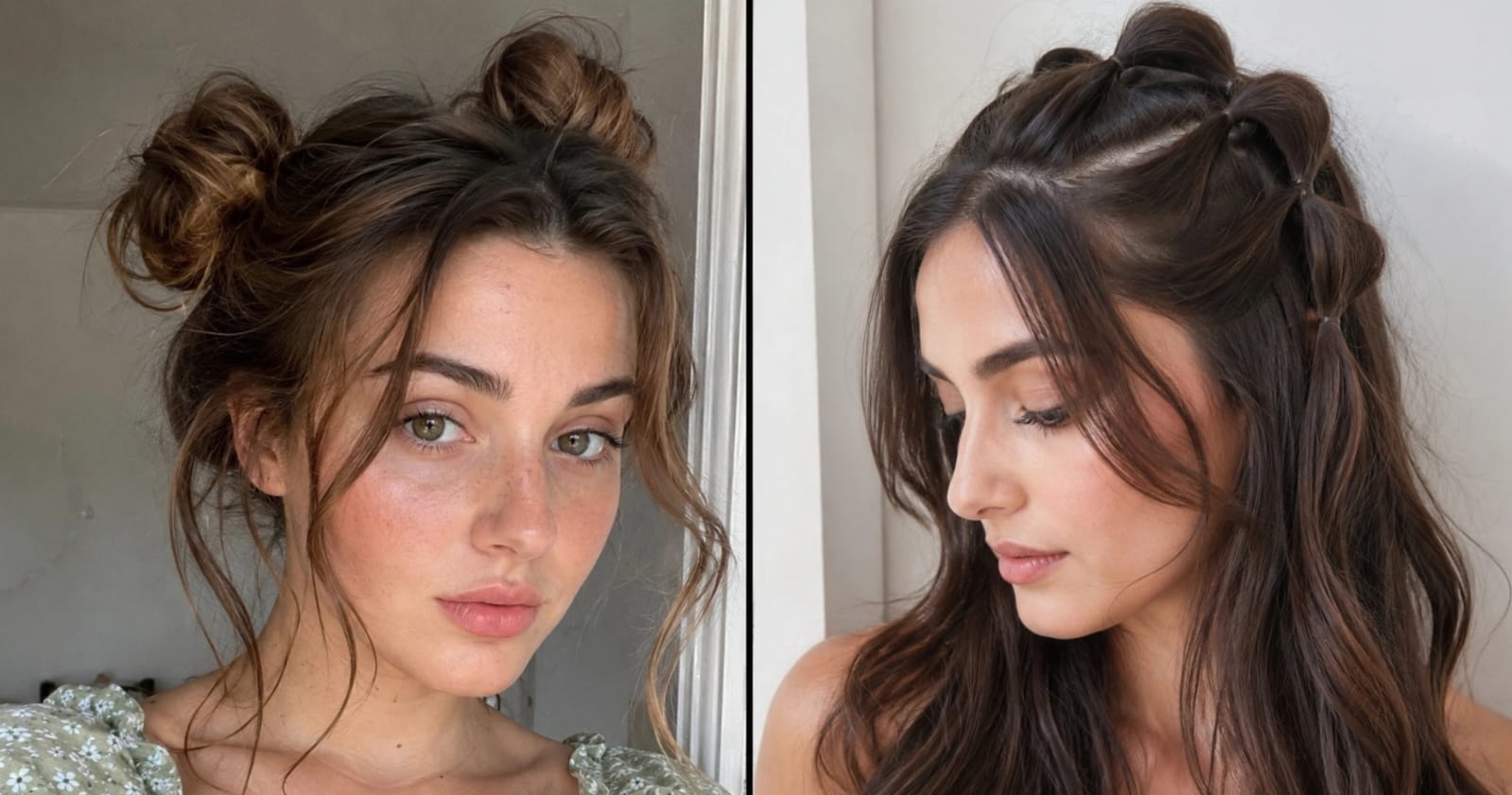
Soft girl hair gets talked about a lot in terms of color — blush pink, honey blonde, strawberry tones — but the style conversation usually stops there. What most guides skip is the structural reason these hairstyles work: they rely on deliberate weight removal and broken texture to create that effortless, slightly undone look. It’s not about being messy. It’s about knowing exactly where to add or remove volume so the hair looks like it fell perfectly without trying.
If you’re already experimenting with curtain bangs or leaning into wavy textures, soft girl hairstyles are a natural next step. Fine hair, thick hair, and curly hair each need a slightly different approach to land the same visual result — and those distinctions are called out throughout this list.
Quick Hairstyle Guide
| Style | Best For | Styling Time |
|---|---|---|
| Butterfly clips half-up | All types | 5 min |
| Loose face-framing braids | Wavy, straight | 8 min |
| Wispy curtain bangs | Straight, fine | 15 min |
| Claw clip updo | Thick, medium | 3 min |
| Heatless waves | All types | Overnight |
| Space buns (soft version) | Fine to medium | 10 min |
1. Butterfly Clip Half-Up

The butterfly clip half-up is the signature soft girl move for a reason — it sits at the intersection of intentional and effortless in a way that most updos don’t. The structural key here is that you’re not actually securing much hair. The top half is loosely gathered, a few face-framing pieces are deliberately left out, and the clip itself is placed slightly off-center toward the crown rather than flat against the head. That slight lift at the crown is what gives the style its characteristic softness. Placed flat, it reads more Y2K revival than soft girl.
How To Style:
- Apply a light texturizing spray to dry hair and scrunch gently from mid-length to ends.
- Gather the top half of your hair — from roughly temple to temple — loosely with your fingers. Don’t pull it tight.
- Twist the gathered section once before clipping so it fans out slightly above the clip.
- Position the butterfly clip slightly behind the crown, angled diagonally rather than straight across.
- Pull two or three face-framing pieces loose at the front, then pinch and lightly twist them so they curl away from your face.
Best For: Oval, heart, and round faces. Works on fine to medium density — thick hair needs a larger clip or two smaller ones side by side.
Tools & Products: Large butterfly clip (avoid plastic ones that snap loudly — they tend to break the fan effect). Texturizing spray like Not Your Mother’s Curl Talk or IGK Mixed Feelings.
2. Loose Curtain Bangs

Curtain bangs are probably the most structurally important element in the soft girl toolkit — more than any color or accessory. The reason they work is weight distribution: by removing bulk from the front hairline and splitting it into two soft curtains, you visually widen the center of the face and create a natural frame that softens strong jaw or forehead lines. The mistake most people make is cutting them too short or too blunt. Curtain bangs should graze the cheekbone at minimum — anything shorter starts reading as statement bangs rather than soft ones.
How To Style:
- Start with slightly damp or dry bangs — dry styling gives more control here.
- Apply a tiny amount of lightweight styling cream to just the bang section.
- Using a small round brush, roll each curtain section away from the center part while directing warm air from your dryer at a downward angle.
- Finish with a cool shot to set the bend, then finger-separate gently — never use a comb on curtain bangs once dried.
Best For: Most face shapes, especially square and heart. Works best on straight to wavy hair; curly hair needs a dry cut and diffuser styling instead.
Tools & Products: Small round brush (1-inch barrel), lightweight styling cream, blow dryer with concentrator nozzle.
3. Heatless Overnight Waves

This is the style that actually defines the soft girl texture baseline — that slightly imperfect wave that looks like you slept well and woke up with good hair. The structural secret is that heatless waves set differently depending on how wet your hair is when you wrap it. Wrapping slightly damp (not soaking) hair gives defined, longer-lasting waves. Wrapping nearly dry hair gives softer, more diffused texture that falls out by midday — which can still look beautiful but won’t hold for a full day. Most tutorials don’t specify this, and it’s why people get inconsistent results.
Quick Styling Note: Wrap hair around a silk robe tie or soft sock rope while it’s about 70% dry — not freshly washed. Sleep on a satin pillowcase to prevent frizz from friction. In the morning, unravel slowly and separate waves with fingers only, then set with a light-hold flexible spray.
4. Soft Space Buns

Space buns have a harder-edged reputation from festival styling, but the soft girl version is a completely different animal. The difference is intentional imperfection: the buns are worn lower (at the middle of the head rather than the very top), left slightly loose so they have a rounded, almost undone shape, and face-framing pieces are always left out. Tight, neat space buns read structured. Loose, low space buns read soft.
How To Style:
- Part hair down the center from forehead to nape.
- Gather each side into a low-to-mid ponytail — position them level with your temples, not the crown.
- Twist the ponytail loosely, then wrap it around the base in a messy coil rather than a flat bun.
- Secure with a small clear elastic, then pull the bun apart gently at the sides to loosen it.
- Let face-framing pieces fall naturally and leave the very ends slightly out for texture.
Best For: Round and oval faces. Fine to medium hair — thick hair may need to split each bun into a twist rather than a full coil to keep the look light.
Tools & Products: Small clear elastics, light-hold flexible hairspray, optional: a few small pearl or floral pins to tuck into the bun for softness.
5. Braided Crown With Loose Ends

A braided crown sounds formal until you understand what makes the soft girl version different: the braid itself is intentionally loose, the ends are not tucked away, and at least a third of the hair is left down beneath it. The crown braid functions as a headband-style accent, not a structured updo. Structurally, it frames the top of the head and draws attention upward, which softens the jawline and adds height without looking severe.
Quick Styling Note: Use the three-strand braid but don’t pull tight — after each cross, gently tug the outer loops of the braid to puff them slightly. This “pancaking” technique is what separates a soft romantic braid from a clean athletic one. Don’t skip it.
6. Low Loose Ponytail With Face Framing Pieces

The low ponytail is so simple it gets dismissed, but done with the right details it’s one of the cleanest soft girl styles. The critical details: it sits at the nape or slightly below (not mid-head), is secured loosely enough to have slight volume at the crown, and always has face-framing pieces left out. Those pieces should be lightly waved or bent — not straight, not perfectly curled. A flat iron used briefly at the ends with a slight outward flip achieves this in under a minute.
How To Style:
- Apply a smoothing serum to the mid-lengths and ends only — leave the roots natural for volume.
- Gather hair loosely at the nape with your hands, not a brush.
- Secure with a soft scrunchie (satin or velvet, not elastic — elastic creates a dent that breaks the soft visual).
- Gently loosen the hair at the crown by lifting and pulling the ponytail down slightly after securing.
- Use a flat iron to add a soft bend to face-framing pieces, flipping them outward at the ends.
Best For: All face shapes. Works on every hair type — curly hair can skip the flat iron and simply define the face pieces with a curl cream.
Tools & Products: Satin or velvet scrunchie, smoothing serum, flat iron for face-framing pieces.
7. Wispy Bun With Tendrils

This is the claw clip bun’s softer, more deliberate cousin. The wispy bun is built around intentional tendrils — small sections pulled loose at the temples, the nape, and sometimes mid-bun — rather than general messiness. The difference matters structurally: random flyaways look unkempt, but placed tendrils look styled. Wrapping each tendril briefly around your finger and holding for ten seconds sets a gentle curl without any heat.
Quick Styling Note: Don’t pull tendrils from the top of the bun — it destabilizes the structure and the whole bun shifts within an hour. Pull them from the nape and temples only, where the hair is held by the bun’s base rather than its body.
8. Claw Clip Updo

The claw clip updo is the fastest soft girl style and also one of the most misunderstood. Most people clip all their hair in one flat mass, which creates a heavy, blunt shape at the back of the head. The soft girl version uses a twist-and-clip technique: twist the hair before clipping so it fans outward and slightly upward above the clip, creating a loose, cascading shape rather than a flat one. That visual difference — a fan of hair versus a flat pack — is entirely down to one extra step.
How To Style:
- Gather all hair into a loose low ponytail position without a hair tie.
- Twist the gathered hair once clockwise.
- Fold the twist upward against the back of your head, letting the ends fan out above.
- Clip the claw clip horizontally through the folded section, catching both the twist and some of the scalp hair for security.
- Pull a few pieces loose at the temples and let the ends cascade freely above the clip.
Best For: Medium and thick hair. Fine hair may need a smaller clip and a thinner gathered section to get the fan effect without the clip slipping.
Tools & Products: Large jaw clip (5–6 cm minimum for medium hair), texturizing spray for grip.
9. Half-Up Hearts or Bubble Sections

Slightly more playful than a standard half-up, the bubble or heart section style uses small elastics to create a puffed section at the crown. Structurally this adds volume and height to the top of the head without any heat — which is useful for fine hair that loses volume quickly. The key is loosening each bubble after securing it. Tight bubbles look childish; loose, puffed bubbles read soft and intentional.
Quick Styling Note: Use clear mini elastics rather than colored ones — you’ll see them on fine hair if they’re anything other than clear or your exact hair color. After placing each elastic, use two fingers to gently stretch the section on either side of it until it puffs slightly.
10. Textured Lob With Invisible Layers

The lob is the soft girl haircut that does the most structural work. The reason it appears in so many soft girl references is weight: a lob removes enough bulk to let hair move freely, while keeping enough length for waves and texture to register visually. The “invisible layers” version — where layers are cut underneath rather than through the surface — is particularly effective for soft girl styling because the exterior looks smooth while the underneath is lightened, giving movement without the choppy surface texture that reads more edgy than soft.
Quick Styling Note: Ask for “invisible layers” or “underneath graduation” rather than standard face-framing layers. The distinction is where the weight removal happens — and it changes the entire texture profile of how the hair moves.
11. Soft Girl Pigtails (Low Version)

Low pigtails in the soft girl context are not the tight, symmetrical pigtails of grade school. They sit below the ear, are loosely secured, and have deliberate face-framing pieces left at the front. The pigtails themselves can be slightly uneven — matching them too precisely reads polished rather than soft. A small bow or ribbon at each elastic adds the finishing detail that pushes this firmly into soft girl territory.
How To Style:
- Part hair down the center — a slightly imperfect part actually works better here.
- Gather each side into a low ponytail below the ear, securing loosely with a ribbon or scrunchie.
- Leave two sections loose at the front on each side.
- Lightly wave the face-framing pieces with a small curling wand, bending them outward.
- Gently loosen the pigtails at the crown to remove any tension.
Best For: Heart and oval faces. Works on straight through wavy hair — curly hair already has natural volume that makes this work without any added waving.
Tools & Products: Satin ribbon hair ties or mini scrunchies, small curling wand (¾ inch barrel) for face pieces.
12. Loose French Braid

The French braid in its soft girl form is braided loosely from the start and then pancaked — each section of the braid gently pulled to widen it. This is fundamentally different from the tight, smooth French braids worn for athletic or formal purposes, and the distinction is worth understanding: a tight French braid pulls hair toward the scalp and creates tension; a loose, pancaked one lets sections separate and gives the braid a softer, more dimensional look that works with the aesthetic instead of against it.
Quick Styling Note: Pancake as you go — don’t wait until the braid is complete to loosen it. Pulling the braid sections after you’ve already worked past them can cause it to unravel. Add a small bow or floral pin at the end instead of a plain elastic.
13. Bubble Ponytail

The bubble ponytail spaces multiple elastics down the length of a ponytail, with each section loosened into a “bubble” between them. Structurally, it creates volume on hair that would otherwise hang flat, which is why it’s especially popular among fine-haired soft girl fans. The soft girl version uses pastel or satin elastics that are visible and match the color palette — the hardware is part of the aesthetic, not hidden.
Quick Styling Note: Space your elastics unevenly — slightly wider gaps lower down make the bubbles proportionally larger at the ends, which looks more intentional and less mechanical than perfectly equal spacing.
14. Halo Braid With Face Framing Strands

The halo braid is a single braid that wraps around the head like a crown, sitting flat against the scalp. In soft girl styling, it works because it creates a delicate headband effect that’s more natural-looking than an actual headband. The face-framing strands left out at the front are non-negotiable here — a fully pinned halo braid reads formal or bridal, while one with loose pieces at the temples softens the entire shape.
How To Style:
- Part out two small face-framing sections at the temples and clip them out of the way.
- Begin a Dutch braid behind one ear, working along the hairline toward the other ear.
- Continue around the nape and back up to the starting point, securing with a small elastic.
- Pancake the braid gently to widen it.
- Release the face-framing sections and add a gentle bend to them with your fingers or a flat iron.
Best For: Oval and long face shapes. Works best on straight to wavy hair; curly hair needs a cream applied first to prevent frizz at the hairline.
Tools & Products: Bobby pins, small clear elastic, edge control or light pomade for flyaways along the braid line.
15. Soft Shag With Curtain Bangs

The shag haircut might seem like the edgier end of the soft girl spectrum, but a soft shag — cut with longer, less aggressive layers than a traditional shag — sits comfortably within the aesthetic. The distinction is layer length and density: a standard shag has short choppy layers throughout; a soft shag keeps layers longer and concentrated at the ends, so the movement reads fluid rather than spiky. Paired with curtain bangs, this becomes one of the most structurally complete soft girl haircuts available — the bangs frame the face while the layers add movement below.
Quick Styling Note: When diffusing a soft shag, use a low heat setting and don’t scrunch aggressively. The goal is texture, not defined curl. Let hair fall naturally while diffusing and only scrunch at the very end to break any crunchiness.
16. Ribbon-Tied Half-Up

The ribbon half-up is one of the most visually soft styles on this list, and it costs almost nothing to try. A length of satin or velvet ribbon (roughly 60 cm) is tied around a small half-up section at the crown, finished in a bow. The structural reason this works is contrast: the smooth ribbon against the texture of the hair creates a deliberate focal point at the crown without any heat or significant effort. The mistake most people make is tying the bow too tightly — a loose, slightly asymmetrical bow reads romantic; a tidy symmetrical one reads schoolgirl.
Quick Styling Note: Use a ribbon that’s slightly wider than you think you need — narrow ribbon tends to crinkle and lose shape within an hour, while a wider satin ribbon holds its bow shape and photographs better.
17. Loose Waves With Deep Side Part

The deep side part wave is probably the simplest style on this list and also the one most dependent on technique. Structurally, the deep part — sitting roughly two-thirds of the way across the head rather than in the center — redistributes weight to one side, creating natural volume on the heavier side and a softer, more swept look overall. Combined with loose waves, the deep part gives the hair directionality and movement that a center part simply doesn’t produce in the same way.
How To Style:
- Apply a heat protectant and a small amount of wave-enhancing mousse before drying.
- Blow dry hair with a round brush, directing all hair toward the heavier side of the part.
- Once dry, use a 1.25-inch curling wand to add loose waves — wrap sections away from the face, alternating direction on every other section for a less uniform look.
- Let waves cool completely before touching.
- Shake out waves with fingers, apply a light serum to the ends, and set the part with a light-hold spray.
Best For: All face shapes — particularly flattering on round faces where the asymmetry adds length. Works on fine through thick hair; fine hair benefits most from the volume the deep part creates.
Tools & Products: 1.25-inch curling wand, wave-enhancing mousse, lightweight serum for ends, light-hold flexible spray.
Stylist Notes Before Trying These Soft Girl Hairstyles
The secret to getting the soft girl aesthetic right is choosing a style that works with your natural hair instead of fighting against it. Soft girl hair is built around movement, softness, and small details — not perfection.
If you have fine hair, focus on creating light volume with texture sprays, loose waves, and styles that add height around the crown. Avoid heavy creams or oils that can make soft shapes fall flat.
For thick hair, the goal is usually balance. Removing extra weight with soft layers, loose face-framing pieces, or relaxed updos helps the hairstyle feel effortless instead of heavy.
Curly and wavy hair already have the natural texture that soft girl styles need. Instead of over-styling, define your shape with lightweight products and let your natural movement show.
The biggest stylist rule: don’t over-polish the look. A few loose strands, soft bends, and slightly undone details are exactly what make these hairstyles feel romantic and effortless.
FAQ
What hair type works best?
There’s no single answer. Wavy hair lands it most naturally. Straight hair needs more texturizing product. Curly hair often needs less manipulation, not more.
Can you do these on short hair?
Yes — the butterfly clip, curtain bangs, ribbon sections, and loose waves all work on a lob or short hair. Only the bubble ponytail needs more length.
How do I make them last all day?
Set your base texture before styling — waves built on a mousse or texturizing spray base last far longer than those applied to bare clean hair. And avoid touching your hair once it’s done.
What products do I actually need?
Texturizing spray, flexible-hold finishing spray, lightweight end serum, and wave mousse if your hair is straight. That’s the full list — less is more here.
Soft girl vs clean girl — what’s the difference?
Clean girl = sleek, smooth, controlled. Soft girl = textured, voluminous, intentionally imperfect. Opposite approaches to the same low-effort look.
Do I need curtain bangs?
No, but they help a lot. If you don’t have them, lean on face-framing pieces and loose tendrils to get a similar softening effect.
Final Thoughts
Soft girl hairstyles reward understanding over imitation. Once you know that the whole aesthetic is built on deliberate, placed imperfection rather than random messiness, every style on this list becomes easier to execute and easier to troubleshoot when it’s not working. Start with the texture base, know which pieces to leave out, and resist the urge to tighten or over-smooth — the softness lives in exactly the places you might be tempted to fix.

