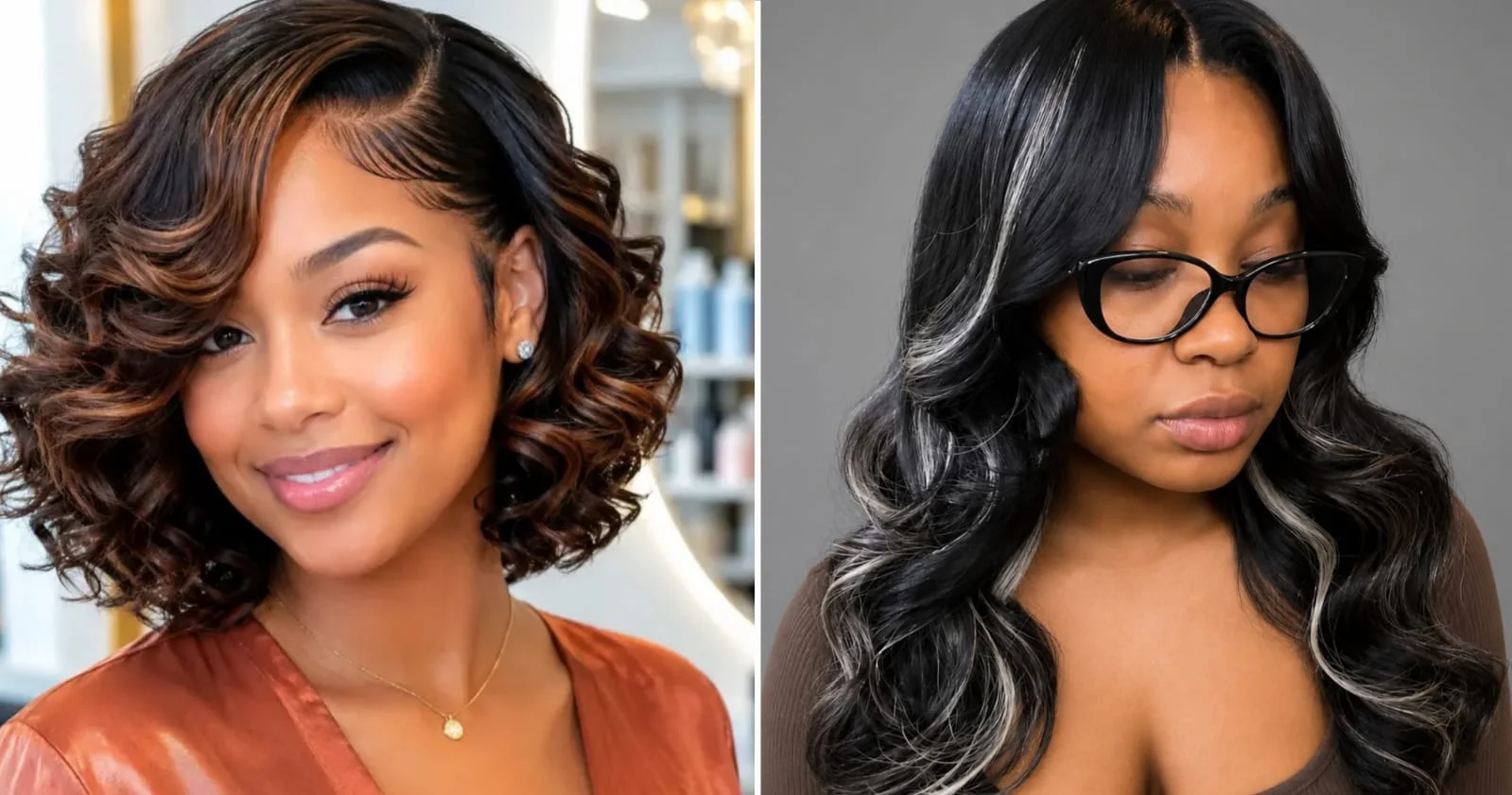
Most “best quick weave hairstyles” roundups treat every style like it’ll behave the same way on everyone once it’s glued down. It won’t. The texture of the extension matters, sure — but what actually decides whether a style holds up for four weeks or falls apart in ten days comes down to three things most guides skip entirely: where the cap sits, whether you leave hair out or seal it under a closure, and how that glue holds up against your climate and your natural hairline. Get those three right for your face shape and hair density, and the exact same 17 looks below can look completely different depending on who’s wearing them.
That’s the angle for this list. Alongside how each style looks and who it flatters, you’ll find the structural “why” behind it, plus an honest comparison of leave-out vs. no-leave-out vs. closure installs — a decision that affects more of these looks than any texture choice does.
Quick Guide
| Style Type | Best For |
|---|---|
| Bobs (straight, blunt, curly) | Fine to medium density, round or oval faces |
| Pixies (layered, side-swept) | Confident face-framers, low-maintenance routines |
| Long & wavy (deep wave, body wave, flip-over) | Heart or oval faces, dramatic length without heat damage |
| Updos (ponytail, half-up, finger wave) | Special occasions, thicker natural hair underneath |
| Color-forward (blonde melt) | Anyone wanting a temporary color change with zero bleach |
1. Straight Leave-Out Bob

A blunt, chin-to-shoulder bob with a natural leave-out along the front hairline. The leave-out is what sells this one — because a few inches of your own hair sit over the front of the cap, the seam where extension meets scalp disappears, and the style reads as fully natural even up close.
How To Style:
- Braid down your hair, leaving out a one- to two-inch section at the front.
- Secure the wig cap and cut the wefts to match your desired bob length.
- Glue the wefts to the cap in horizontal rows, working from the nape upward.
- Blend the leave-out over the front row with a flat iron on low heat.
This one leans on medium-density hair more than any other bob on the list, since a leave-out this size needs enough natural hair to blend without looking sparse — on fine hair, the part line tends to show through instead of disappearing. Round or oval faces get the softest frame out of this cut.
2. Half-Up Half-Down Updo

The top half is gathered and pinned while the bottom half falls loose — occasion-ready without a full updo commitment. This hides cap seams better than almost anything else on the list, since the gathered top section naturally covers the crown, which is exactly where most quick weave caps sit slightly raised. It’s one of the easier updos to adapt from a full half up half down hairstyles roundup if you want more pinning and sectioning variations beyond the basic version described here.
3. Layered Pixie Quick Weave

A short, face-framing pixie built from graduated wefts rather than one solid block of extension — the layering is what gives it movement instead of a helmet-like finish.
How To Style:
- Choose wefts pre-cut at graduated lengths, not a single uniform length.
- Glue the shortest layer nearest the scalp at the crown.
- Build outward with progressively longer layers toward the perimeter.
Oval and heart-shaped faces can carry short length near the jaw the best, and this cut works better on fine to medium hair, since thick natural hair underneath can push the cap outward and disrupt the layering. It’s also worth re-texturizing the ends every few days with a small amount of pomade, since layered pixies lose their piece-y shape faster than a solid-cut one does. If short length appeals to you generally, our full roundup of pixie cut hairstyles has more variations worth browsing before you commit to an install.
4. Blunt Closure Bob

Loose to medium curls cut into a rounded bob shape, using extensions that already come pre-curled rather than curled after install. Curl pattern hides a rough cut line far better than straight hair does, which makes this the more forgiving choice if you’re installing at home instead of at a salon — any unevenness in the trim just reads as texture instead of a mistake.
Oval and heart-shaped faces suit this one particularly well since the curl adds width right where those face shapes can carry it. If you like the curl-hides-flaws logic here but want it in a shorter cut, our curly pixie haircuts guide works the same way, just at pixie length.
5. Curly Bob Quick Weave

Loose to medium curls cut into a rounded bob shape, using extensions that already come pre-curled rather than curled after install. Curl pattern hides a rough cut line far better than straight hair does, which makes this the more forgiving choice if you’re installing at home instead of at a salon — any unevenness in the trim just reads as texture instead of a mistake.
Oval and heart-shaped faces suit this one particularly well since the curl adds width right where those face shapes can carry it.
6. Side-Part Quick Weave

A deep side part with sleek, straight hair falling past the shoulders. The part does the heavy lifting here, adding height and angle to the face without needing layers or bangs.
How To Style:
- Mark your part directly on the cap before adding any wefts.
- Install wefts starting at the nape, keeping rows even on both sides of the part.
- Flat-iron in sections once the install is fully dry and set.
This is one of the lowest-tension installs on the list since a deep side part needs less leave-out than a middle part — a solid pick if your hairline tends to be sensitive. Best for oval or heart-shaped faces looking for a soft, angled frame.
7. Middle-Part Sleek Quick Weave

Center-parted, straight, and glass-smooth from root to tip. A middle part is far less forgiving than a side part, because any unevenness in cap placement shows immediately down the center of the head, so this style rewards a slow, symmetrical install more than almost anything else on this list. It suits symmetrical or long face shapes best, and holds up better on fine to medium hair, since thick hair underneath can make the center seam harder to keep flat.
8. Flip-Over Quick Weave

This one skips a visible part entirely — hair is flipped forward over the crown, then styled back, leaving no side or middle line at all. It’s a genuinely different technique from the rest of the list because the leave-out sits at the crown rather than the front hairline, which is exactly why it builds so much volume on top without adding bulk near the face.
How To Style:
- Leave out a small circular section at the crown instead of the front.
- Cap and glue wefts in rows moving front to back.
- Flip the leave-out forward over the installed hair.
- Curl the flipped section to blend it into the surrounding volume.
- Set with a light-hold spray so the flip doesn’t fall flat by midday.
Square or round faces benefit most from the added height this creates. Because the leave-out sits at the crown rather than the front, sleep with a satin bonnet propped slightly forward — lying flat on your back is what usually flattens this one out early.
9. Deep Wave Quick Weave

Tight, defined S-shaped waves from root to end, using a wave pattern that’s baked into the extension rather than curled in after install. Compared to a body wave further down this list, deep wave holds its pattern noticeably longer in humidity, since there’s no styled-in curl to fall out — a real advantage if you live somewhere hot and don’t want to re-curl mid-week. It flatters most face shapes equally, which is part of why it’s one of the more popular picks for first-time quick weave wearers.
10. Kinky Straight No-Leave-Out Quick Weave

A textured, yaki-style straight extension installed with full coverage — no leave-out anywhere. This is where the leave-out vs. no-leave-out trade-off shows up most clearly: without any natural hair exposed, there’s zero risk of glue reacting with your edges, but you lose the seamless hairline blend a leave-out gives you, so a wig cap that closely matches your skin tone at the perimeter becomes essential rather than optional.
How To Style:
- Braid your entire head flat, including the front hairline.
- Cap with a perimeter-matched cap color.
- Glue kinky straight wefts in rows from the nape forward.
- Blend the front rows into a natural hairline with a small comb and light gel.
11. Long Body Wave Quick Weave

Loose, beachy waves running well past the shoulders. This style carries more physical weight than almost anything else on the list, which means whatever leave-out or closure method you choose needs reinforcing — extra glue at the temples helps the install keep pace with the extension’s pull, especially in the first week. It works best on oval or heart-shaped faces that can carry the extra length without it overwhelming the features.
12. Side-Swept Pixie Quick Weave

A pixie with longer front pieces swept to one side instead of layered evenly all around. This is a gentler entry point than a fully layered pixie if you’re new to short quick weaves — one long side section blends far more easily with a small leave-out than matching layers around the whole head, which is why it’s often the first pixie style people try.
Best for oval and heart-shaped faces, since the swept front piece adds soft width right at the forehead — round or square faces can also wear it well by sweeping the length slightly further forward to break up a stronger jawline.
13. High Ponytail With Finger Waves

A sleek, pulled-back ponytail with vintage-style finger waves set close to the hairline. This is a more secure updo than it looks, because the tension pulling the style back is carried by the cap rather than your natural roots — the glue and cap absorb the strain that a regular high pony would otherwise put directly on your scalp.
How To Style:
- Install with wefts angled toward the crown for a smooth ponytail base.
- Gather everything into a high ponytail and secure tightly.
- Wrap a small section around the base to hide the elastic.
- Set finger waves along the hairline with a fine-tooth comb and gel.
- Mist with firm-hold spray and let the waves air-dry fully before touching.
14. Warm Blonde Color-Melt Quick Weave

A gradual transition from your natural root shade into a warm blonde through the mid-lengths and ends — achieved entirely through the extension’s color, with zero bleach touching your own hair. Compared to actually lightening your natural hair, this route lets you test a full blonde transformation with complete reversibility once the weave comes out, which makes it a lower-risk way to try a color change you’re not fully committed to. For more root-to-ends blending ideas if you do decide to go permanent later, our dark roots blonde hair guide covers that transition in detail.
15. Curtain Bangs Quick Weave

Face-framing bangs parted down the center and swept to either side, added as a small stand-alone install rather than cut into a full-coverage cap. Because bangs only need a tiny leave-out or closure section at the front, they can be added to almost any other style on this list without redoing the whole install.
How To Style:
- Section a small triangle at the front hairline for the bang leave-out.
- Cut the bang wefts slightly longer than your target length.
- Glue the wefts just behind the leave-out for a natural root blend.
- Round-brush while blow-drying for a soft curve.
Bangs sit closest to the forehead and collect oil faster than the rest of the install, so a midweek dry shampoo touch-up keeps them from looking limp before the rest of the style needs attention. Round or long face shapes get the softest benefit from the extra frame at the forehead.
16. Vintage Finger Wave

Structured S-shaped waves set close to the scalp across the entire head, styled flat rather than voluminous. This look depends entirely on how flush the cap sits against the head, which is why it works better with a thinner, low-profile cap than the standard base most other styles here use.
How To Style:
- Install using a slim-profile wig cap instead of a standard one.
- Apply setting gel in sections while combing the wave pattern with a fine-tooth comb.
- Pin each wave ridge with duckbill clips.
- Air-dry fully before removing the clips.
It suits fine or medium hair best, since a low-profile cap leaves less room for thick natural hair underneath.
17. Full-Coverage No-Leave-Out Quick Weave

A complete cap install with no natural hair exposed anywhere, styled straight, wavy, or curled entirely through the extension. This is the most protective option on the list for anyone actively growing out damage — no leave-out or closure seam puts any tension on the hairline at all. The trade-off is a slightly less blended edge, which a well-matched cap color mostly offsets.
Best for anyone recovering from breakage or thinning edges, and works well on most face shapes since the full coverage lets you shape and style the extension however your features need — round or square faces in particular can use the added height and length to soften stronger jawlines.
The Real Reason Some Quick Weaves Last and Others Don’t
The styles that actually hold up aren’t always the ones with the priciest bundles — they’re the ones where the install method matches the wearer’s hairline and routine. Someone with sensitive edges who insists on a deep leave-out usually ends up back at the salon within two weeks, not because the style failed, but because the method fought against what their hair could handle. Climate matters too: a body wave install can loosen at the temples within days in humid weather, while the same style holds closer to a month in cooler, drier conditions.
So before you screenshot a look, ask yourself how sensitive your edges are right now and what your climate and routine look like for the next few weeks. If your hairline needs a break, lean toward a closure or full no-leave-out install even at the cost of a slightly less blended front. If you’re in a hot or humid stretch, pick a style with a wave pattern built into the extension rather than one you’ll have to re-curl — it holds up far better against sweat and moisture.
FAQ
How long does a quick weave last?
Most quick weaves hold up for two to five weeks, depending on glue quality, install method, and exposure to heat or humidity.
Does a quick weave damage your hair?
It can, mainly if glue touches your natural hair or the cap sits directly on your hairline instead of behind it. A no-leave-out or closure install, plus careful removal, reduces this risk significantly.
Is a quick weave or a sew-in better?
A sew-in is generally more secure and gentler long-term since there’s no glue involved, but it takes longer to install and remove. A quick weave is faster and more affordable, making it the better choice for a shorter-term style change.
Can you lay your edges with a quick weave?
Yes, as long as your natural edges are prepped and moisturized before the cap goes on, and the cap sits slightly behind the hairline rather than directly on top of it.
How many bundles do you need for a quick weave?
Typically two bundles for styles under 12 inches, and three to four bundles for anything longer than 20 inches, though exact amounts vary by desired fullness.
Can you wash a quick weave?
Yes, but avoid oil-based products near the cap — oil breaks down the glue holding the wefts in place and can cause premature shedding.
Final Thoughts
The right quick weave isn’t just the one that looks best in a photo — it’s the one whose install method actually fits your hairline, your hair density, and how you live day to day. Browse the linked guides above if any of these styles have you curious about a related cut, color, or texture.

