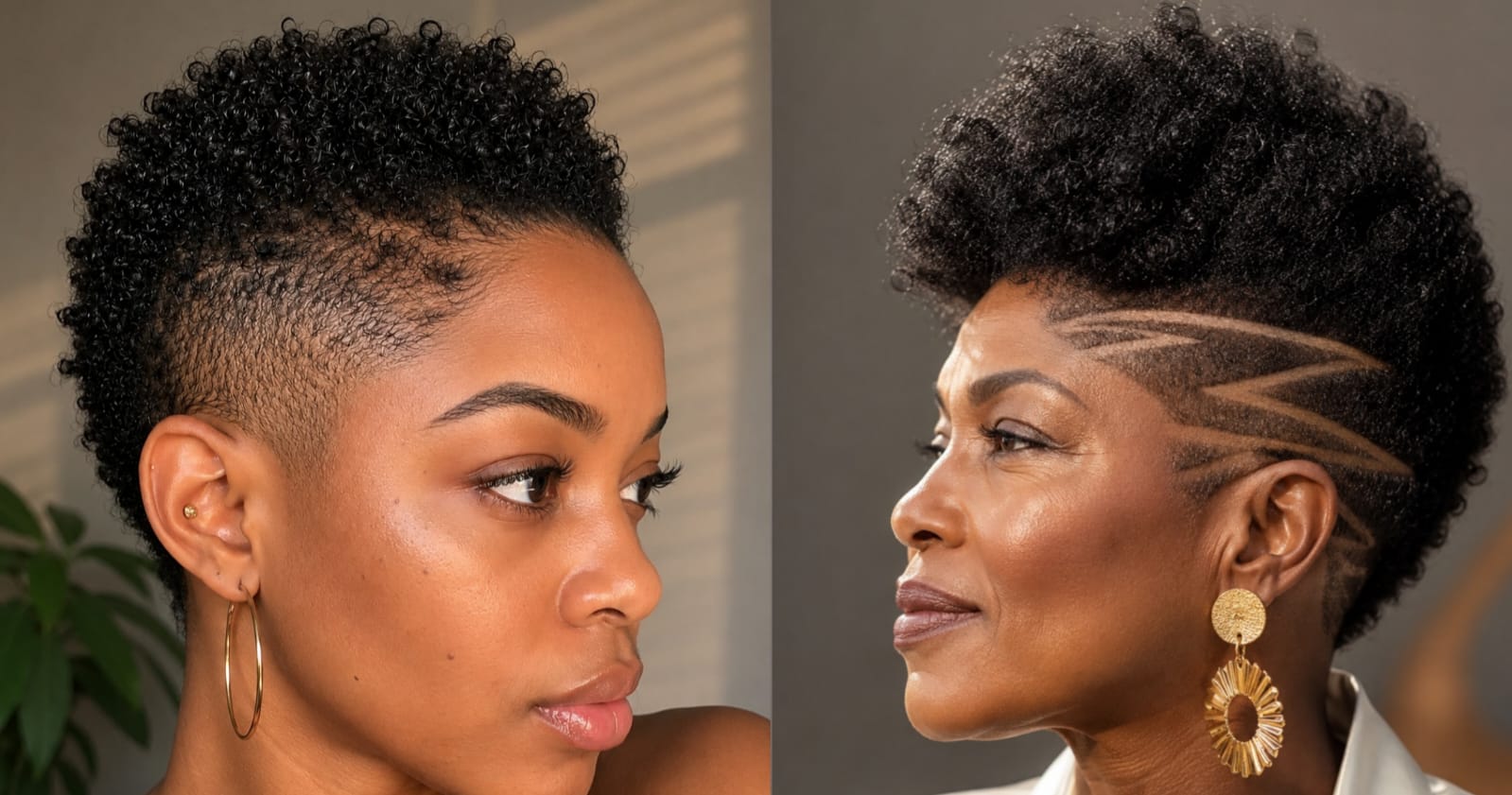
There’s a quiet myth that’s kept a lot of Black women in the chair for an extra hour, asking for “just a trim”: that short hair reads as a compromise, something you settle for between length goals. It’s not. A well-cut low style does something length often can’t — it puts your bone structure, your edges, and your texture front and center, with nothing competing for attention.
The real skill is matching the cut to your face shape, your hair’s natural texture, and how much upkeep you actually want to commit to. Get that right, and a low cut isn’t a phase — it’s a statement. If you’re coming from longer styles, it’s worth seeing how other Black women have approached short, natural looks before picking your version.
Below are 16 low cut hairstyles that prove the point, from sharp fades to soft cropped curls — each one built around a different face shape, texture, or vibe.
Why Low Cuts Hit Different on Black Women
Black hair texture is genuinely built for short styles. The natural coil pattern, the density, the way it holds shape — it creates definition that straight hair simply can’t replicate with a close cut. A simple taper on 4C hair looks architectural. A defined TWA on coily hair looks like a whole mood.
The problem isn’t the hair. It’s usually two things: fear of the unknown, and not knowing which style actually fits your face shape and lifestyle. So let’s fix that.
The 16 Low Cut Hairstyles
1. The Classic TWA (Teeny Weeny Afro)

This is usually the first stop after the big chop — and honestly, it deserves way more credit than it gets. A TWA sits close to the scalp but has volume and bounce from your natural curl pattern.
The key is moisture. A good leave-in conditioner and a little eco styler gel will make your TWA pop with definition. It works on every face shape because the volume is even all around.
Best for: First-timers, women with round or oval faces, low-maintenance seekers.
2. The Tapered Cut

This one is where barbershop meets femininity. The sides and back are cut close — sometimes with a fade — while the top keeps more length and volume. It’s structured, sleek, and incredibly versatile.
You can wear the top natural and fluffy one day, then twist it out the next. The taper does the heavy lifting in terms of shape.
Best for: Women who want a polished, put-together look without sacrificing natural texture.
3. The Fade with Natural Top

A full fade on the sides — skin fade or low fade — with a full natural top is genuinely one of the most striking looks in the game right now. The contrast between the clean fade and the coily texture on top is chef’s kiss.
It reads bold, confident, and intentional. Not low maintenance though — you’ll want to get the fade touched up every 2–3 weeks to keep that crisp line.
Best for: Women who love a dramatic contrast and don’t mind frequent salon visits.
4. The Temple Fade (Brooklyn Fade)

Similar to a full fade but the fade is focused around the temples, blending into a natural hairline at the top. It softens the look compared to an all-over fade and gives a more rounded, feminine silhouette.
A lot of women prefer this over a full fade because it feels less “barbershop” and more “editorial.”
Best for: Women transitioning from longer styles who want something edgy but not extreme.
5. The Caesar Cut

Flat on top, straight across the front with a defined line. The Caesar has been around forever for a reason — it’s clean, sharp, and surprisingly versatile for women.
Adding finger waves to a Caesar cut takes it from simple to stunning. It’s a look that photographs beautifully too, which is probably why it keeps showing up on Pinterest boards everywhere.
Best for: Women with strong jawlines, square or heart-shaped faces.
6. The Finger Wave Low Cut

This is artistry. Finger waves on a low cut require a skilled stylist and some patience with a good setting lotion, but the result is vintage glamour at its finest.
Celebrities like Erykah Badu and Halle Berry have rocked variations of this, and it never looks dated — just timeless. Gel down your waves, sit under the dryer, and let the waves set. Done right, they last several days.
Best for: Special occasions, women who love a retro-inspired aesthetic.
7. The Pixie Cut

The pixie on Black women hits differently from how it looks on a magazine’s standard reference. Natural texture gives the pixie actual dimension. Instead of lying flat, the curls and coils create a lived-in, textured style that looks intentional rather than simple.
You can also play with the shape — longer in the front, swept to the side, or even with a defined part cut in.
Best for: Oval and heart-shaped faces, women who love a soft, feminine short look.
8. The Defined Curl Low Cut

This is for the women with tighter curl patterns who want their texture to do the talking. Keep it low, keep it close, but use a curl cream or denman brush to define each coil before it dries.
The result is a sculptural, almost painterly look where every curl sits with intention. Pineapple it at night with a satin scarf and refresh in the morning with a water spritz.
Best for: Women with 3C–4B curl patterns, naturalistas who want to highlight their texture.
9. The Shape-Up Low Cut

Take whatever low cut you already have and add a crisp shape-up — clean edges at the forehead, temples, and sideburns — and the whole look levels up immediately.
Seriously. A slightly grown-out low cut with a fresh shape-up looks more intentional than a freshly cut style with messy edges. Edges matter. Invest in a good edge brush and some edge control.
Best for: Every face shape — this is a finishing technique, not a standalone style.
10. The Mohawk Fade

The sides are faded down to the skin or very low, and the center strip is left longer — sometimes with a twist out, coil out, or even braids running down the center.
It’s dramatic, yes. But it’s also surprisingly wearable. The key is keeping the center strip moisturized and defined while maintaining the fade around it. The contrast is the whole point.
Best for: Women with strong features, those who want maximum visual impact.
11. The Low Cut with Hard Part

A hard part is a shaved line — usually at the side — that creates a geometric separation in the hair. On a low cut, it adds an architectural, almost graphic element that makes the style feel custom and deliberate.
You can do a subtle side part or go bold with a curved or zigzag part. Some women add a small design shaved into the part line for extra personality.
Best for: Women who love details and want a unique, non-generic look.
12. The Buzz Cut

The most stripped-back option on this list. A buzz cut is literally the same length all over — usually a 1 or 2 guard — and it is genuinely one of the most face-flattering options for Black women with strong features.
It sounds intimidating, but the boldness of a buzz cut draws all attention to your face — your eyes, your cheekbones, your bone structure. It’s the ultimate confidence move.
Best for: Women with defined features, those who want zero styling time.
13. The Low Loc Style (Starter Locs or Short Locs)

If you’ve been growing your locs and they’re still in the early stages, you’re rocking a low loc style whether you planned it or not. Short locs sit close to the scalp and look almost like a textured low cut until they gain more length.
Keep them retwisted regularly and moisturized with a light oil (jojoba or almond work great). The grow-out phase is genuinely beautiful if you embrace it.
Best for: Women starting a loc journey, those who love low-maintenance texture.
14. The Colored Low Cut

Take any style on this list and add color — copper, burgundy, platinum blonde, or even a bold blue — and you have an entirely different look.
Color on a low cut is powerful because there’s no length to distract from it. The color is the statement. Bleaching natural hair requires care and a good deep conditioning routine, so always go to a colorist who has experience with textured hair.
Best for: Women who want to express personality through color, any face shape.
15. The Asymmetrical Low Cut

One side shorter than the other. It sounds simple but it photographs like a fashion editorial. The asymmetry adds movement and visual interest to what would otherwise be a uniform shape.
This works especially well if you add a design or hard part on the shorter side. It’s a creative cut that requires a stylist with real skill — don’t let just anyone touch this one.
Best for: Women with oval or oblong faces, fashion-forward personalities.
16. The Grown-Out Low Cut (The In-Between Stage)

Here’s the one nobody talks about enough — the grown-out phase. That period between a fresh cut and actual length where the hair is maybe half an inch to an inch long and seems like it has no shape.
This stage is actually stunning if you work with it instead of fighting it. A little curl cream, a satin bonnet at night, and maybe some small two-strand twists or coils styled in place. Embrace the softness of it. This is where a lot of women give up and shave it back down — but if you push through, you’re on your way to a full TWA or natural pixie.
Best for: Every woman on a natural hair journey. Patience is the tool here.
Choosing the Right Low Cut for Your Face Shape
This doesn’t have to be complicated:
- Oval face — Lucky you. Almost every style on this list works. Go for whatever appeals to you most.
- Round face — Add height on top (TWA, mohawk fade, pixie) to elongate. Avoid styles that are equal width all around.
- Square face — Softer edges work best. Tapered cuts and temple fades round out strong angles beautifully.
- Heart face — Fuller at the sides helps balance a wider forehead. Avoid styles with too much volume on top.
- Oblong/Long face — Keep volume on the sides rather than the top. Asymmetrical cuts and full tapers work well.
Products Worth Having
You don’t need a shelf full of products for a low cut. Keep it simple:
- Edge control — For shape-ups and edges. Eco Styler, Mielle, or Ampro work well.
- Curl cream or defining cream — For TWAs and natural tops. Cantu or SheaMoisture are reliable and accessible.
- Light oil — Jojoba or almond oil for scalp health and shine.
- Satin bonnet or pillowcase — Non-negotiable. Protects moisture and keeps your style intact overnight.
The Mistakes People Make
Going too short too fast is real. If you’ve never had a low cut before, consider going in stages — start with a tapered cut before committing to a full fade. See how you feel. Hair grows back, yes, but adjusting your whole self-image overnight can be jarring.
Also: not communicating clearly with your stylist is a bigger problem than most people admit. Bring reference photos. Describe the vibe — are you going for soft and feminine or sharp and editorial? What’s your maintenance commitment? These details change everything about the cut they give you.
FAQ
Will a low cut suit me if I have a big forehead? Honestly, yes — but go for styles that bring some volume forward, like a soft TWA or a defined curl low cut with a little sweep at the front. Avoid styles that pull everything back or expose the full forehead.
How often do I need to get it touched up? Fades and shape-ups need refreshing every 2–3 weeks to stay crisp. More natural styles like a TWA or low loc style can go 4–6 weeks between salon visits.
Can I still look feminine with a low cut? This question gets asked so much, and the answer is always yes. Femininity comes from how you carry yourself, not from hair length. Many women report feeling more themselves — and more beautiful — after going short.
What if I hate it? Hair grows. But also — give it two weeks before deciding. The first few days after a dramatic cut are always the adjustment period, not the verdict.
Is the big chop painful? Not physically, no. Emotionally, it can be a whole experience. It helps to have someone with you whose opinion you trust, and to go in with a clear vision of what you want rather than just saying “cut it off.”
Wrapping It Up
A low cut isn’t a compromise or a last resort. For Black women especially, it’s a choice that often reveals something — a sharpness of feature, a confidence of presence — that longer styles can actually hide.
The 16 styles above aren’t exhaustive, but they cover the range from ultra-subtle to full-on statement. Start with the one that excites you most and scares you second most. That’s usually the right one.
Your hair — however short — is yours. Wear it like you meant it.

