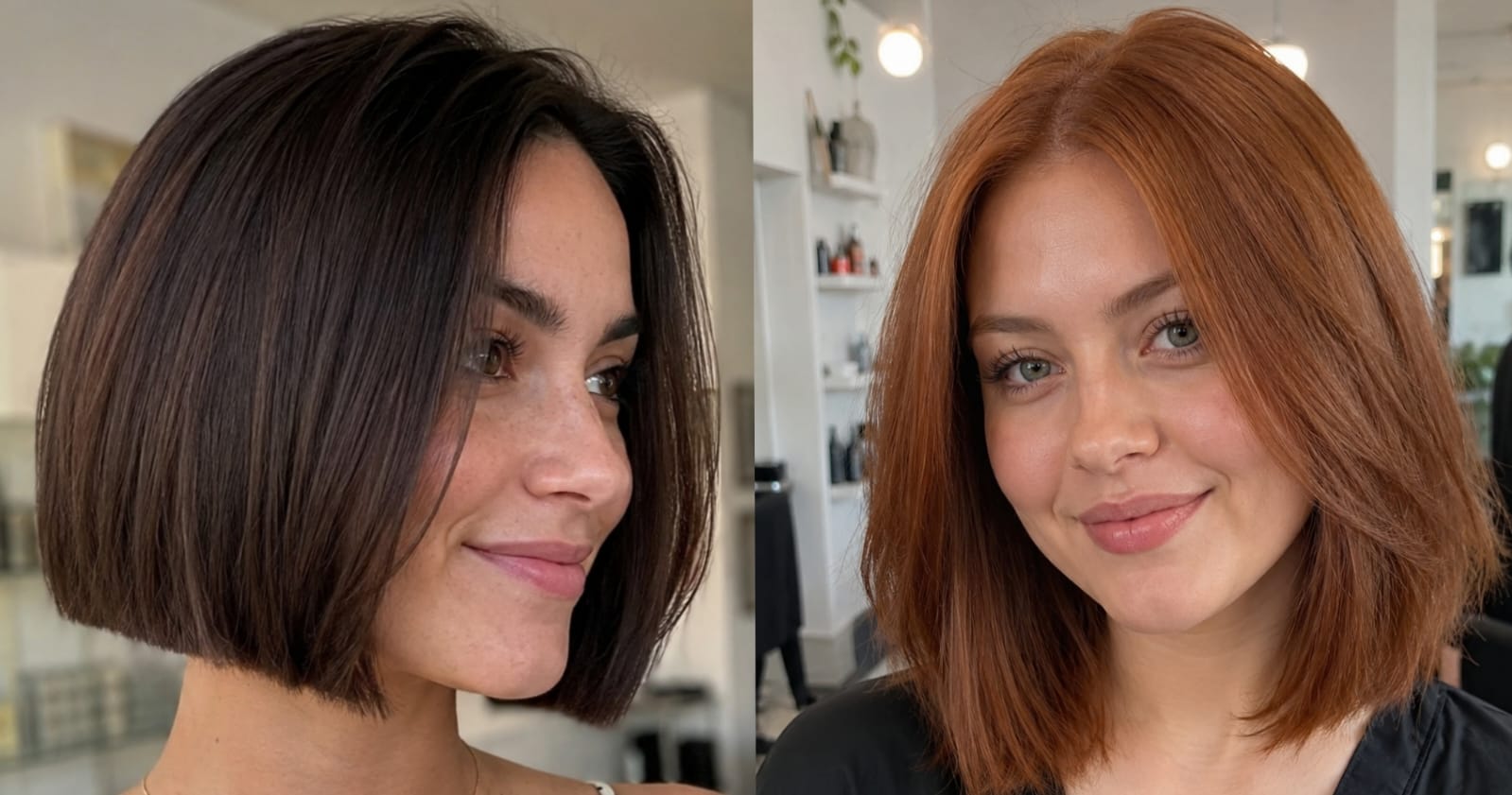
Straight hair has a reputation for being “easy” — and in some ways it is. But that same sleekness that makes it low-maintenance can also make it feel flat, one-note, or stuck in a loop of the same ponytail you’ve been wearing since college. The real challenge with straight hair isn’t managing it. It’s figuring out how to actually do something with it.
Here’s the thing: straight hair is one of the most versatile textures to style. It holds a blowout beautifully, takes to slick, polished looks effortlessly, and can go from undone-casual to put-together in minutes. You just need the right starting points — and that’s exactly what these 16 hairstyles give you.
1. The Classic Blunt Bob

Okay, I’ll be honest — I was scared of this one. Chopping off length felt risky. But the blunt bob completely changed my relationship with my hair.
A blunt bob is a one-length, razor-sharp cut with no layers, creating a bold, polished look that works at chin, jaw, collarbone, or lob lengths. It’s especially flattering for oval, heart, and square face shapes, while round faces should opt for lengths below the chin to elongate the face. My stylist told me the same thing before I sat down in her chair — go longer if you’re worried about it shortening your face.
- Face Shape: Oval, heart, square (longer versions for round)
- Hair Texture: Straight to slightly wavy, fine to medium
- Maintenance Level: High — this cut shows everything
- Trim Frequency: Every 4–6 weeks to keep those lines crisp
- Styling Difficulty: Easy once you own a good paddle brush
- Common Mistake: Going too short too fast — always start at collarbone length first
- Pros: Timeless, incredibly polished, photographs beautifully
- Cons: Grows out awkward if you skip trims
Celebrity hairstylist Cody Renegar says to be ready to invest in regular mini trims every four to six weeks, adding that it’s essential to cut the hair with super sharp scissors, which makes the bob’s bluntness more noticeable and makes the cut last longer. This was news to me — I thought scissors were scissors. Apparently not.
2. Curtain Bangs with Long Straight Hair

This was the style that made me feel like I had a whole new face. I’d been putting off bangs for years because every photo I found looked too heavy. Curtain bangs are nothing like that.
This version works especially well on straight or slightly wavy textures, adding just enough movement to elevate a simple style into something with dimension and polish. Styling with a large round brush, blowing the bangs away from the face to create volume and finishing with a medium hold hairspray locks it all in place.
- Face Shape: Oval, round, heart, square — genuinely flattering on almost everyone
- Hair Texture: Best on straight to lightly wavy hair
- Maintenance Level: Medium — bangs need regular upkeep
- Trim Frequency: Every 3–4 weeks specifically for the bangs
- Styling Difficulty: Medium (the blowout technique takes a week to master)
- Common Mistake: Getting them cut too short or too thick
- Pros: Face-framing, youthful, versatile
- Cons: Forehead oils can make them separate by noon — carry a dry shampoo
I use the Drybar Detox Dry Shampoo between washes and it genuinely saves my bangs on humid days. The R+Co BALLOON Dry Volume Spray is another stylist favorite that keeps them fluffy and full.
3. The Sleek Center Part

This is my “I did nothing but I look like I tried” style. When my straight hair is freshly washed and blown out, a dead-center part with hair falling perfectly on both sides is unbeatable.
The sleek center part works beautifully with straight hair because it accentuates the natural shine and smoothness of the strands. Using a smoothing serum tames flyaways and adds a glossy finish, perfecting the sleekness of straight strands.
- Face Shape: Oval and long faces shine here; less ideal for very round faces
- Hair Texture: Naturally straight or freshly flat-ironed
- Maintenance Level: Low
- Trim Frequency: Every 8–10 weeks depending on length
- Styling Difficulty: Easy
- Common Mistake: Skipping a shine serum — dull hair makes this look flat, not sleek
- Pros: Quick, polished, editorial-ready
- Cons: Shows oily roots faster than a side part
My go-to is the Olaplex No. 7 Bonding Oil — just two drops through the mid-lengths and ends gives that mirror-like finish everyone on Pinterest is chasing.
4. Low Sleek Ponytail

I wore this to a wedding last fall and got more compliments on my hair than I have in years. The key is that it’s not just a regular ponytail — the execution matters a lot.
The low-slung ponytail is a minimalist yet fashionable choice for straight hair. It offers a refined, pulled-together appearance and works well with any length of straight hair. Wrapping a small section of hair around the ponytail base to hide the elastic creates a more polished, runway-inspired finish.
- Face Shape: Flatters all face shapes
- Hair Texture: Works on any straight texture, even fine hair
- Maintenance Level: Low
- Trim Frequency: Whenever you normally trim
- Styling Difficulty: Easy (5 minutes tops)
- Common Mistake: Leaving it loose and frizzy — smooth with a boar bristle brush first
- Pros: Works for everything from errands to events
- Cons: Can cause tension breakage if you do it daily with a tight elastic
Always use a silk or satin scrunchie if you’re wearing this style frequently. It sounds like a small thing until you notice the breakage at your hairline.
5. The Blunt Lob (Long Bob)

This is the big sister of the blunt bob and honestly, it’s the most wearable haircut I’ve ever had. It sits just below the collarbone and somehow flatters everyone in the room.
A lob is versatile: long enough for ponytails, short enough for body. Adding a slight bend with a flat iron adds volume without sacrificing the straight, polished look.
- Face Shape: All face shapes, especially round and square
- Hair Texture: Fine, medium, or thick straight hair
- Maintenance Level: Medium
- Trim Frequency: Every 6–8 weeks
- Styling Difficulty: Easy
- Common Mistake: Over-layering it — the bluntness is the whole point
- Pros: Maximum versatility; can be pinned up, worn down, or braided
- Cons: The in-between grow-out phase is real and slightly awkward
6. Straight Hair with Face-Framing Layers

This is the style I recommend to anyone who’s bored of straight hair but not ready for a cut. The best styles for straight hair include face-framing layers, which add shape, movement, and volume without sacrificing length — perfect for enhancing naturally straight textures. My stylist added layers starting from my cheekbones down and it made such a difference. My hair had dimension it never had before.
- Face Shape: All shapes — layers are customized to flatter yours
- Hair Texture: Works beautifully on fine to thick straight hair
- Maintenance Level: Low to medium
- Trim Frequency: Every 8 weeks to keep layers intentional, not scraggly
- Styling Difficulty: Easy — air dry or blow out with a round brush
- Common Mistake: Getting too many layers, which creates a stringy look on fine hair
- Pros: Movement, dimension, body
- Cons: Requires a skilled stylist cut — bad layers are hard to grow out gracefully
7. Half-Up Half-Down with a Twist or Knot

This is my Saturday afternoon style. It’s casual but intentional, and the center knot version feels way more fashion-forward than it sounds.
A super sleek half-up, half-down style can be turned into even more of a statement by knotting the pony part into itself, as seen on recent runway looks — an effortlessly polished technique that works beautifully on straight hair.
- Face Shape: Oval, heart, square
- Hair Texture: Medium to thick straight hair holds this better
- Maintenance Level: Low
- Trim Frequency: No specific requirement
- Styling Difficulty: Easy once you’ve done it twice
- Common Mistake: Using too much product — it weighs the knot down
- Pros: Gets hair off the face while still showing length
- Cons: Can fall out in humid weather without pins
8. Stick-Straight with Invisible Layers

This is for the girls who want their straight hair to move. Not waves — just movement. Invisible layers are exactly what they sound like: layers you can’t see, but you can absolutely feel. Invisible layers are the secret to movement without obvious layer lines — perfect if you want body without losing fullness.
- Face Shape: Oval, oblong, square
- Hair Texture: Fine to medium
- Maintenance Level: Low
- Trim Frequency: Every 8–10 weeks
- Styling Difficulty: Easy
- Common Mistake: Asking for too many — subtlety is the whole concept
- Pros: Adds life to flat, pin-straight hair
- Cons: Hard to see whether they’ve been cut correctly until the style is done
9. Straight Brunette with Caramel Highlights

This is less a hairstyle and more a whole vibe, but hear me out. The combination of straight texture and warm highlights is the reason half of Pinterest exists.
Caramel highlights break up thick hair beautifully, especially when it’s straight and smooth. The straight style adds movement and helps prevent the hair from feeling too heavy — the result is shiny, soft, and full of dimension.
- Face Shape: Universally flattering depending on highlight placement
- Hair Texture: Especially stunning on medium to thick straight hair
- Maintenance Level: Medium to high (color upkeep every 8–10 weeks)
- Trim Frequency: Every 6–8 weeks to keep ends healthy
- Styling Difficulty: Easy — the color does most of the visual work
- Common Mistake: Going too blonde too fast — gradual highlights look more natural
- Pros: Dimension, warmth, and that effortless glow
- Cons: Color maintenance costs add up quickly
10. Long Straight Hair with Blunt Ends

Simple. Dramatic. Powerful. There is something about really long, really straight hair with a perfectly blunt hem that stops people in their tracks.
Straight, long brunette hair with blunt ends creates a silky, mirror-like finish. The smooth texture allows light to reflect evenly, showcasing the richness of the color from root to tip.
- Face Shape: Oblong, oval, heart
- Hair Texture: Medium to thick — fine hair can look a little stringy at this length
- Maintenance Level: Medium (length requires moisture and protein balance)
- Trim Frequency: Every 10–12 weeks, trim the ends only
- Styling Difficulty: Easy
- Common Mistake: Skipping deep conditioning treatments — long straight hair shows dryness fast
- Pros: Iconic, show-stopping, versatile
- Cons: Takes longer to style and dry; weighs more in a bun
11. Side Part with a Shoulder-Length Cut

There’s something about a classic side part that makes a shoulder-length cut look more intentional. I went through a phase where everything I did felt off — then I switched from a center part to a deep side part and suddenly the whole look came together.
A shoulder-length look frames an oval-shaped face perfectly. Straight or wavy hair are great textures for this style. Regular trimming is key to avoid the hair growing too long and drawing the face downward.
- Face Shape: Oval, square, oblong
- Hair Texture: Fine to medium straight hair
- Maintenance Level: Low
- Trim Frequency: Every 6–8 weeks
- Styling Difficulty: Easy
- Common Mistake: Letting the part get unintentional — use a rat-tail comb for a clean, sharp line
- Pros: Classic and easy to dress up or down
- Cons: Flat-looking if hair isn’t volumized at the root
12. Straight Hair with Blunt Bangs

This is the bold choice on this list. Not for the faint of heart, but absolutely worth considering if you have the right face shape. A blunt bob with bangs is especially flattering for oblong faces and those with a larger forehead and thinner hair density — it’s the perfect face-framing look that serves extra drama when styled straight.
- Face Shape: Oblong, oval — with caution for round faces
- Hair Texture: Straight hair only — this look requires precision flatness
- Maintenance Level: High
- Trim Frequency: Every 2–3 weeks for the bangs specifically
- Styling Difficulty: Medium to hard (bangs curl under from humidity)
- Common Mistake: Cutting them yourself at home — please, please don’t
- Pros: Structured, editorial, statement-making
- Cons: Highest maintenance style on this list by far
13. Straight Platinum with Long Bangs

Platinum has a reflective finish that really comes through on smooth, straight hair. Long bangs add a soft edge and give you options for styling — it’s the kind of look that always feels sleek and is an easy wash-and-wear style for naturally straight hair.
- Face Shape: Oval, heart
- Hair Texture: Medium to thick — bleaching thins fine hair further
- Maintenance Level: Very High (bleach = commitment)
- Trim Frequency: Every 6 weeks to manage breakage
- Styling Difficulty: Easy once the color is done
- Common Mistake: Skipping a toning treatment — brassiness hits platinum fast
- Pros: Eye-catching, sleek, bold
- Cons: Significant chemical upkeep; bond-building treatments like Olaplex are non-negotiable
14. Straight Copper Lob

Copper hair on straight, smooth strands is one of those combinations that just photographs beautifully. The color shifts in natural light in a way that makes people stop and stare.
Copper tones glow even more when your hair is worn straight. The lob length gives some weight and shape without feeling heavy, and you’ll notice the color shifts more in natural light, especially around the ends.
- Face Shape: Oval, round, square
- Hair Texture: Medium to thick
- Maintenance Level: Medium to high (copper fades faster than brunette)
- Trim Frequency: Every 8 weeks
- Styling Difficulty: Easy
- Common Mistake: Using the wrong shampoo — always use a color-safe, sulfate-free formula
- Pros: Vibrant, unique, season-appropriate year-round
- Cons: Color maintenance needed every 6–8 weeks to stay vivid
15. Straight Hair in a Sleek High Ponytail

Different energy from the low ponytail entirely. The high ponytail on straight hair is powerful — it’s the look you wear when you mean business or when you want to feel 6 feet tall.
The trick my stylist taught me: blow dry your hair forward, then flip it back and secure at the crown. This creates volume at the crown that a regular ponytail won’t give you. Wrap a strand around the elastic and pin it underneath.
- Face Shape: All face shapes
- Hair Texture: Fine hair benefits most — gravity helps it lie flat and sleek
- Maintenance Level: Low
- Trim Frequency: No specific requirement
- Styling Difficulty: Easy
- Common Mistake: Pulling too tight too often — this creates traction alopecia over time
- Pros: Instant face lift effect, very polished
- Cons: Not great for hairlines with repeated daily wear
16. The Air-Dry Straight Look (Effortless Undone)
Sometimes the best straight hairstyle is the one you don’t have to work for at all. If you have naturally straight hair, you already know that air-drying with the right products can create something genuinely beautiful. The “air cut” is one of 2025’s trendiest options for straight hair, designed to enhance naturally straight textures with minimal effort while still adding shape and movement.
- Face Shape: Works for any face shape with the right cut underneath
- Hair Texture: Naturally straight hair only — this won’t work on hair that needs to be straightened
- Maintenance Level: Low
- Trim Frequency: Every 8–10 weeks
- Styling Difficulty: Easy
- Common Mistake: Not using any product at all — a small amount of smoothing cream prevents frizz without weighing hair down
- Pros: Zero heat damage, low time investment, naturally healthy-looking
- Cons: Humidity can disrupt the smoothness quickly
I use the Verb Ghost Oil on damp hair before air drying — it adds serious shine without any crunch or stiffness.
How to Protect Your Straight Hair from Heat Damage
No matter which of these styles you’re trying, protecting your hair has to come first. Heat damage can make straight hair appear dry and brittle, exaggerate the appearance of split ends, and make it harder for your hair to lie flat. Not exactly what we’re going for.
A heat protectant creates a protective barrier over the hair shaft to minimize moisture loss, prevent breakage, and reduce frizz caused by high temperatures. To use it effectively, simply spray or apply it evenly to damp or dry hair, then comb through to ensure even distribution before proceeding with heat styling.
My personal favorites are the CHI 44 Iron Guard and the Kenra Platinum Silkening Mist — both affordable, effective, and widely available.
Prevention is key. Choose a shampoo formulated for your hair type and look for formulas that are sulfate-free. I’ve been using a sulfate-free shampoo for two years now and the difference in shine and softness is real.
FAQ
Q: Can I get a blunt bob if my straight hair is really fine? Yes — actually, fine straight hair is one of the best hair types for a blunt bob. The even weight line makes thin hair look fuller and more intentional. Just keep it trimmed regularly.
Q: What’s the best way to add volume to flat, straight hair? The biggest game changers for me were using a volumizing mousse before blow drying, flipping the hair forward during the blow dry, and switching to a lighter conditioner only on the ends. Applying conditioner near the roots is what’s flattening your hair.
Q: How often should I flat iron my straight hair? Ideally, no more than two to three times per week. Daily flat ironing will cause visible damage within a few months — even with a heat protectant. Use it for special occasions and let your hair air dry or blow dry on low the rest of the time.
Q: Are curtain bangs hard to maintain if you have straight hair? They’re actually much easier with straight hair than with curly or wavy hair. The hardest part is the three-week grow-out phase when they’re too long to style properly. Book a bang trim every three to four weeks and you’ll be completely fine.
Q: What’s the most low-maintenance straight hairstyle on this list? The air-dry look, the sleek center part, and the low ponytail are the easiest three. If you want something with a little more structure, the blunt lob is also pretty forgiving between trims.

