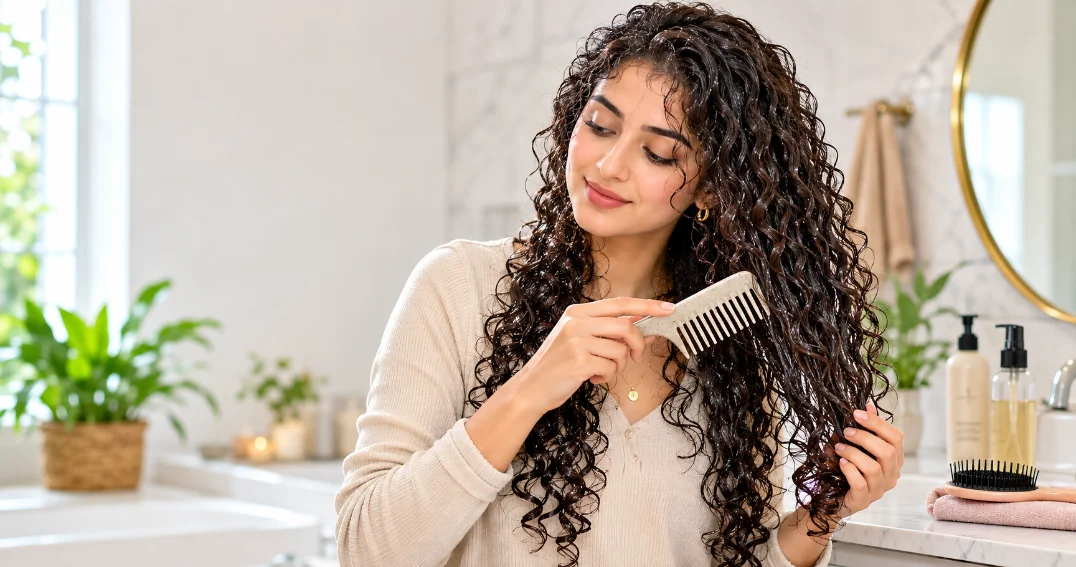
| Quick Answer The best way to brush curly hair is to work section by section while the hair is soaking wet and coated in conditioner or a leave in, always starting at the ends and moving up toward the roots with a wide tooth comb or a flexible detangling brush. Curly hair should almost never be brushed dry, since dry brushing breaks the curl clumps apart and creates frizz rather than definition. |
Curly hair has a reputation for being high maintenance, and honestly, a lot of that reputation comes down to one simple habit: brushing it the wrong way. A curl pattern is fragile in a way that straight hair simply is not, and a few seconds of rough brushing can undo an entire wash day routine, turning smooth clumps into a frizzy halo. The good news is that brushing curly hair correctly is a skill, not a mystery, and once the right tools, timing, and technique come together, detangling stops being a dreaded chore and starts being the step that actually makes curls look their best.
This guide breaks down everything worth knowing about brushing curly hair, from the ends up: the tools that work for each curl type, the wet versus dry debate settled with dermatologist guidance, a full curl type breakdown from 2A to 4C, a step by step method, and the mistakes that quietly cause breakage over time.
Table of Contents
Why Curly Hair Needs a Different Brushing Approach
Straight hair grows out of a round follicle, so the hair shaft is uniform and oil from the scalp travels down it easily. Curly and coily hair grows from an oval or asymmetrical follicle, which is what creates the bend in the strand in the first place. That bend also means natural scalp oils struggle to travel down the length of the hair, leaving curls naturally drier, and it means the cuticle layer (the outermost, shingle like layer of the hair shaft) is more raised and prone to friction at every twist and turn.
Because of that structure, a curl pattern relies on strands staying grouped together in clumps to look defined. Standard brushing, the kind that works fine on straight hair, pulls those clumps apart strand by strand. The result is not smoother hair, it is a fluffy, undefined halo of frizz and, over time, broken strands and single strand knots.
Brushing, Detangling, and Curl Styling Are Not the Same Thing
One gap in most brushing advice is that it treats all brushing as one activity, when curly hair routines actually rely on three distinct actions.
- Detangling: removing knots and shed hair, usually done once during wash day while conditioner is still in the hair.
- Brush styling: using a brush (often a Denman or similar) on soaking wet, product saturated hair to smooth strands into defined clumps, sometimes called the brush and curl or BAC method.
- Refreshing: light finger combing on day two or three hair to reshape curls without fully redoing them.
Detangling is about damage control and only needs to happen once per wash. Brush styling is a deliberate technique for definition and volume, and it uses tension on purpose. Mixing the two up, for example brush styling dry hair or trying to detangle with a stiff paddle brush, is where most of the frizz and breakage complaints come from.
Should Curly Hair Be Brushed Wet or Dry?
For most hair types, wet hair is more fragile than dry hair, since water swells the hair shaft and temporarily loosens the protein bonds that hold it together. That is why general hair care advice usually says to be gentle with wet strands. Curly and coily hair is the exception to that rule. According to the American Academy of Dermatology, curly hair should be detangled while soaking wet and coated in a leave in conditioner, using fingers and a wide tooth comb, and it should not be brushed while dry.
The reasoning is about friction, not just fragility. Dry curly hair has almost no slip between strands, so a brush or comb catches on every twist of every curl, stretching and snapping strands before it ever gets through a tangle. Wet, conditioned hair has slip: the strands glide past each other, so a comb can travel from ends to roots without ripping through the curl pattern. The takeaway is simple. Fragility matters less than friction, and for curls, friction is lowest when the hair is wet and slippery, not dry.
The AAD’s broader styling guidance confirms this split by hair type directly, noting that most people should handle wet hair as little as possible, but people with tightly curled or textured hair should brush their hair when wet to reduce breakage. Both pieces of advice are correct, they simply apply to different hair textures.
The Best Tools for Brushing Curly Hair
Not every brush belongs in a curly hair routine. The right tool depends on whether the hair is wet or dry, and how tight the curl pattern is.
| Tool | Best For | Curl Type | Notes |
| Wide tooth comb | Detangling wet, conditioner coated hair | All curl types, especially 3C to 4C | Gentle, minimal snagging, the safest daily detangling tool |
| Detangling brush (flexible bristle) | Removing knots without pulling clumps apart | 2A to 3B, fine to medium texture | Brands like Tangle Teezer or Wet Brush use flexible teeth that bend around knots |
| Denman brush | Brush styling for definition and volume (the BAC method) | 3A to 4A | Sturdy nylon bristles create the tension that smooths strands into clumps; not meant for daily detangling |
| Boar bristle brush | Distributing scalp oil, smoothing the surface layer | Loose waves, 2A to 2C | Too stiff for tight coils, can create frizz on 3B and tighter patterns |
| Fingers (finger detangling) | The gentlest possible detangling, best for fragile or damaged hair | 3C to 4C, low porosity or damaged hair | Slower, but allows total control over tension around fragile coils |
A brush is never a substitute for the hands and eyes doing the actual work. Even the best detangling brush needs to be paired with sectioning and product, or it will still catch on knots and pull at the roots.
How to Brush Curly Hair by Curl Type (2A to 4C)
The curl typing system most people use today (2A through 4C) traces back to a hair chart created by celebrity stylist Andre Walker in the 1990s. His original system stopped at 4B; the natural hair community later added 3C and 4C to fill in gaps that people needed language for. It is not a scientific classification, but it is a useful shorthand for matching technique to curl pattern.
| Curl Type | Description | Brushing Frequency | Best Approach |
| 2A to 2C (wavy) | Loose S shaped waves to voluminous, frizz prone waves | Daily, wet or damp | Wide tooth comb or flexible detangling brush on wet hair; a boar bristle brush can smooth dry waves lightly |
| 3A to 3B (curly) | Loose spirals to bouncy, springy ringlets | On wash day, wet and conditioned | Wide tooth comb to detangle, then a Denman brush for brush styling if more definition is wanted |
| 3C (curly) | Tightly packed, pencil sized corkscrew curls, added by the natural hair community | On wash day only, in sections | Detangle in small sections with a wide tooth comb and plenty of leave in conditioner or conditioner slip |
| 4A to 4B (coily) | Densely packed S shaped or Z shaped coils with significant shrinkage | On wash day, minimal in between | Finger detangle first, then a wide tooth comb in small sections; avoid brushes with rigid bristles |
| 4C (coily) | Tightest coil pattern, minimal visible curl definition when dry, most fragile texture | On wash day only, very gently | Finger detangling is usually safest; if a brush is used, choose the softest, most flexible option and work in small sections |
Not sure which category applies? Wash the hair with a gentle cleanser, skip styling products, and let it air dry to see the natural pattern. Pairing that pattern with the right cut also matters. Readers figuring out their curl type often find it helpful to look through this breakdown of hairstyles suited to every hair type, from fine straight to tight coily, or explore a protective option like crochet styles for curly and coily hair for the days when detangling needs a break.
How Hair Porosity Changes the Brushing Routine
Porosity describes how easily the hair’s cuticle lets moisture in and out, and it matters just as much as curl type when deciding how to detangle. Low porosity hair has a tightly shut cuticle that resists moisture, so it needs more slip (heavier conditioner or a dedicated detangling product) before a comb will move through it smoothly. High porosity hair has a raised, more open cuticle that soaks up moisture quickly but also tangles and frizzes easily, so it benefits from lightweight leave ins and extra gentle handling since the strand itself is often already more fragile. A fast way to estimate porosity at home is the float test: a clean strand of hair dropped into a glass of water that sinks quickly usually points to high porosity, while a strand that floats for several minutes usually points to low porosity.
How to Brush Curly Hair Step by Step
This is the core method that works across most curl types from 2A to 4B, adjusted in small ways for tighter coils as noted above.
1. Start in the shower with conditioner in

Begin detangling while a rinse out conditioner is still in the hair. This gives maximum slip and is far gentler than detangling on dry or product free strands.
2. Divide the hair into four to six sections

Working on one small section at a time, secured with clips, means the comb never has to fight through the full density of the head at once.
3. Apply a leave in conditioner or detangling spray

Once out of the shower, mist or apply a leave in conditioner to each section before touching it with any tool, to maintain slip as the hair starts to dry.
4. Start at the very ends

Hold the section firmly an inch or two above where the comb is working, and clear knots from the bottom two inches first.
5. Work upward in small increments

Move the comb up an inch at a time, re gripping above each new section, until the entire piece is smooth from root to end.
6. Switch to a Denman or styling brush if defining curls

For those who want more clump definition (the brush and curl or BAC method), run a Denman brush through each wet, product coated section in one smooth motion after detangling.
7. Seal with a curl cream or gel

Apply a styling product to each section immediately after brushing to lock in the smoothed clump before it has a chance to frizz.
What to Do After Brushing: Locking In the Style
Brushing is only half the job. Once curls are smoothed and clumped, how they dry determines whether that work holds. Scrunching, pressing damp hair upward into the palm to encourage curls to clump further, adds bounce right after product application. Plopping, wrapping soaking wet hair in a microfiber towel or soft cotton t shirt for ten to twenty minutes, removes excess water without the friction of a regular towel, which helps prevent the frizz that undoes a careful brush out. Diffusing on low heat and low speed, or simply air drying undisturbed, finishes the job. Touching, restyling, or brushing the hair again while it is drying is one of the fastest ways to reverse all of that earlier work.
For low maintenance days between wash sessions, a loosely gathered style like a messy bun for curly hair keeps curls protected without undoing definition, and a soft side part can refresh the whole look without a full re-wet.
How Often Should Curly Hair Be Brushed?
As a general rule, curly and coily hair should be fully detangled once per wash day, not daily. Daily brushing on dry curls breaks up clumps, strips definition, and adds unnecessary friction and breakage over time. Looser waves (2A to 2C) can usually tolerate light daily finger combing or a soft brush pass without much disruption, since the curl pattern is more resilient. Tighter patterns (3C to 4C) hold up best with a single, thorough wet detangling session per wash, followed only by gentle finger separation or a light misting to refresh curls in between.
Signs the Brushing Technique Needs to Change
- Excess frizz appears within minutes of brushing, even on wet hair with product applied.
- Curl clumps look separated or fluffy immediately after styling instead of grouped and defined.
- Short broken pieces show up around the hairline or on clothing, a sign of breakage rather than normal shedding.
- The scalp feels sore or tight after detangling, which usually points to too much tension or brushing too close to the root.
- Single strand knots (small, tight knots that form within one strand of hair) are common, often a sign the hair is being handled dry or without enough product.
A useful distinction: normal shedding looks like full strands with a small white bulb at one end, and it is a routine part of the hair growth cycle. Breakage looks like short, uneven pieces with no bulb, snapped mid strand, and it is a direct result of too much tension, friction, or the wrong tool.
Common Mistakes to Avoid
- Brushing dry curls: the single most common mistake, and the fastest way to create a frizzy, undefined halo.
- Starting at the roots: pushes every knot below down into one dense tangle instead of clearing them individually.
- Skipping the leave in or conditioner: brushing without slip means more friction, and friction is what causes breakage.
- Using the wrong brush for the curl type: a stiff paddle brush on 4C coils, or a heavy Denman on fine 2A waves, causes more damage than it prevents.
- Overbrushing: running a brush through the same section repeatedly does not add smoothness, it adds friction and breaks down curl clumps that were already defined.
- Restyling once hair is drying: touching or brushing hair that is 60 to 90 percent dry reactivates frizz and disrupts the cast that was holding curls in place.
Myth vs Fact: Brushing Curly Hair
| Myth | Fact |
| Brushing 100 strokes a day keeps curls healthy. | That advice dates back to boar bristle era straight hair care. On curly hair, frequent brushing breaks up clumps and increases frizz and breakage. |
| Curly hair should never be brushed with a brush, only fingers. | Brushes are fine, and even useful for definition, as long as they are used on wet, product coated hair rather than dry curls. |
| Detangling should start at the roots to work out knots faster. | Starting at the roots pushes tangles downward into a bigger knot. Ends first is always safer. |
| Thicker curls are automatically stronger and can handle rougher brushing. | Thickness is not the same as strand strength. Type 4 hair, despite looking dense, often has fewer cuticle layers and is the most fragile curl category. |
How to Clean a Curly Hair Brush (and Why It Matters)
A brush that is full of shed hair, dried product, and scalp oil cannot glide through curls smoothly, which means more friction on every single use. It also transfers buildup back onto clean hair right after a wash, which can weigh curls down or contribute to scalp irritation. A simple routine keeps tools working properly: remove trapped hair after every use, then once a week soak the brush head in warm water with a few drops of clarifying shampoo or gentle soap for ten minutes, scrub the base of the bristles with an old toothbrush to clear product buildup, rinse thoroughly, and let it air dry bristle side down so water does not pool in the base.
Brushing Curly Hair for Kids
The same core rules apply to children’s curly hair, with a lighter touch. Detangling works best right after a bath while conditioner is still in, using fingers first to loosen the biggest knots before introducing a wide tooth comb, since a young scalp is more sensitive to tension. Breaking the process into a game, such as counting sections or letting a child hold their own detangling spray bottle, helps reduce the fidgeting that leads to accidental tugging. Trimming a small amount of length every few months also helps, since split ends tangle more easily than healthy ones and make the whole process harder on both a parent and a child.
FAQ
Is it better to brush curly hair wet or dry?
Wet is better for almost all curl types. Wet, conditioned hair has slip that lets a comb or brush glide through without snagging, while dry curls have far more friction and tend to frizz or break under a brush.
What brush is best for curly hair?
A wide tooth comb is the safest daily detangling tool for every curl type. A Denman or similar flexible bristle brush works well for adding definition to wet, product coated curls, and finger detangling is often the gentlest option for very tight 3C to 4C coils.
Should curly hair be brushed every day?
No. Most curl patterns only need a full detangling session once per wash day. Daily brushing on dry curls breaks up clumps and creates unnecessary frizz and breakage.
Why does brushing curly hair cause frizz?
Brushing separates the strands within a curl clump. Since curl definition depends on strands clumping together, pulling them apart, especially on dry hair, exposes more surface area to air and humidity, which shows up as frizz.
Does brushing curly hair damage it?
Brushing itself is not damaging when done correctly. Brushing dry hair, starting at the roots, or using a stiff brush not suited to the curl pattern is what leads to breakage over time.
Can finger detangling replace a brush entirely?
Yes, for many curl types, especially tighter coily patterns. Finger detangling takes longer but offers the most control over tension, which is why it is often recommended for fragile or low porosity hair.
What is the difference between a Denman brush and a detangling brush?
A Denman has sturdy, closely set nylon bristles designed to create tension for curl definition and is typically used on wet, product saturated hair. A detangling brush has flexible, widely spaced bristles designed to bend around knots with minimal pulling, and is meant purely for removing tangles.
Final Takeaway
Brushing curly hair well comes down to three habits: work on wet, conditioned hair rather than dry, always start from the ends and move up, and match the tool (wide tooth comb, detangling brush, Denman, or fingers) to the curl type and porosity involved. Once those three pieces are in place, brushing stops being the step that ruins curl definition and becomes the step that builds it.
For more on choosing the right cut and part for a natural curl pattern, see this guide on how to choose a new hairstyle that actually works with your hair’s natural movement, or browse wavy haircut ideas for texture specific cut inspiration.

