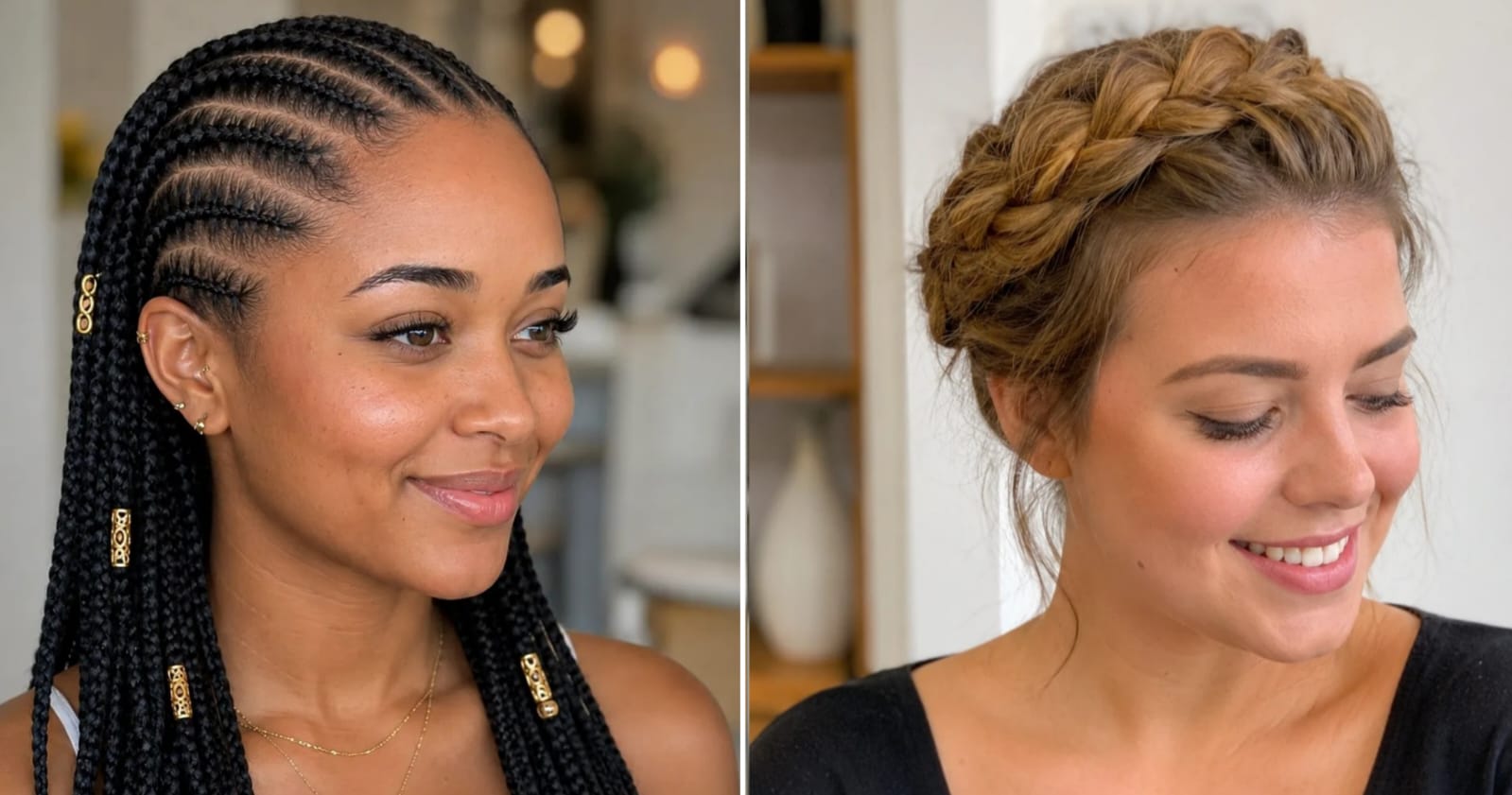
Braids have a way of looking effortless and intricate at the same time — which is exactly why they never really go out of style. What does change is how people wear them. Right now, the styles getting the most attention are a long way from the basic three-strand plait you learned as a kid, and the range is genuinely impressive: sculptural cornrows, soft boho twists, chunky updos, and everything in between.
The other thing worth knowing? Braids aren’t just for long hair or a specific texture. Whether your hair is fine and straight or thick and coily, there’s a braid style in this list that works with what you’ve got — not against it. If you’ve been exploring different braid styles and want to see what’s actually trending right now, you’re in the right place. Here are 14 braid hairstyles that are genuinely having a moment.
1. Classic Box Braids

Box braids are those iconic square-sectioned individual braids you’ve seen everywhere — and for good reason. They’re protective, low manipulation, and the morning routine basically disappears overnight.
The catch? Tight braids worn repeatedly can weaken hair follicles, leading to thinning edges and bald spots if not addressed early. Always speak up during installation if something hurts.
- Best Face Shape: Oval, heart, square
- Hair Texture: 3C–4C, medium to thick density
- Maintenance Level: Low
- Styling Difficulty: Hard — professional recommended
- Common Mistake: Going too long or too thick; heavy braids = more tension on roots
- Pros: Long-lasting (6–8 weeks), extremely versatile
- Cons: Can dry out hair underneath if you skip weekly moisturizing
2. Knotless Braids

Knotless braids are box braids’ gentler, smarter younger sibling. I switched two years ago and never looked back. They cost more and take longer, but the scalp comfort is completely different from day one.
With knotless braids, you have instant flexibility to style and manipulate the hair from day one — unlike traditional box braids, where your scalp needs a few days to relax before you can style them. Gradually adding hair mid-braid means less chance of traction alopecia and follicle damage.
- Best Face Shape: All face shapes; especially flattering on round faces with a middle part
- Hair Texture: All natural textures; great for fragile edges
- Maintenance Level: Low to Medium
- Styling Difficulty: Hard — go to a professional
- Common Mistake: Leaving them in past 8 weeks — the weight eventually pulls on roots
- Pros: Scalp-friendly, natural look at the roots, comfortable immediately
- Cons: Higher cost; doesn’t last quite as long as traditional box braids
3. Cornrows

Cornrows were my very first braid experience — my mom doing them on Sunday nights before school. They’re braided flat against the scalp in rows and can go straight back, curved, or styled into patterns that are genuinely works of art.
They’re also the most versatile base style out there. Wear them alone, under a wig, or add extensions on top for a full protective set.
- Best Face Shape: Oval, oblong, heart
- Hair Texture: Best on 3C–4C with at least 2 inches of length
- Maintenance Level: Low
- Styling Difficulty: Medium — DIY possible with practice; professional for patterns
- Common Mistake: Braiding too tightly at the nape — that area is extremely sensitive
- Pros: Great for under wigs and weaves, very long-lasting
- Cons: Can cause breakage on fine-textured hair if installed with too much tension
4. French Braid

I watched so many tutorials before my French braid actually looked decent. But once it clicked, it never left my rotation. It’s that flat-against-the-head three-strand braid where you pick up new sections as you go — polished, simple, and perfect for second-day hair.
The trick is slightly damp or texturized hair before you start. A tiny spritz of water and a dab of Got2b Glued Gel keeps sections together without frizzing out midway.
- Best Face Shape: Oval, round, heart
- Hair Texture: Straight to wavy; fine to medium density
- Maintenance Level: Low — redo daily or every other day
- Styling Difficulty: Medium — takes practice to self-braid
- Common Mistake: Braiding too tightly from the start; it creates tension and pulls the hairline
- Pros: No fancy tools needed, polished look in minutes
- Cons: Needs to be redone frequently; doesn’t hold overnight
5. Dutch Braid

Think French braid — but you cross the strands under instead of over. That tiny change makes the braid pop out on top of the hair in a beautiful raised, 3D effect. I wear mine in double Dutch braids on gym days and genuinely feel unstoppable.
For fine hair, mousse works better than gel here. It gives grip without weighing strands down and keeps the style looking full instead of flat.
- Best Face Shape: Oval, square, round
- Hair Texture: Medium to thick works best; fine hair can work with volumizing products
- Maintenance Level: Low to Medium
- Styling Difficulty: Medium to Hard — self-braiding takes real mirror practice
- Common Mistake: Starting too close to the hairline, which creates uncomfortable pulling
- Pros: Eye-catching, stays put longer than a basic braid, great for active lifestyles
- Cons: Hard to do on yourself without a lot of practice
6. Fishtail Braid

The fishtail looks like you spent an hour on it. The actual secret? It’s just two sections — you alternate taking small pieces from the outer edge of each side and crossing them over. That’s literally it.
Once you get the hang of it, a fishtail is one of the easiest ways to style your hair and looks appropriate for any occasion, from bridal to runway — and it can be as neat or as messy as you want.
- Best Face Shape: All face shapes; side fishtail is especially flattering on heart-shaped faces
- Hair Texture: Straight to wavy; longer hair is easier
- Maintenance Level: Low — remake daily
- Styling Difficulty: Easy once learned
- Common Mistake: Taking sections that are too large — smaller pieces = more intricate, beautiful result
- Pros: Looks complex, takes 5 minutes, no tools needed
- Cons: Doesn’t work well on very short or heavily layered hair
7. Fulani Braids

I first saw Fulani braids at a rooftop party and immediately asked the woman where she got her hair done. The style features cornrows along the front and sides with longer hanging braids, decorated with gold cuffs and beads. It is genuinely one of the most stunning styles I’ve ever worn.
Fulani braids originate from the Fulani people, a nomadic ethnic group of West Africa, where braiding is traditionally used to express identity, heritage, and social status — with beads, cowrie shells, and decorative elements symbolizing beauty and cultural pride. When you wear these, you’re carrying centuries of culture forward.
- Best Face Shape: Oval, round, square — the side braids frame and balance most features
- Hair Texture: Natural 3C–4C; extensions typically added for length
- Maintenance Level: Medium
- Styling Difficulty: Hard — professional recommended for the traditional pattern
- Common Mistake: Skipping the beads and cuffs — they’re what make the style recognizable and intentional
- Pros: Stunning, culturally rich, works for casual and formal settings
- Cons: Intricate installation takes time; not ideal for very fine or short hair without extensions
8. Lemonade Braids

Beyoncé’s 2016 Lemonade visual album made these iconic and they’ve never really left. Lemonade braids are cornrows that go sideways — laying across the head horizontally or diagonally instead of straight back. Bold, sleek, and they make a statement before you even open your mouth.
These tend to put more tension on the edges because of that sideways pulling direction. Ask your stylist specifically to ease up at your hairline, and use Jamaican Black Castor Oil daily on your edges once installed.
- Best Face Shape: Oval, oblong — the side direction adds horizontal width beautifully
- Hair Texture: Natural 3C–4C; medium to thick density
- Maintenance Level: Low to Medium
- Styling Difficulty: Hard — professional only
- Common Mistake: Too much tension at the temples; side-directional braids are notorious for edge pulling
- Pros: Incredibly chic, long-lasting, very Pinterest-worthy
- Cons: More edge tension than straight-back styles; not beginner-friendly to install
9. Ghana Braids (Feed-In Braids)

Ghana braids are thick cornrows where extensions get gradually fed in as the braid progresses — starting small at the front and getting thicker toward the back. The result is a super clean, defined look that I love for summer because they sit close to the scalp and handle humidity really well.
They last up to three weeks with proper care and look completely fresh the whole time. Daily scalp oiling is non-negotiable with these — because they lay so flat, the scalp dries out fast without moisture.
- Best Face Shape: Oval, heart, oblong
- Hair Texture: Natural 3C–4C; medium to thick density
- Maintenance Level: Low
- Styling Difficulty: Hard — skilled professional recommended
- Common Mistake: Skipping daily scalp oil — these dry out faster than you’d expect
- Pros: Very sleek, great for summer heat, surprisingly long-lasting
- Cons: Installation requires serious skill; poor feed-in technique looks very obvious
10. Crown Braid

There is something almost magical about a crown braid. It wraps around your head like a halo, and somehow it works for a farmers market run and a black-tie event equally well. I’ve worn mine to weddings, beach days, and casual brunches without changing a thing.
The crown braid is two regular braids on either side that you pin across the top meeting in the middle. Bobby pins and texture spray are your best friends. Leaving out a couple of face-framing pieces around the front softens the whole look beautifully.
- Best Face Shape: Round, square — the upward lift elongates and balances
- Hair Texture: Medium to thick holds best; fine hair needs texture spray or dry shampoo for grip
- Maintenance Level: Medium — redo every 1–2 days
- Styling Difficulty: Medium — doable at home with practice
- Common Mistake: Pinning the braids too flat — lift them slightly for the full halo effect
- Pros: Elegant, keeps hair off the face completely, works for all occasions
- Cons: Requires enough length to wrap around; very short hair won’t get there
11. Micro Braids

Micro braids are tiny, delicate individual braids that take hours to install and feel absolutely worth every minute when you see the finished look. They have this feathery, soft movement that no other style quite replicates.
But the removal process is just as serious as the installation. Leaving protective styles in for too long — more than 4–6 weeks — can lead to excessive tension, severe breakage, and even permanent hair loss that takes years to recover from. With micro braids especially, don’t push past six weeks no matter how good they still look.
- Best Face Shape: Oval, oblong, heart — fine texture doesn’t overwhelm delicate features
- Hair Texture: Medium to thick; too-fine hair thins out over time with this style
- Maintenance Level: Medium
- Styling Difficulty: Hard — professional only; plan for a very long appointment
- Common Mistake: Keeping them in past 6 weeks; regrowth creates serious root tension
- Pros: Incredibly beautiful, lightweight feel, very versatile
- Cons: Long and expensive installation; removal takes significant effort and patience
12. Goddess Braids

Goddess braids are thick, raised cornrows — bigger and more sculptural than Ghana braids. They have a regal quality that completely earns their name. I’ve seen them done in two big cornrows straight back, in curved S-shapes, and fanned out dramatically across the whole head.
Goddess braids add volume and texture that enhances features, while curly or wavy ends soften the overall look and create a romantic, ethereal vibe. The combination of bold structure and softness is what makes them work on almost everyone.
- Best Face Shape: Oval, square, round — the thick volume balances most features well
- Hair Texture: 3A–4C; medium to thick density
- Maintenance Level: Low
- Styling Difficulty: Hard — professional recommended
- Common Mistake: Making them too small — goddess braids lose their drama when they’re not substantial
- Pros: Bold and striking, long-lasting, regal look for any occasion
- Cons: Can feel heavy with added extensions; not ideal for very fine hair
13. Waterfall Braid

The waterfall braid is the one that makes people stop and ask who did your hair — and the answer can be you, your bathroom mirror, and a little patience. It’s a French braid variation where you drop sections through instead of picking them up, creating that cascading waterfall effect down the side.
It works beautifully with longer hair that has natural wave or curl. A light curl-enhancing cream on the dropped sections makes the waterfall look lush and intentional instead of just messy.
- Best Face Shape: Heart, oval — the side sweep frames and softens beautifully
- Hair Texture: Wavy to curly works best; straight hair needs a texturizing spray first
- Maintenance Level: Low — redo fresh each time
- Styling Difficulty: Hard for beginners; Medium once practiced
- Common Mistake: Letting too much hair fall through — smaller drops look far more elegant
- Pros: Gorgeous for special occasions, romantic and feminine, genuinely turns heads
- Cons: Shorter hair can’t pull it off easily; doesn’t hold as long as other styles
14. Boho Box Braids (Braids with Curly Ends)

This is my most-returned-to style every single summer. Boho box braids are regular box braids with wavy or curly extensions peeking out at the ends — giving you that relaxed, effortless festival look that somehow also works for dinner out.
The loose braiding and soft curly finish of boho braids gently frames the face, making it appear slimmer and more defined — a perfect combination of laid-back vibe with a touch of elegance. Ask your stylist to blend Freetress Water Wave hair into the ends for the most natural, beachy result.
- Best Face Shape: Round, heart, oval — soft curls add dimension without overwhelming
- Hair Texture: 3C–4C natural hair; medium to thick density
- Maintenance Level: Medium — curly ends need moisture to stay defined
- Styling Difficulty: Hard — professional recommended for seamless blending
- Common Mistake: Using too much hair per braid — heavy boho braids droop fast and lose their airy look
- Pros: Beautiful texture contrast, very on-trend, versatile for casual and dressy occasions
- Cons: Curly ends tangle or frizz faster without regular moisture and gentle handling
A Quick Word on Scalp Health
Before you book your next appointment, keep this in mind. Wearing tight braids or hairstyles that are tightly pulled back for long periods can damage hair follicles and lead to traction alopecia. Giving your scalp at least two weeks to recover between sets — and never keeping braids in longer than 6–8 weeks — is one of the most important things you can do for long-term hair health. If it hurts during installation, say something. A good stylist will always listen.
FAQ
Q: How long do braids typically last? Cornrows and knotless braids last around 4–6 weeks with good care. Traditional box braids can go up to 8 weeks. Everyday styles like French and fishtail braids need to be redone daily or every couple of days.
Q: Which braid is best for beginners who want to DIY? Start with a basic three-strand braid, then move to the fishtail once that feels natural. French and Dutch braids are next — they take practice but are totally learnable at home.
Q: Can I braid my hair if it’s fine or low density? Yes, but be cautious about tension and weight. Avoid heavy extensions, choose lighter styles like mini cornrows or a simple French braid, and always communicate your hair’s fragility to your stylist upfront.
Q: How do I stop my scalp from getting itchy under braids? Use a diluted sulfate-free shampoo to cleanse your scalp every 1–2 weeks. Follow with a lightweight scalp oil like diluted tea tree or peppermint oil. Avoid heavy butters directly on the scalp while braided — they build up fast and make itching worse.
Final Thoughts
Braids aren’t just a hairstyle. They’re a whole lifestyle — a way of taking care of yourself, expressing who you are, and giving your hair a break from daily manipulation. But the key to loving braids long-term is choosing styles that work with your hair’s natural texture and density, not fighting against it.
Start with what excites you most. Ask your stylist questions. Speak up if something feels too tight. Moisturize your scalp weekly. And take those breaks between sets — your edges will thank you for years to come.

