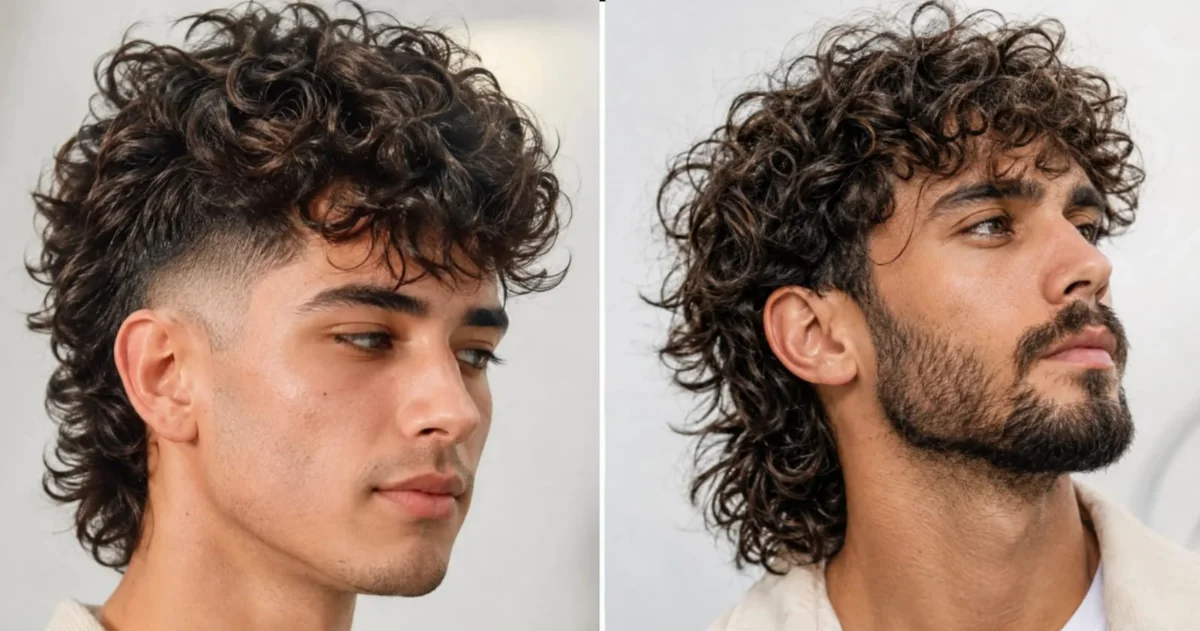
Curly hair and the modern mullet turn out to be a genuinely good match, and the numbers back that up as much as the barbershops do. This guide covers everything a man with wavy, curly or coily hair needs before booking the cut: which curl types suit it best, how to talk to a barber about it, what it actually costs, and eighteen real style directions to bring in as reference.
Not every curl pattern is built for length, though, and that’s worth saying upfront. If your curls are tighter, your hairline is receding, or you’d simply rather keep maintenance low, the mullet isn’t your only lane — it’s worth browsing our guide to short haircuts for men before you commit to growing anything out. But for the guys whose curl pattern does have the bounce and volume this cut wants, the payoff is a shape that looks intentional instead of “grown-out,” and that’s exactly what the rest of this guide will help you nail down.
| Question | Short Answer |
|---|---|
| Does a curly mullet work for men? | Yes. Curl adds natural volume and texture that a mullet needs, so curly and wavy hair often looks fuller with less styling effort than straight hair does. |
| Best curl types for it? | 2B to 3B tends to be the easiest starting point. Tighter coils (3C to 4C) still work but need a barber who specializes in textured cuts. |
| How long to grow one out? | Roughly 3 to 6 months from a short cut, depending on how much back length is wanted and how fast the hair grows. |
| How often to trim? | Every 4 to 7 weeks, depending on whether the sides are faded or just tapered. |
| What does it cost? | About $25 to $50 at a standard barbershop, often $50 to $90+ with a specialist who works regularly with curly or textured hair. |
| Cut wet or dry? | Both methods are used by real curl specialists. Dry cutting shows true shrinkage; damp cutting (like the Carve and Slice method) shows the curl pattern before it fully springs up. Either is fine as long as the barber works with curls often. |
Table of Contents
What Is a Modern Mullet on Curly Hair?
A modern mullet keeps the classic shape (shorter through the front and sides, longer at the back) but updates it with a blended fade or taper instead of one hard, uneven line. On curly hair specifically, the curl pattern does a lot of the visual work on its own. The top gets natural lift without a blow dryer, and the back gets movement and bounce that a straight-haired mullet has to be styled into.
How It Differs From the Classic ’80s Mullet
The original mullet was often one length, chopped bluntly across the back with little thought given to the sides. The modern version is built in layers, uses a proper fade or taper for the transition, and treats the back as its own shaped section rather than an afterthought. On curly hair, that layering matters even more, since curls need internal shaping to avoid the bulky, triangular look that can happen when curly hair is cut all one length.
Mullet vs. Shag vs. Wolf Cut on Curly Hair
These three get confused constantly, and curly hair makes the lines blurrier. A useful rule of thumb, borrowed from a real working stylist profiled by NPR: if the ears are fully exposed and the back has a clear length drop, it reads as a mullet. If the sides are worn longer and cover the ears, it edges into shag territory instead. The wolf cut sits in between, combining a mullet’s back length with a shag’s heavier, choppier layering throughout. On curly hair, the wolf cut and the curly mullet often look similar in photos, so it is worth being specific with a barber about which one is actually being requested.
Why the Modern Curly Mullet Is Trending Right Now
This is not a fringe trend. According to search-tracking platform Rising Trends, “modern mullet” pulled roughly 450,000 monthly searches in the United States as of mid-2026, making it the second-most-searched named haircut after the low taper fade, and notably a cut that spans both men’s and women’s styling searches. That is a serious volume of men actively looking this cut up before booking it.
The demand has real staying power behind it, too. A national survey of 2,000 American men, conducted by OnePoll on behalf of Sport Clips Haircuts, found that one in five men (20%) named the mullet the vintage hairstyle they would most want brought back into regular rotation. The same survey found that 55% of men want to change their look but hold back out of fear of trying something bold, which helps explain why so many men research the cut heavily before committing to it.
Celebrity visibility keeps feeding the trend as well. Fashion trade press has reported a sharp year-over-year jump in searches for the low-key “mini mullet” variation following recent awards-season red carpets, with several younger male stars wearing softer, shorter takes on the cut. TikTok has played a similar role at the barbershop level: stylists report a steady stream of clients arriving with a saved video rather than a static photo, asking for a specific fade height or back length they saw online.
Is a Curly Mullet Right for You?
Best Curl Types for a Mullet
Curl pattern matters more than most men expect going in.
- Wavy hair (roughly 2A to 2C on the standard hair-typing scale) suits a softer, shaggier mullet, since the movement is subtle and needs the extra length at the back to really show.
- Curly hair (3A to 3B) is arguably the easiest starting point. The curls provide built-in volume and definition without much daily effort.
- Tighter curls (3C) hold shape well and look striking with a fade, though the crown may need extra thinning to avoid excess bulk.
- Coily and kinky hair (4A to 4C) absolutely works, but it benefits from a barber who specifically understands how to layer and shape coily textures, since the shrinkage is more dramatic and the density is usually higher.
When to Think Twice
A mullet draws attention to the crown, so thinning hair at the top can work against the style rather than for it. Very fine, low-density curls may also struggle to hold the “fullness” that makes a mullet read as intentional rather than just uneven. In either case, a shorter cut with more uniform layering is often the safer starting point, and a barber should say so honestly during a consultation.
The Best Modern Mullet Styles by Curl Type
Wavy Curls (2A to 2C)

Wavy texture pairs best with a shaggy, softly layered mullet rather than a sharply defined one. Since the wave pattern is looser, it benefits from a bit of extra length at the back to build enough visual weight, and a light sea salt spray brings out natural texture without weighing it down.
Curly (3A to 3B)

This range handles almost any variation well, from a tight burst fade to a longer, looser back section. A leave-in conditioner followed by a lightweight curl cream is usually enough to keep the shape defined through the day.
Coily and Kinky (4A to 4C)

Coily hair holds a mullet’s shape exceptionally well once it is cut, since the density naturally supports the fuller silhouette. A barber experienced with textured hair will typically layer more at the crown to control bulk, and a heavier butter or cream helps manage shrinkage and definition.
18 Modern Mullet Curly Hair Styles to Show Your Barber
1. Low Fade Curly Mullet

A subtle, gradual fade that keeps things office-friendly while still showing off curl texture on top and length in the back. If you’re not sold on the mullet specifically, this fade height alone is worth exploring further in our low fade haircuts guide.
2. High Fade Curly Mullet

Sharp contrast between the closely faded sides and the fuller curly crown, best suited to thicker, denser curl patterns.
3. Burst Fade Curly Mullet

The fade curves around the ear rather than straight up the side, keeping the back section full while still looking sharp and intentional.
4. Skin Fade Curly Mullet

The boldest contrast option, taking the sides down to bare skin for maximum focus on the curly length up top and at the back.
5. Taper Curly Mullet

A softer, more gradual transition than a fade, good for men who want a lower-maintenance regrowth schedule between barber visits.
6. Curly Wolf Cut Mullet

Heavier, choppier layering throughout, blending mullet-length back with shag-style volume everywhere else.
7. Shaggy Curly Mullet

Loose, undone layers with minimal precision shaping, ideal for wavy to curly textures that already have natural movement.
8. Short Curly Mullet

A compact version with only an inch or two of extra length at the nape, the easiest entry point for anyone unsure about commitment.
9. Long Curly Mullet

Significant back length paired with shorter sides, a bolder statement cut that needs more patience to grow into.
10. Curly Mullet With Beard

Pairing a full or medium beard with the cut balances proportions nicely, especially on square or angular face shapes.
11. Curly Fringe Mullet

A soft, curled fringe left longer at the front adds a face-framing element that works well on oval and heart face shapes.
12. Undercut Curly Mullet

Closely shaved or clippered sides paired with a fuller, longer curly top and back for maximum textural contrast.
13. Curly Afro Mullet

Built specifically for coily and kinky textures, keeping the natural volume up top and back while defining the sides.
14. Blonde or Bleached Curly Mullet

Lightened curls add extra dimension and make individual curl clumps more visible, though it requires more upkeep to manage damage.
15. Grown-Out Curly Mullet

For anyone past the awkward stage of growing hair out, blending longer sides into the back length for a softer, less structured shape.
16. Mini Mullet (Baby Mullet), Curly

A subtle, low-commitment version with barely an inch of extra length at the nape, currently one of the fastest-growing search terms in the mullet category.
17. Curly Mullet With Curtain Fringe

A center-parted, curled fringe on either side of the face, softer and more polished than a straight-across fringe.
18. Textured Crop Curly Mullet

A shorter, cropped front blended into mullet length at the back, a hybrid look for men who want the trend without going too dramatic.
Which Curly Mullet Suits Your Face Shape?
- Oval: The most flexible shape. Nearly any version of the cut, from short to long, tends to work.
- Round: Added height and volume at the crown helps create the illusion of length, so a taper fade with a fuller top works better than a heavy, low back section.
- Square: Softer, shaggier layering takes the edge off strong jawlines, so styles like the wolf cut mullet or a curly mullet with a beard tend to balance well.
- Heart: Extra length and weight at the back helps balance a narrower chin, so a low fade with a fuller back section is a good direction.
- Diamond: A soft fringe helps balance narrow forehead and chin proportions against wider cheekbones.
- Oblong: Less height on top is the goal here, so a mid-length, textured mullet without too much crown volume tends to look more proportional than a tall, voluminous one.
How to Ask Your Barber for a Curly Mullet
Key Terms to Use
Coming in with the right vocabulary saves an awkward back-and-forth in the chair. Useful terms include fade height (low, mid, high, skin), taper versus fade, back length (how many inches past the collar), crown volume (how much bulk to remove or keep), and internal layering (thinning done inside the hair to reduce bulk without shortening the visible length). Bringing two or three reference photos, ideally from the front, side and back, and matching a curl pattern similar to your own, makes a huge difference in the result.
Wet Cut or Dry Cut: What to Expect
There is a genuine, ongoing debate among curl specialists over cutting curly hair wet versus dry, and both are legitimate professional methods rather than one being objectively correct. Dry cutting, popularized by methods like DevaCurl’s technique, lets a barber see exactly how each curl shrinks and falls in its natural state, which helps avoid over-cutting. Wet or damp cutting, such as the trademarked Carve and Slice technique used at Ouidad-trained salons, cuts curls at an angle while damp and checks the shape again once the hair is dry. The detail that matters more than which method is used is whether the barber regularly works with curly or textured hair at all. A stylist who is used to cutting straight hair wet, using the same tension and technique on curls, is the more common source of a bad mullet than the wet-versus-dry choice itself.
Styling Your Modern Curly Mullet Step by Step
- Wash gently. Use a sulfate-free shampoo, and rinse with cool to lukewarm water to help the cuticle lie flatter and reduce frizz.
- Skip the towel rub. Squeeze water out with a microfiber towel or an old cotton T-shirt instead of rubbing, since friction is one of the biggest causes of frizz on curly hair.
- Apply product to damp hair. A leave-in conditioner first, followed by a curl cream or light mousse, layered while the hair is still wet, helps lock in definition before it dries.
- Diffuse or air-dry. A diffuser attachment on low heat, cupping sections of hair upward toward the scalp, builds volume without disturbing the curl pattern. Air-drying works too, just more slowly.
- Finish with texture. Once fully dry, a small amount of matte clay or texture powder worked through the top and fringe area adds separation without looking greasy.
Maintenance, Trims and Growing It Out
Fades and skin fades grow out fastest and typically need a refresh every 4 to 5 weeks to keep the contrast sharp, while softer tapers can usually stretch to 6 or 7 weeks. The back length should still get a light shape-up during those visits, even if the barber is not cutting off any real length, just to keep split ends from creeping in.
Growing out a curly mullet from a shorter cut generally takes 3 to 6 months to reach a length most men consider “done,” though curl shrinkage means the hair is often longer than it looks. During the growing-out phase, asking for a burst fade or a taper rather than a hard line makes each stage look more intentional rather than like an in-between mess.
How Much Does a Modern Curly Mullet Cost?
Nationally, a standard men’s haircut runs somewhere between $25 and $50 at most barbershops, based on current 2026 pricing data from services like StyleSeat and Yelp. Curly and textured cuts, however, often cost more, sometimes $50 to $90 or higher at salons and barbershops that specialize in curl work, since the technique typically takes longer and requires more precise, section-by-section shaping than a straight-hair cut. It is worth asking directly whether curly hair pricing differs before booking, since not every shop lists it separately.
Common Mistakes to Avoid
- Skipping a curl-experienced barber. A stylist who mainly cuts straight hair may use techniques, like heavy thinning shears, that disrupt curl clumps and cause frizz rather than clean shape.
- Cutting too much off the top. The crown gives a mullet its silhouette, so over-thinning it flattens the whole look.
- Ignoring face shape entirely. The wrong fade height or back length can work against strong or soft facial features rather than complementing them.
- Skipping regular trims. Split ends on curly hair show up fast and make the whole cut look less defined over time.
- Overusing heavy products. Too much cream or gel weighs curls down and can make a mullet look flat instead of full.
FAQs
Is a mullet good for curly hair?
Yes. Curl pattern adds natural volume and texture that a mullet relies on, so curly hair often needs less daily styling effort to achieve the look than straight hair does.
How long does it take to grow a curly mullet?
Most men reach a length they are happy with in 3 to 6 months, though this depends on starting length, hair growth rate and how dramatic the back-to-front length difference is meant to be.
What is the difference between a mullet and a shag on curly hair?
As a general rule, ears fully exposed with a clear length drop toward the back reads as a mullet, while longer sides that cover the ears lean toward a shag. The wolf cut blends elements of both.
Can I style a curly mullet myself at home?
Yes, for day to day maintenance. A leave-in conditioner, curl cream and a diffuser cover most daily styling needs, though the initial cut and any fade maintenance should go to a barber.
Is a curly mullet appropriate for the office?
Softer, blended versions, particularly with a low fade or taper and minimal back length, generally read as polished enough for most professional settings.
Final Thoughts
A modern curly mullet rewards men whose hair already has natural movement, since the curl pattern does much of the visual work that straight hair needs styling tools to fake. The details that separate a great version from a rough one come down to a few things: finding a barber who genuinely works with curly or textured hair, being specific about fade height and back length, and sticking to a trim schedule that keeps the shape intentional rather than shaggy by accident.

