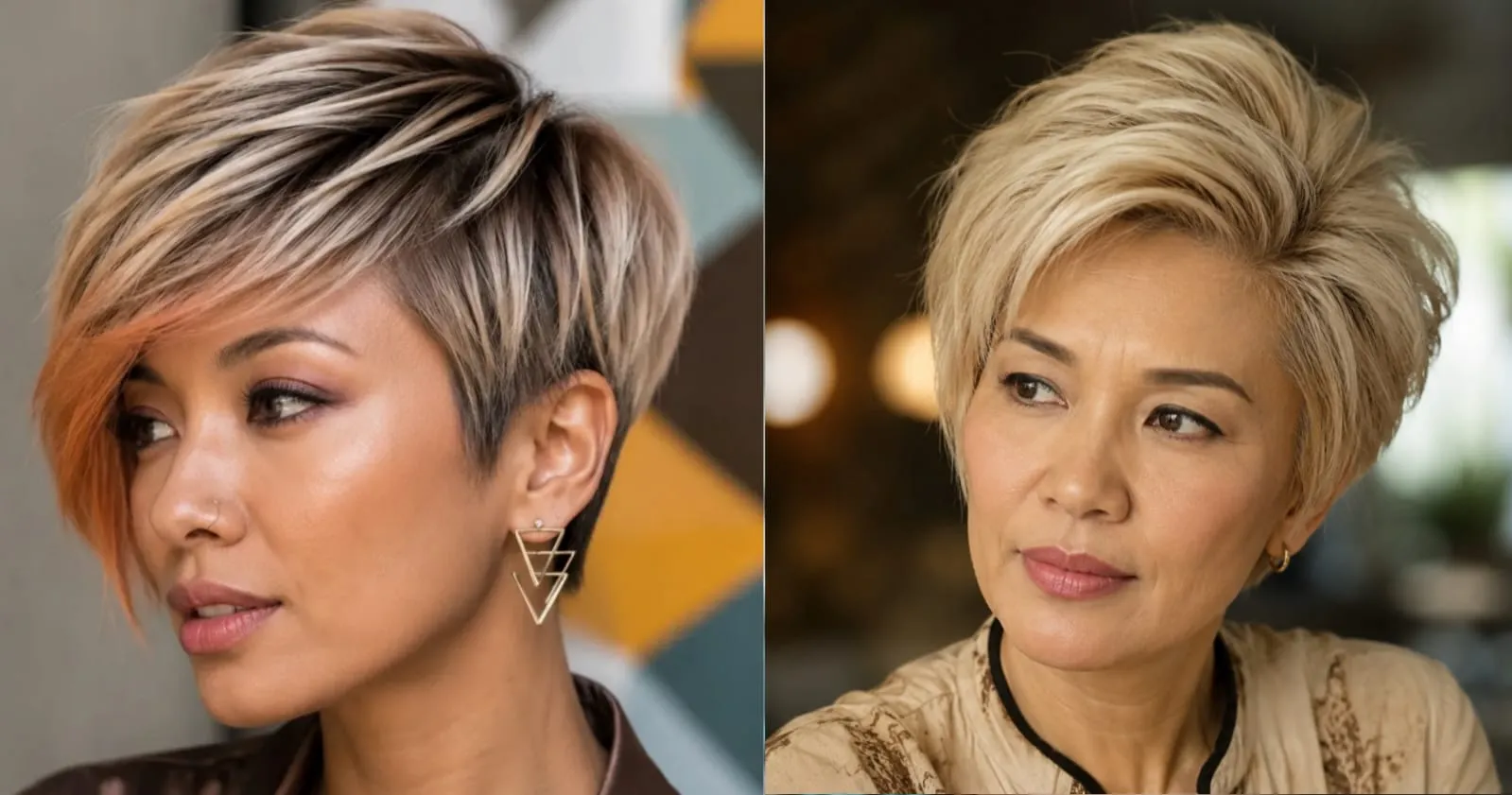
The bixie sits in a strange spot: too short to be a bob, too textured to be a pixie, and that in-between quality is exactly why it works. It borrows the ease of a pixie with the softness of a bob, which means you get shape around the face without losing the low-maintenance factor that made short cuts so popular in the first place. If you’ve ever felt torn between chopping it all off and keeping enough length to style, this cut solves that specific problem.
What makes the bixie interesting is how much room it leaves for personalization. Face shape, hair texture, and even how much time you want to spend on it in the morning all change what the finished look ends up being, which is why no two bixies really look the same. If you’re curious how this style has shifted since its 90s roots, you’ll notice the modern versions lean more textured and less uniform.
That flexibility is exactly what makes it worth seeing in more than one form before you sit down in the chair. Here are 15 takes on the bixie that show just how differently this cut can be worn.
What Actually Makes It a Bixie
A bixie isn’t just “short hair.” It lives in a specific in-between zone — longer than a pixie on the sides and back, shorter than what most people picture when they hear “bob.” The length usually falls somewhere between the ear and the jaw. What actually defines it though isn’t really the length. It’s the way the interior is cut — weight taken out from underneath, disconnected layers, ends broken up with a razor rather than cut straight across.
The result is hair that moves, looks a little undone even when you’ve styled it, and somehow looks better at the end of the day than it did in the morning. That last part is not a coincidence. It’s the point.
15 Bixie Cut Variations Worth Knowing About
1. The Classic Textured Bixie

This is what you picture when you hear the word. Piece-y ends, lived-in texture, looks like you woke up that way even though you absolutely used three products. Works best on naturally wavy or slightly coarse hair because the texture is already halfway there. Your stylist will go at the ends with a razor or point-cutting technique — snipping into the ends at an angle rather than cutting straight across.
I have medium-thickness hair with a slight wave and this is exactly what I got the first time. It took me four minutes to style on day one and progressively less effort as the week went on. No one’s going to accuse you of trying too hard.
Best for: Oval and heart-shaped faces, wavy or slightly coarse hair
2. The Sleek Bixie

Same structure, totally different energy. Run a flat iron through it, add a smoothing serum, do a deep side part — suddenly it looks architectural. Intentional. Like you have your life together. This version photographs beautifully, which is probably why you see it on editorial accounts so much.
One honest warning: if you have thick hair and your stylist doesn’t remove enough internal weight, this version can go helmet-y. Talk to them beforehand. Ask specifically about thinning through the back and sides.
Best for: Straight, fine to medium hair, polished aesthetics
3. The Curly Bixie

Nobody talks about this enough and I find that genuinely baffling. Curly hair at bixie length might be the most effortlessly beautiful version of this cut. The curls spring up, have room, and stop being weighed down by all that length. If you have type 3A through 3C curls, ask specifically for a dry cut — cutting curly hair wet means your stylist is guessing where things will land once it shrinks up.
DevaCuts are worth it if your city has a trained stylist. Cutting dry means they can see your actual curl pattern and make real decisions. The difference in result is noticeable.
Best for: Type 3 curls, anyone who’s always fought shrinkage with length
4. The Shaggy Bixie

This is the one for people who watched too many videos of seventies rock bands and are not sorry about it. Heavy layers, maximum texture, the kind of cut that looks like you live somewhere coastal and don’t own a hair dryer. The shaggy bixie goes harder on disconnected layers than the classic version — quite a bit of difference between the shortest and longest points.
Styling is basically effortless. Salt spray, scrunch, air dry, done. Curtain bangs work really well alongside it but are totally optional. If you want volume, diffuse — either way it looks good.
Best for: Bohemian aesthetics, people who genuinely don’t want to style their hair
5. The Bixie with Curtain Bangs

Curtain bangs have been having a long moment and I don’t think they’re going anywhere. When paired with a bixie, the proportion just works — the bangs soften the front, the short length at the back keeps the whole thing from feeling heavy, and the overall effect is quietly romantic.
The key is keeping the bangs wispy. Heavy, blunt bangs on a bixie read as severe. The curtain version should part gently in the middle and sweep toward the temples. Ask for face-framing pieces that blend into the bangs naturally — no obvious line between them.
Best for: Round or square faces, anyone wanting to soften angular features
6. The Blunt Bixie

Most bixie advice says texture is everything — but a blunt bixie has its own very specific appeal. Clean perimeter, no feathered ends, minimal internal layering. It reads intentional and a bit geometric. Less effortless, more deliberate, and genuinely sharp looking.
I’d only recommend this for fine to medium hair. On thick hair, cutting blunt without serious weight removal tends to create a boxy shape. Fine hair benefits from the clean line because it makes hair look denser and more substantial.
Best for: Fine to medium hair, clean geometric aesthetics
7. The Asymmetrical Bixie

One side stays at the jaw, the other sits at the ear. The difference can be subtle or dramatic depending on how bold you’re feeling. Done well, it’s one of the most striking haircuts on this entire list — adds drama without requiring color or any particular product.
This works best on people who have a consistent styling habit. If you do something different every morning, the asymmetry can feel limiting. But if you have a usual routine, that structure is actually an asset.
Best for: Bold personalities, those who want edge without committing to color
8. The Bixie with an Undercut

From the front it looks completely normal — regular bixie length, nothing unusual. Then you see the back and there’s a hidden undercut sitting underneath. The top layer covers it completely when your hair is down. Practically speaking, this is a lifesaver for thick hair — removing that bulk from underneath makes everything sit better and dry faster.
In summer it’s also just cooler. Literally. And in professional settings, nobody can see it unless you choose to show them, which is a genuinely fun detail to have.
Best for: Very thick hair, warmer climates, people who want a subtle hidden edge
9. The Silver or Platinum Bixie

There’s something about a silver or platinum bixie that is genuinely next-level. The color reads bolder at short length — there’s less of it, so each strand gets more visual attention. It looks intentional in a way that the same color on long hair sometimes doesn’t quite achieve.
Here’s the practical argument: bleaching shorter hair is faster, less costly, and causes less cumulative damage. The maintenance is also more manageable. If you’ve been thinking about going platinum and hesitating on the cut too, doing both at once actually makes each decision easier.
Best for: Anyone going platinum or embracing gray for the first time
10. The Colored-Tips Bixie

Low-commitment color — you’re just touching the ends. Dip-dye style, or a soft balayage concentrated at the tips. The shortness of a bixie makes this look better than it does on longer hair because the colored ends are right there at the focal point, nothing buried in the middle of a long length.
Pastels work especially well — dusty lavender, faded rose, soft copper. On dark hair even a subtle lightening at the ends reads as intentional and creative. On lighter hair, pastels show up immediately.
Best for: Low-commitment color, creative or artsy aesthetics
11. The Bixie with Face-Framing Pieces

Different from curtain bangs. Face-framing pieces are longer strands that fall forward at the temples and cheekbones — not bangs exactly, just hair cut to frame rather than cover. The back and sides stay short while these specific pieces at the front add softness and a sense of length.
This is genuinely a good option for people nervous about going short for the first time. The face-framing pieces give you something familiar, something to tuck behind your ear, something that makes the cut feel less severe when you look in the mirror.
Best for: First-time short hair people, oval and oblong face shapes
12. The Voluminous Bixie

Not all bixies hug close to the head. With the right cut and styling you can get genuinely big hair — round brush blowout, Velcro rollers set while hair cools, or a diffuser on high. Your stylist needs to leave a bit more length on top than a standard bixie and concentrate layering on the sides and back, which builds a natural dome shape you can then push further.
Fine hair benefits most from this approach — the cut adds volume that fine hair struggles to generate on its own. It’s one of those results where people look at you and can’t figure out exactly why your hair looks so good.
Best for: Fine hair that needs body, people who love big full styles
13. The Bixie with Micro Bangs

Let’s be real: this one isn’t for everyone. Micro bangs sitting well above the eyebrows are a statement on their own. Combined with bixie length, the whole thing goes fashion-forward and a bit avant-garde. It’s the kind of haircut that makes people actually stop and look.
If you’re thinking about it, try a clip-in fringe first. Wear it for five days including work and video calls, then decide. Micro bangs require upkeep every two to three weeks and they grow out slowly — you’re signing up for maintenance, not just the initial cut.
Best for: Bold style personalities, those with smaller foreheads
14. The Natural Wash-and-Go Bixie

This is the reason I personally made the switch. I am not someone who enjoys styling my hair. I enjoy having styled-looking hair, which is a different thing — and the bixie was the first haircut that actually closed that gap for me.
Shower, put something in it, scrunch gently, air dry. That’s the routine. Products that have actually worked for me: Not Your Mother’s Curl Talk mousse for wave definition, R+Co Rockaway Salt Spray for texture without crunch, and a microfiber towel to blot water out instead of rubbing.
Best for: Low-maintenance routines, wavy and coily textures
15. The Grown-Out Bixie

Here’s what nobody tells you and it matters if commitment is your hesitation: a bixie grows out well. A pixie going through its awkward phase is a whole situation. A bixie just gradually becomes a lob, with no real crisis stages along the way. You are not locked in.
The in-between stages are their own looks — a slightly longer bixie with a few clips, then a short bob, then a lob. None of it requires suffering through a bad hair period.
Best for: Commitment-averse people, anyone who rotates through lengths
How to Talk to Your Stylist
The most common mistake is walking in and just saying “I want a bixie” with no other context. That word means different things to different stylists. Bring photos — more than one — and point at specific things in each one. The texture on this, the nape length on that, the bang situation in this other one.
Tell them how much time you’ll actually spend styling — be honest, they’ve heard everything. Mention your hair’s quirks: the cowlick at the crown, the side that flips, the frizz in humidity. Then ask to see photos of bixies they’ve personally cut, not their saved Instagram folder.
FAQ
Is a bixie good for fine hair?
Yes — the shortness itself creates the appearance of density. Ask your stylist to be deliberate with layering rather than aggressive. Overdone texture on fine hair can actually make it look thinner.
What about round faces?
Works great with the right approach. A bit of height at the crown, some length at the front, and don’t go heavy on side volume. Face-framing pieces or soft curtain bangs help a lot.
Does thick hair work?
Yes but weight removal has to be real and thorough. If your stylist isn’t getting into the interior and taking out actual bulk, the shape puffs and goes boxy. An undercut underneath solves a lot of this.
How do I style it without heat?
Texturizing spray or mousse while damp, scrunch, air dry. The cut does most of the work — you just need to stop it from drying flat. A diffuser on low is a good middle ground.
How long to grow it out?
Four to eight months to a proper bob, depending on your growth rate. The stages are all wearable. There’s no genuinely bad phase the way there is with a pixie.
Bixie vs wolf cut — what’s the actual difference?
The wolf cut has mullet DNA — shorter layers at the crown, longer length at the back. A bixie is shorter overall and more uniform. Both are textured but the wolf cut goes further in every direction.
Final Thoughts
I waited two years longer than I needed to before getting this haircut. I kept talking myself out of it — too short, too different, what if it doesn’t suit me. And then I finally sat in the chair and forty minutes later I genuinely could not believe it took me that long.
If you’ve been going back and forth on a shorter cut, go have the conversation with a stylist. Bring the photos. Ask the questions. The version you’re imagining is probably more achievable than you think — and the worst case is a haircut you were going to grow out anyway. That’s not really a risk worth overthinking.

